MCQ
Which of the following defines electromagnetic induction:
  • A
    When the magnetic field associated with a coil changes, an induced electric current flows through the coil.
  • B
    Electric current induces magnetic field near the wire carrying current.
  • C
    Two permanent magnets exert force on each other.
  • D
    Electrolyte disintegrates into ions in a battery.

Answer

  1. When the magnetic field associated with a coil changes, an induced electric current flows through the coil.

Explanation:

The magnetic field associated with a coil is the magnetic flux flowing normally to the surface area of the current-carrying coil. When it changes, an emf is produced opposing the cause. This is the principle of Electromagnetic induction.

Need a full question paper?

Generate a complete, print-ready paper with questions like this in minutes — across 16+ boards, with answer keys.

Start Generating Free

Similar questions

What is a virtual image?

If an observer is moving with respect to a stationary electron, then he observes

(a) Only magnetic field

(b) Only electric field

(c) Both (a) and (b)

(d) None of the above

Speed of electromagnetic waves is the same:
Same current is flowing through two parallel conducting wires at a distance $d$ in opposite directions. The intensity of magnetic field at the midpoint between the wires is :
Which one of the following properties of an element is not variable?
During the 19th century, light was considered to be a stream of particles called:

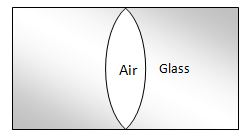
In the figure, an air lens of radii of curvature 10 cm (= 10 cm) is cut in a cylinder of glass (μ = 1.5). The focal length and the nature of the lens is

(a) 15 cm, concave

(b) 15 cm, convex

(c) , neither concave nor convex

(d) 0, concave

Which of the following is a wrong description of binding energy of a nucleus?
  1. It is the energy required to break a nucleus into its constituent nucleons.
  2. It is the energy made available when free nucleons combine to form a nucleus.
  3. It is the sum of the rest mass energies of its nucleons minus the rest mass energy of the nucleus.
  4. It is the sum of the kinetic energy of all the nucleons in the nucleus.

In a working nuclear reactor, Cadmium rods, (control rods) are used to

(a) Speed up neutrons

(b) Slow down neutrons

(c) Absorb some neutrons

(d) Absorb all neutrons

The critical angle for a medium is 60°. The refractive index of the medium is

(a)  

(b)

(c)

(d)