MCQ
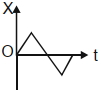
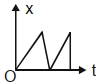
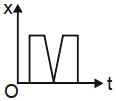
Which of the following displacement $(X)$ time graphs is not possible?
  • A

  • B

  • C


Answer

Correct option: D.

d

Need a full question paper?

Generate a complete, print-ready paper with questions like this in minutes — across 16+ boards, with answer keys.
Start Generating Free

Similar questions

A metre scale is moving with uniform velocity. This implies:
$Assertion$ : There is a stage when frictional force is not needed at all to provide the necessary centripetal force on a banked road.
$Reason$ : On a banked road, due to its inclination the vehicle tends to remain inwards without any chances of skidding.
The length of the two rods made up of the same metal and having the same area of cross-section are $0.6 m$ and $0.8 m$ respectively. The temperature between the ends of first rod is ${90^o}C$ and ${60^o}C$ and that for the other rod is $150^oC$ and ${110^o}C$. For which rod the rate of conduction will be greater
A man, of mass m, standing at the bottom of the staircase, of height L climbs it and stands at its top.
  1. Work done by all forces on man is equal to the rise in potential energy mgL.
  2. Work done by all forces on man is zero.
  3. Work done by the gravitational force on man is mgL.
  4. The reaction force from a step does not do work because the point of application of the force does not move while the force exists.
The acceleration of a body in a non-uniform circular motion is $5\, ms^{-2}$. Which one of the following is correct?
What is the pressure on a swimmer $20 \,m$ below the surface of water ........ $atm$
A body of mass $10\,kg$ at rest is acted upon simultaneously by two forces $4 \,N$ and $3\,N$ at right angles to each other. The kinetic energy of the body at the end of $10 \,sec$ is .............. $\mathrm{J}$
A Carnot's engine works as a refrigerator between $250\, K$ and $300\, K$. It receives $500\, cal$ heat from the reservoir at the lower temperature. The amount of work done in each cycle to operate the refrigerator is ..... $J$
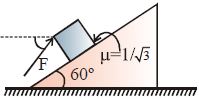
The minimum value of $‘F’$ so that block is in equilibrium is
A particle of mass m is executing oscillations about the origin on the $X-$axis. Its potential energy is $U(x) = k{[x]^3}$, where $k$ is a positive constant. If the amplitude of oscillation is $a$, then its time period $T$ is