Answer

  1. $\text{y = a}\tan\omega\text{t}$

Explanation:

S.H.M. is one which is bounded within well defined limits, periodic and oscillatory. The first four equations represent S.H.M. but the fifth equation does not represent S.H.M.

Need a full question paper?

Generate a complete, print-ready paper with questions like this in minutes — across 16+ boards, with answer keys.
Start Generating Free

Similar questions

Find the frequency of minimum distance between compression & rarefaction of a wire. If the length of the wire is $1m$ & velocity of sound in air is $360\, m/s$ .... $sec^{-1}$
Two thermometers $X$ and $Y$ have ice points marked at $15^o$ and $25^o$ and steam points marked as $75^o$ and $125^o$ respectively. When thermometer $X$ measures the temperature of a bath as $60^o$ on it, what would thermometer $Y$ read  when it is used to measure the temperature of the same bath ? ...... $^o$
$Assertion :$ A tube light emits white light.
$Reason :$ Emission of light in a tube takes place at a very high temperature.
A transverse wave propagating along $x-$ axis is represented by $y (x,t)= 8.0 sin$ $\left( {0.5\pi x - 4\pi t - \frac{\pi }{4}} \right)$ where $x$ is in metres and $t$ is in seconds. The speed of the wave is ..... $m/s$
The fundamental physical quantities that have same dimensions in the dimensional formulae of torque and angular momentum are
The collisions of the molecules of an ideal gas are:
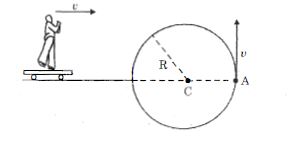
A boy is moving with a constant speed $v$ on a small trolley towards a distant circle as shown in the figure. A point mass is moving on the circle with a constant speed $v$, what is the frequency of change in magnitude of relative velocity of the point mass, as observed by the boy.
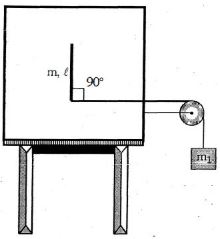
There is a rod of lenght $l$, mass $m$ lying on a fixed horizontal smooth table. A cord is led through a pulley, and its horizontal part is attached to one end of the rod, while its vertical part is attached to a block of mass $m_1$.  Assume pulley and the cord is ideal. The maximum possible acceleration of the rod's centre of mass $C$ (for all possible values of masses $m$ and $m_1$) at the moment of releasing the block $m_1$ is $\frac{g}{n}$.  Find the value of $n$


Dimensions of strain are
A liquid is flowing in a horizontal pipe of non-uniform cross section. Which of the following quantities may remain unchanged with respect to time?