MCQ
Which of the following factors will favour the reverse reaction in a chemical equilibrium
  • A
    Increase in the concentration of one of the reactants
  • B
    Removal of at least one of the product at regular time intervals
  • Increase in the concentration of one or more products
  • D
    None of these

Answer

Correct option: C.
Increase in the concentration of one or more products
(c) A reaction is in equilibrium it will shift in reverse or backward direction when we increase the concentration of one or more product (from Le chatelier’s principle).

Need a full question paper?

Generate a complete, print-ready paper with questions like this in minutes — across 16+ boards, with answer keys.

Start Generating Free

Similar questions

Consider the reaction equilibrium, $2S{O_{2(g)}}$+${O_{2(g)}}$ $\rightleftharpoons$ $2S{O_{3(g)}}$;  $\Delta H^\circ =\, -198\,kJ$. On the basis of Le-Chatelier’s principle, the condition favourable for the forward reaction is
Which one of the following has the regular tetrahedral structure

(Atomic no. : $B = 5,S = 16,Ni = 28,Xe = 54$)

Supposing the energy (in arbitrary units) of the energy levels in the hydrogen atom is given as under:

Energy level $K$ $L$ $M$ $N$
  $n=1$ $n=2$ $n=3$ $n=4.....n=\infty$
Energy $- 864 \,a.u.$     Zero

the excitation energy needed to raise the electron from $M$ level to $n = \infty$ would be :

If $\lambda _L, \lambda _M$ and $\lambda _N$ are the wave lengths of electron in $L, M, N$ energy levels of $H-$ atom respectively. What is their decreasing order :
Which compound will react with an aqueous solution of $Ag(N{H_3})_2^ + O{H^ - }$
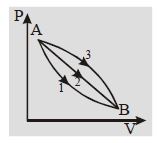
A given mass of gas expands reversibly from the state $A$ to the state $B$ by three paths $1, 2$ and $3$ as shown in the figure. If $w_1, w_2$ and $w_3$ respectively be the work done by the gas along three paths then:
Benzene cannot undergo
What volume of dioxygen is required for complete combustion of $2\, volumes$ of acetylene gas at $NTP$ ? ................. $\mathrm{Volumes}$
The presence of carbon in an organic compound is detected by heating it with :
Which of the following are not state functions?

$(I)\,\,q + \mathrm{w}$           $(II)\,\, q$

$(III)\,\, \mathrm{w}$              $(IV)\,\, H - TS$