Which of the following is not a sex hormone
Medium


Download our appand get started for free
Experience the future of education. Simply download our apps or reach out to us for more information. Let's shape the future of learning together!No signup needed.*
Similar Questions
- 1View SolutionThe intermediate compound formed in the conversion of starch to glucose is
- 2The reason for double helical structure of $DNA$ is operation ofView Solution
- 3$\begin{array}{*{20}{c}}View Solution
{HN = C - linkage\,?} \\
{\,\,\,\,\,\,\,\,\,\,\,\,\,\,\,\,\,\,\,\,|\,\,\,\,\,\,\,\,\,\,\,\,\,\,\,\,\,\,\,\,\,\,\,\,\,\,\,\,\,\,\,} \\
{\,\,\,\,\,\,\,\,\,\,\,\,\,\,\,\,\,\,\,N{H_2}\,\,\,\,\,\,\,\,\,\,\,\,\,\,\,\,\,\,\,\,\,\,\,\,\,}
\end{array}$ - 4Which reagent/s can be used to distinguish glucose and fructose ?View Solution
$(I)$ Bromine water $(I I)$ Tollen's reagent $(III)$ Schiffs reagent - 5View SolutionThe sugar present in milk is
- 6Given below are two statements.View Solution
Statments $I:$ Maltose has two $\alpha$-D-glucose units linked at $C _{1}$ and $C _{4}$ and is a reducing sugar.
Statement $II:$ Maltose has two monosaccharides: $\alpha$-D-glucose and $\beta$-D-glucose linked at $C_{1}$ and $C_{6}$ and it is a non-reducing sugar.
In the light of the above statements, choose the correct answer from the options given below.
- 7View SolutionThe bond that determines the secondary structure of proteins is or secondary structure of protein is due to
- 8View SolutionGlucose and mannose are
- 9Which of the following compound will behave as a reducing sugar in $aq.KOH$ solution ?View Solution
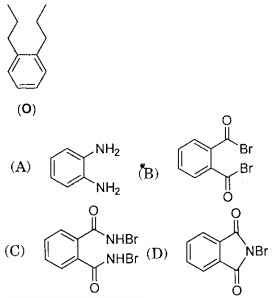
- 10Treatment of compound $O$ with $KMnO_4 / \mathrm{H}^{+}$gave $P$, which on heating with ammonia gave $Q$. The compound $Q$ on treatment with $Br_2 / NaOH$ produced $R$. On strong heating, $Q$ gave $S$, which on further treatment with ethyl $2$-bromopropanoate in the presence of $KOH$ followed by acidification, gave a compound $T$.View Solution
(image)
($1$) The compound $R$ is
(image)
($2$) The compound $T$ is
($A$) glycine
($B$) alanine
($C$) valine
($D$) serine
Given the answer question ($1$) and ($2$)