MCQ
Which of the following is the correct formula for average velocity?
  • A
    $\text{v}=\frac{\text{dx}}{\text{dt}}$
  • $\text{v}=\frac{\text{x}}{\text{t}}$
  • C
    $\text{v}=\text{xt}$
  • D
    $\text{v}=\frac{\text{t}}{\text{x}}$

Answer

Correct option: B.
$\text{v}=\frac{\text{x}}{\text{t}}$
$b.$ $\text{v}=\frac{\text{x}}{\text{t}}$
Explanation:
The correct formula is $\text{v}=\frac{\text{x}}{\text{t}}.$ Average velocity is total change in displacement divided by total change in time. $\text{v}=\frac{\text{dx}}{\text{dt}}$ is the formula for instantaneous velocity.

Need a full question paper?

Generate a complete, print-ready paper with questions like this in minutes — across 16+ boards, with answer keys.
Start Generating Free

Similar questions

A planet is orbiting the sun in an elliptical orbit. Let $U$ denote the potential energy and $K$ denote the kinetic energy of the planet at an arbitrary point on the orbit. Choose the correct statement.
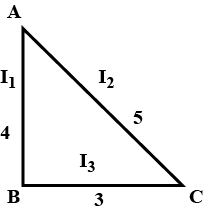
For the adjoining diagram, the incorrect relation between $I_{1}, I_{2}$ and $I_{3}$ is ($I-$ moment of inertia)
The radius and mass of earth are increased by $0.5\%$. Which of the following statements are true at the surface of the earth
Using equipartition of energy, the specific heat (in $J\, kg^{-1}\, K^{-1}$ ) of aluminium at room temperature can be estimated to be ( atomic weight of aluminium $= 27$)
A body of mass $0.4\, kg$ is whirled in a vertical circle making $2\, rev/sec$. If the radius of the circle is $2\, m$, then tension in the string when the body is at the top of the circle, is ......... $N$
Newton's law of cooling is used in laboratory for the determination of the
At a height of $10 \,km$ above the surface of earth, the value of acceleration due to gravity is the same as that of a particular depth below the surface of earth. Assuming uniform mass density for the earth, the depth is ............. $km$
$Assertion$ : If a body is thrown upwards, the distance covered by it in the last second of upward motion is about $5\, m$ irrespective of its initial speed
$Reason$ : The distance covered in the last second of upward motion is equal to that covered in the first second of downward motion when the particle is dropped.
Two identical balls $P$ and $Q$ moving in the $x-y$ plane collide at the origin $(x=0,y=0)$ of the coordinate system. Their velocity components just before the moment of impact were, for ball $P$, $v_x=6\ m/s$, $v_y=0$; for ball $Q$, $v_x=-5\ m/s$, $v_y=2\ m/s$. As a result of the collision, the ball $P$ comes to rest. The velocity components of the ball $Q$ just after collision will be
The density of a material is $CGS$ system of units is $4\,g/cm^3$. In a system of units in which unit of length is $10\,cm$ and unit of mass is $100\,g$, the value of density of material will be