MCQ
Which of the following is wrong statement about binding energy?
  • A
    It is the sum of the rest mass energies of nucleons minus the rest mass energy of the nucleus.
  • B
    It is the energy released when the nucleons combine to form a nucleus.
  • C
    It is the energy required to break a given nucleus into its constituent nucleons.
  • D
    It is the sum of the kinetic energies of all the nucleons in the nucleus.

Answer

  1. It is the sum of the kinetic energies of all the nucleons in the nucleus.

Explanation:

The first three options are correct from the definition of Binding energy.

B.E. has nothing to do with K.E. of the nucleons in nucleus.

Need a full question paper?

Generate a complete, print-ready paper with questions like this in minutes — across 16+ boards, with answer keys.

Start Generating Free

Similar questions

Lenz's law gives

(a) The magnitude of the induced e.m.f.

(b) The direction of the induced current

(c) Both the magnitude and direction of the induced current

(d) The magnitude of the induced current

$\mu_\text{V}​>\mu_\text{R}$​ indicates:

On passing electric current in two long straight conductors in mutually opposite directions, the magnetic force acting between them will be:

A, B and C are parallel conductors of equal length carrying currents I, I and 2I respectively. Distance between A and B is x. Distance between B and C is also x.   is the force exerted by B on A and F2 is the force exerted by B on A choose the correct answer

(a)  

(b)  

(c)  

(d)  

If there are n capacitors in parallel connected to V volt source, then the energy stored is equal to

(a) CV     

(b)

(c)    

(d)  

The plates of a capacitor are charged to a potential difference of 320 volts and are then connected across a resistor. The potential difference across the capacitor decays exponentially with time. After 1 second  the potential difference between the plates of the capacitor is 240 volts, then after 2 and 3 seconds the potential difference between the plates will be

(a) 200 and 180 V

(b) 180 and 135 V

(c) 160 and 80 V

(d) 140 and 20 V

For small currents, ‘X’ obeys Ohm’s law. But when large currents are passed through the same conductor, it deviates from ohmic behaviour. Identify X.

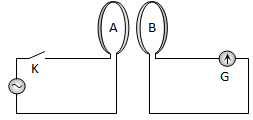
The diagram below shows two coils A and B placed parallel to each other at a very small distance. Coil A is connected to an ac supply. G is a very sensitive galvanometer. When the key is closed

(a) Constant deflection will be observed in the galvanometer for 50 Hz supply

(b) Visible small variations will be observed in the galvanometer for 50 Hz input

(c) Oscillations in the galvanometer may be observed when the input ac voltage has a frequency of 1 to 2 Hz

(d) No variation will be observed in the galvanometer even when the input ac voltage is 1 or 2 Hz

When an input signal 1 is applied to a NOT gate, its output is:

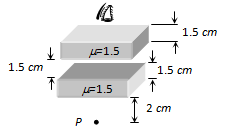
The image of point P when viewed from top of the slabs will be

(a) 2.0 cm above P

(b) 1.5 cm above P

(c) 2.0 cm below P

(d) 1 cm above P