MCQ
Which of the following molecular geometry is not produced by $sp^3$ hybridisation
  • Triangular planar
  • B
    See-Saw
  • C
    $T-$ shape
  • D
    Linear

Answer

Correct option: A.
Triangular planar
a
From $sp ^3 d$-hybridization trigonal planar geometry is not possible, because in trigonal planar geometry lone pair electrons will be placed at the axial position, which violates $VSEPR$ theory or Bent's rule and leads to greater repulsion btween lon pairs and bond pairs.

Need a full question paper?

Generate a complete, print-ready paper with questions like this in minutes — across 16+ boards, with answer keys.

Start Generating Free

Similar questions

What is $[H^+]$ in $mol/L$ of a solution that is $0.20\, M$ in $CH_3COONa$ and $0.10\, M$ in $CH_3COOH$ $?$ $K_a$ for $CH_3COOH = 1.8 \times 10^{-5}$
$0.2\, g$ of an organic compound was subjected to estimation of nitrogen by Dumas method in which volume of $N _{2}$ evolved (at STP) was found to be $22.400 \,mL$. The percentage of nitrogen in the compound is $.......$. [nearest integer] (Given: Molar mass of $N _{2}$ is $28\, mol ^{-1}$. Molar volume of $N _{2}$ at STP : $22.4\, L$ )
Which of the following has the highest dipole moment
When water is added to quick lime, the reaction is
Two moles of an ideal monoatomic gas are allowed to expand adiabatically and reversibly from $300\,K$ to $200\,K.$ The work done in the process will be .....$kJ$
Two elements $X$ and $Y$ have atomic weights of $14$ and $16$. They form a series of compounds $A, B, C, D$ and $E$ in which the same amount of element $X$, $Y $ is present in the ratio $1 : 2 : 3 : 4 : 5$. If the compound $A$ has $28$ parts by weight of $X $ and $16$ parts by weight of $Y$, then the compound of $C$ will have $28$ parts weight of $X$ and
The correct order of ionic radii for the ions, $\mathrm{P}^{3-}, \mathrm{S}^{2-}$ $\mathrm{Ca}^{2+}, \mathrm{K}^{+}, \mathrm{Cl}^{-}$is :
An organic compound $C_8H_{12}$ on ozonolysis give $2\, moles$ of $3\,-$ oxobutanal. Then the structure of compound can not be
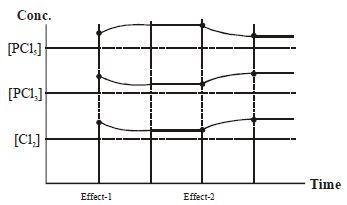
Consider given endothermic reaction at equilibrium, $PCl_5(g) \rightleftharpoons  PCl_3(g) + Cl_2(g) $

A graph is plotted between concentration and time as shown. Effect$-1$  &   Effect$-2$ are due to respectively
A hydrocarbon containing $2$ carbon atoms gives Sabatier and Senderen's reaction but does not give precipitate with ammoniacal silver nitrate solution. The hydrocarbon in the question is