MCQ
Which of the following phenomena is based on atmospheric refraction?
  • A
    Tyndall effect.
  • B
    Colour of sun at sunrise.
  • C
    Twinkling of stars.
  • D
    None of these.

Answer

  1. Twinkling of stars.

Explanation:

Atmospheric refraction is the phenomenon of bending of light on passing through the earth's atmosphere. Twinkling of stars Stars twinkle on account of atmospheric refraction. Starlight undergoes refraction many times before reaching the earth.

Need a full question paper?

Generate a complete, print-ready paper with questions like this in minutes — across 16+ boards, with answer keys.
Start Generating Free

Similar questions

Consider two statements A and B given below:
  1. Real image is always inverted.
  2. Virtual image is always erect.
Out of these two statements:
  1. Only A is true.
  2. Only B is true.
  3. Both A and B are true.
  4. None is true.
Choose the incorrect statement:
A concave mirror has a focal length of 25cm. At which of the following distance should a person hold his face from this concave mirror so that it may act as a shaving mirror?
The image of an object formed by a plane mirror is:
  1. Virtual.
  2. Real.
  3. Diminished.
  4. Upside-down.
What is the type of field line of a magnetic field passing through the centre of current carrying circular ring?
To find the focal length of a concave mirror Rahul focuses a distant object with this mirror. The chosen object should be:
The magnetic field lines in the middle of the current-carrying solenoid are?
  1. Circles.
  2. Spirals.
  3. Parallel to the axis of the tube.
  4. Perpendicular to the axis of the tube.
Coke is move valuable when used:
  1. As a fuel for industrial boilers.
  2. As an oxidising agent.
  3. As a reducing agent.
  4. As a fuel in domestic ovens.
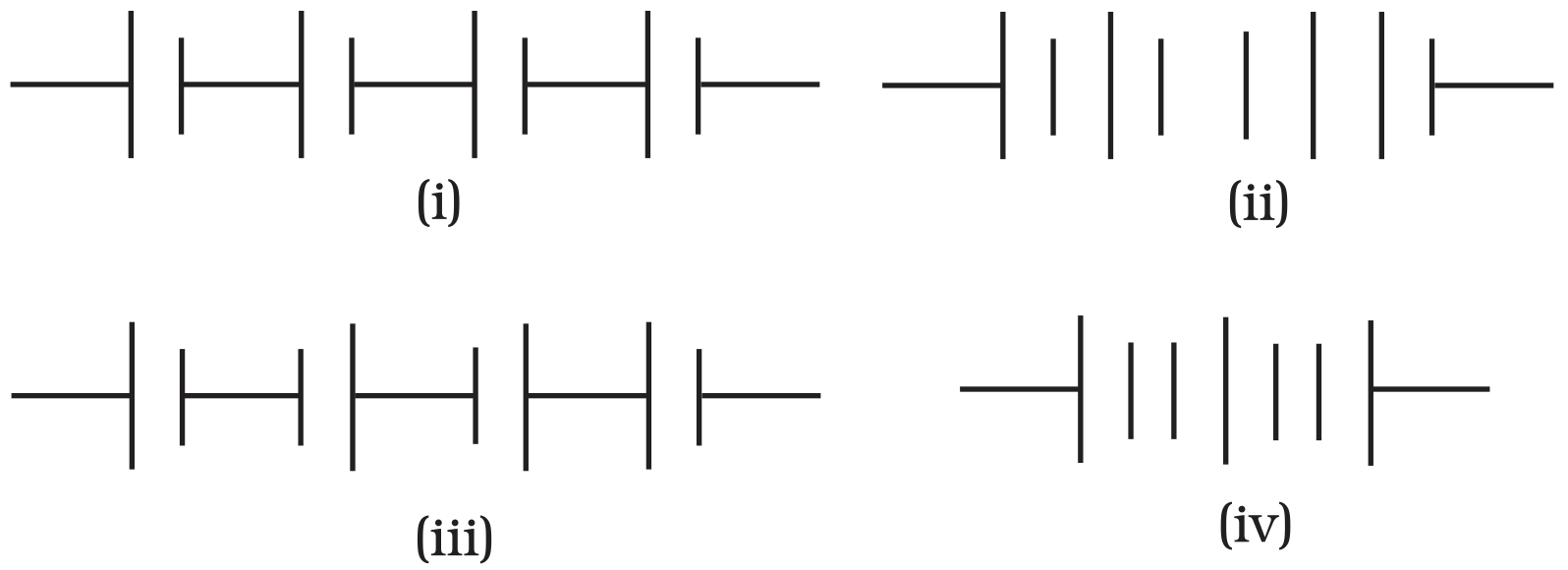
The proper representation of series combination of cells (Figure) obtaining maximum potential is:
A student sitting on the last bench can read the letters written on the blackboard but is not able to read the letters written in his text book. Which of the following statements is correct?
  1. The near point of his eyes has receded away.
  2. The near point of his eyes has come closer to him.
  3. The far point of his eyes has come closer to him.
  4. The far point of his eyes has receded away.