Question
Which of the following planets have rings around it

Answer

(d)Saturn only has ring around it.

Need a full question paper?

Generate a complete, print-ready paper with questions like this in minutes — across 16+ boards, with answer keys.
Start Generating Free

Similar questions

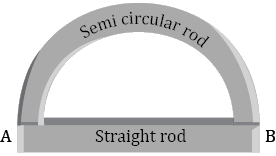
Two rods (one semi-circular and other straight) of same material and of same cross-sectional area are joined as shown in the figure. The points $A$ and $B$ are maintained at different temperature. The ratio of the heat transferred through a cross-section of a semi-circular rod to the heat transferred through a cross section of the straight rod in a given time is
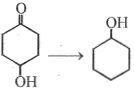
Which of the following reagent must be used in given interconversion ?
If the radius of curvature of the path of two particles of same mass are in the ratio $3:4,$ then in order to have constant centripetal force, their velocities will be in the ratio of:
Critical angle of light passing from glass to air is minimum for which light
A particle is projected from the mid-point of the line joining two fixed particles each of mass $m.$ If the distance of separation between the fixed particles is $l,$ the minimum velocity of projection of the particle so as to escape is equal to
Four solid spheres each of diameter $\sqrt{5} \ cm$ and mass $0.5 \ kg$ are placed with their centers at the corners of a square of side $4 \ cm$. The moment of inertia of the system about the diagonal of the square is $N \times 10^{-4} kg - m ^2$, then $N$ is
A thin mica sheet of thickness $2 \times {10^{ - 6}}m$and refractive index $(\mu = 1.5)$ is introduced in the path of the first wave. The wavelength of the wave used is $5000 Å$. The central bright maximum will shift
Susceptibility of ferromagnetic substance is
Half mole of an ideal monoatomic gas is heated at constant pressure of $1\, atm$ from $20\,^oC$ to $90\,^oC$. Work done by has is close to ..... $J$ (Gas constant $R = 8.31\, J/mol.K$)
Two boys are standing at the ends $A$ and $B$ of a ground where $AB = a$. The boy at $B$ starts running in a direction perpendicular to $AB$ with velocity ${v_1}.$ The boy at $A$ starts running simultaneously with velocity $v$ and catches the other boy in a time $t$, where $t$ is