MCQ
Which of the following process will give maximum amount of heat to surrounding when volume becomes half of initial
  • Iso-baric
  • B
    Isothermal
  • C
    Isochoric
  • D
    Adiabatic

Answer

Correct option: A.
Iso-baric
a
Here isochoric process is not possible and for

adiabatic process, $\mathrm{Q}=0$ For isothermal process

${Q_{rejected}}\, =  - W = nR{T_0}\ell n\left( {{V_0}/\frac{{{V_0}}}{2}} \right) = nR{T_0}\ell n\,2$

$=0.693 \mathrm{nRT}_{0}$

For isobaric process

$Q_{\text {rejected }}=-n C_{p} \Delta T=-n\left(\frac{f}{2}+1\right) n R\left(-\frac{T_{0}}{2}\right)$

$=\left(0.5+\frac{f}{4}\right) n R T_{0}>0.693 n R T_{0}$

It is clear that more heat is rejected in isobaric process.

Need a full question paper?

Generate a complete, print-ready paper with questions like this in minutes — across 16+ boards, with answer keys.
Start Generating Free

Similar questions

A block of mass $2\, kg$ is placed on a rough inclined plane as shown in the figure $(\mu = 0.2)$ so that it just touches the spring. The block is allowed to move downwards. The  spring will be compressed to a maximum of .............. $\mathrm{cm}$
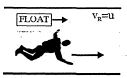
A swimmer can swim with speed '$v$' with respect to still water in a river which is flowing with speed $u$. There is a float moving with the river. Now the swimmer overtakes float and gets a lead of $l$ and returns back to the float. Time taken by swimmer in this process will be
$\hat i.\left( {\hat j \times \,\,\hat k} \right) + \;\,\hat j\,.\,\left( {\hat k \times \hat i} \right) + \hat k.\left( {\hat i \times \hat j} \right)=$
A body of mass $2.9\, kg$ is suspended from a string of length $2.5\, m$ and is at rest. A bullet of mass $100\, g$ , strikes the block horizontally with velocity $150 \,ms^{-1}$  and sticks to it. What is the maximum angle made by the string with the vertical after  the impact ? .............. $^o$ $(g = 10\, m/s^2) $
The dimensions of "time constant" $\frac{L}{R}$ during growth and decay of current in all inductive circuit is same as that of
Which of the following forces cannot be a resultant of $5\, N$ and $7\, N$ force...........$N$
A particle of mass $m$ is moving along a trajectory given by
$x = x_0 + a\, cos\,\omega_1 t$
$y = y_0 + b\, sin\,\omega_2t$
The torque, acing on the particle about the origin, at $t = 0$ is
The Doppler's effect is applicable for
One quality of a thermometer is that its heat capacity should be small. If $P$ is a mercury thermometer, $Q$ is a resistance thermometer and $R$ thermocouple type then
The angle turned by a body undergoing circular motion depends on time as $\theta = {\theta _0} + {\theta _1}t + {\theta _2}{t^2}$. Then the angular acceleration of the body is