MCQ
Which of the following processes is reversible
  • A
    Transfer of heat by radiation
  • B
    Electrical heating of a nichrome wire
  • C
    Transfer of heat by conduction
  • Isothermal compression

Answer

Correct option: D.
Isothermal compression
d
(d) Slow isothermal expansion or compression of an ideal gas is reversible process, while the other given process are irreversible in nature.
 

Need a full question paper?

Generate a complete, print-ready paper with questions like this in minutes — across 16+ boards, with answer keys.
Start Generating Free

Similar questions

Two bottles $A$ and $B$ have radii $R_{A}$ and $R_{B}$ and heights $h_{A}$ and $h_{B}$ respectively, with $R_{B}=2 R_{A}$ and $h_{B}=2 h_{A}$. These are filled with hot water at $60^{\circ} C$. Consider that heat loss for the bottles takes place only from side surfaces. If the time, the water takes to cool down to $50^{\circ} C$ is $t_{A}$ and $t_{B}$ for bottles $A$ and $B$, respectively. Then, $t_{A}$ and $t_{B}$ are best related as
Water rises upto $10\, cm$ height in a long capillary tube. If this tube is immersed in water so that the height above the water surface is only $8 \,cm,$  then
A body is executing simple harmonic motion with an angular frequency $2\,rad/s$. The velocity of the body at $20\, mm$ displacement, when the amplitude of motion is $60\, mm$, is ...... $mm/s$
Half life of a radio-active substance is $20\, minutes$. The time between $20\%$ and $80\%$ decay will be ........... $minutes$
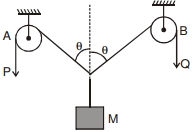
In the arrangement shown in fig. the ends $P$ and $Q$ of an unstretchable string move downwards with uniform speed $U$. Pulleys $A$ and $B$ are fixed. Mass $M$ moves upwards with a speed.
The magnetic field of earth at the equator is approximately $4 \times 10^{-5}\, T$ . The radius of earth is $6.4 \times 10^6\, m$. Then the dipole moment of the earth will be nearly of the order of
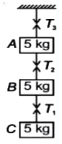
The value of $\frac{T_3}{T_1}$ is .............
A perfect gas at $27\,^oC$ is heated at constant pressure so as to double its volume. The final temperature of the gas will be, close to ...... $^oC$
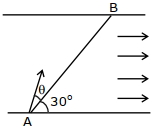
A swimmer wants to cross a river from point $A$ to point $B$. Line $A B$ makes an angle of $30^{\circ}$ with the flow of river. Magnitude of velocity of the swimmer is same as that of the river. The angle $\theta$ with the line ${AB}$ should be $^{\circ}$, so that the swimmer reaches point ${B}$.
The mass number of a nucleus is