Which of the following relation is true ?
AIIMS 2014, Easy


Download our appand get started for free
Experience the future of education. Simply download our apps or reach out to us for more information. Let's shape the future of learning together!No signup needed.*
Similar Questions
- 1The upper end of a wire of diameter $12\,mm$ and length $1\,m$ is clamped and its other end is twisted through an angle of $30^{\circ}$. The angle of shear is$........^{\circ}$View Solution
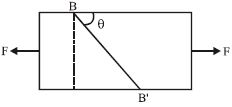
- 2A bar of cross-sectional area $A$ is subjected two equal and opposite tensile forces at its ends as shown in figure. Consider a plane $BB'$ making an angle $\theta $ with the length The ratio of tensile stress to the shearing stress on the plane $BB'$ isView Solution
- 3Join the relation of physical quantities in Column$-I$ to the details given in Column$-II$ appropriately :View Solution
Column $-I$ Column $-II$ $(a)$ Stress $\propto $ Strain $(i)$ $M^1\,L^{-1}\,T^{-2}$ $(b)$ Dimensional formula for compressibility $(ii)$ $M^{-1}\,L^{1}\,T^{-2}$ $(iii)$ Poisson’s ratio $(iv)$ Hooke’s law - 4View SolutionIn which case there is maximum extension in the wire, if same force is applied on each wire
- 5View SolutionWhich of the following relations is true
- 6The area of cross section of the rope used to lift a load by a crane is $2.5 \times 10^{-4} m ^{2}$. The maximum lifting capacity of the crane is $10$ metric tons. To increase the lifting capacity of the crane to $25$ metric tons, the required area of cross section of the rope should be.$.........\times 10^{-4} \,m ^{2}$ (take $g =10\, ms ^{-2}$ )View Solution
- 7View SolutionLiquids have no Poisson's ratio, because
- 8If the force constant of a wire is $K,$ the work done in increasing the length of the wire by $l$ isView Solution
- 9How much force is required to produce an increase of $0.2\%$ in the length of a brass wire of diameter $0.6\, mm$ (Young’s modulus for brass = $0.9 \times {10^{11}}N/{m^2}$)View Solution
- 10A steel wire of length $3.2 m \left( Y _{ S }=2.0 \times 10^{11}\,Nm ^{-2}\right)$ and a copper wire of length $4.4\,M$ $\left( Y _{ C }=1.1 \times 10^{11}\,Nm ^{-2}\right)$, both of radius $1.4\,mm$ are connected end to end. When stretched by a load, the net elongation is found to be $1.4\,mm$. The load applied, in Newton, will be. (Given $\pi=\frac{22}{7}$)View Solution