MCQ
Which of the following statement is correct
  • A
    Liquids obey fully the ohm's law
  • Liquids obey partially the ohm's law
  • C
    There is no relation between current and p.d. for liquids
  • D
    None of the above

Answer

Correct option: B.
Liquids obey partially the ohm's law
b
(b) In $V-I$ graph, we will not get a straight line in case of liquids.

Need a full question paper?

Generate a complete, print-ready paper with questions like this in minutes — across 16+ boards, with answer keys.
Start Generating Free

Similar questions

Two coaxial solenoids 1 and 2 of the same length are set so that one is inside the other. The number of turns per unit length are $n_1$ and $n_2$. The currents $i_1$ and $i_2$ are flowing in opposite directions. The magnetic field inside the inner coil is zero. This is possible when
In an electron gun the control grid is given a negative potential relative to cathode in order to:
Electric flux through a surface of area $100$ $m^2$ lying in the $xy$ plane is (in $V-m$) if $\vec E = \hat i + \sqrt 2 \hat j + \sqrt 3 \hat k$
An $LC$ circuit contains a  $20\,\,mH$  inductor and a $50\,\,\mu F$ capacitor with an initial charge of  $10 \,\,mC.$ The resistance of the circuit is negligible. Let the instant the circuit is closed be $t = 0.$  At what time is the energy stored completely magnetic $t=$ .......... $m/s$
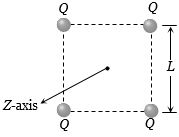
Four point $+ve$ charges of same magnitude $(Q)$ are placed at four corners of a rigid square frame as shown in figure. The plane of the frame is perpendicular to $Z$ axis. If a $-ve$ point charge is placed at a distance $z$ away from the above frame $(z<< L)$ then
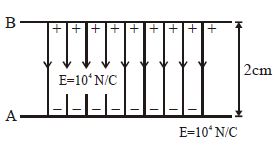
An electron is released from the bottom plate $A$ as shown in the figure $(E = 10^4\, N/C)$. The velocity of the electron when it reaches plate $B$ will be nearly equal to
A converging lens is used to form an image on a screen. When upper half of the lens is covered by an opaque screen
The plates of a parallel plate capacitor of capacity 50 μC are charged to a potential of 100 volts and then separated from each other so that the distance between them is doubled. How much is the energy spent in doing so
Two electrons each are fixed at a distance $'2d'$. A third charge proton placed at the midpoint is displaced slightly by a distance $x ( x << d )$ perpendicular to the line joining the two fixed charges. Proton will execute simple harmonic motion having angular frequency : $( m =$ mass of charged particle)
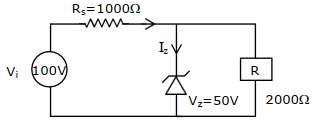
For the circuit shown below, calculate the value of ${I}_{{z}}$ : (In ${mA}$)