MCQ
Which of the following statement is false
  • A
    Heat produced in a conductor is proportional to its resistance
  • B
    Heat produced in a conductor is proportional to the square of the current
  • Heat produced in a conductor is proportional to charge
  • D
    Heat produced in a conductor is proportional to the time for which current is passed
Answer

Correct option: C.
Heat produced in a conductor is proportional to charge
c
$H = {i^2}Rt$ and $i = \frac{q}{t}$.

Hence $H = \frac{{{q^2}R}}{t}$ ;

$\therefore \,\,H \propto \,{q^2}$

Need a full question paper?

Generate a complete, print-ready paper with questions like this in minutes — across 16+ boards, with answer keys.

Start Generating Free

Similar questions

$A$. The drift velocity of electrons decreases with the increase in the temperature of conductor.

$B$. The drift velocity is inversely proportional to the area of cross-section of given conductor.

$C$. The drift velocity does not depend on the applied potential difference to the conductor.

$D$. The drift velocity of electron is inversely proportional to the length of the conductor.

$E$. The drift velocity increases with the increase in the temperature of conductor.

Choose the correct answer from the options given below:

An electron and a proton have equal kinetic energies. They enter in a magnetic field perpendicularly, Then
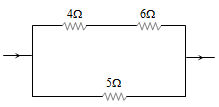
In the circuit shown in figure, the heat produced in 5 ohm resistance is 10 calories per second. The heat produced in 4 resistance is

The mass and energy equivalent to $1\, a.m.u.$ respectively
In an ac circuit, current $I=5 \sin \left(100 t-\frac{\pi}{2}\right)$ ampere and altemating potential difference is $V =200$ sin ( 100 t ). The power dissipated in the circuit is :
A particle of mass $m$ moves in circular orbits with potential energy $V ( r )=F r$, where $F$ is a positive constant and $r$ is its distance from the origin. Its energies are calculated using the Bohr model. If the radius of the particle's orbit is denoted by $R$ and its speed and energy are denoted by $v$ and $E$, respectively, then for the $n ^{\text {th }}$ orbit (here $h$ is the Planck's constant)-

$(A)$ $R \propto n ^{1 / 3}$ and $v \propto n ^{2 / 3}$

$(B)$ $R \propto n ^{2 / 3}$ and $v \propto n ^{1 / 3}$

$(C)$ $E=\frac{3}{2}\left(\frac{n^2 h^2 F^2}{4 \pi^2 m}\right)^{1 / 3}$

$(D)$ $E=2\left(\frac{n^2 h^2 F^2}{4 \pi^2 m}\right)^{1 / 3}$

The ratio of kinetic energy to the total energy of an electron in a Bohr orbit of the hydrogen atom is 
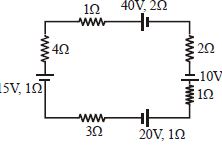
Find the current in the loop.
Electric field at a point $(x, y, z)$ is represented by $\vec E = 2x\hat i + {y^2}\hat j$ if potential at $(0,0,0)$ is $2\, volt$ find potential at $(1, 1, 1)$
The wavelength $\lambda_e$ of an electron and $\lambda_p$ of a photon of same energy $E$ are related by