MCQ
Which of the following statements is incorrect?
  • A
    Most of the collisions on the macroscopic scale are inelastic collisions.
  • In a perfectly inelastic collision, there is complete loss of $KE$
  • C
    Forces involved in an elastic collision are conservative in nature
  • D
    Oblique collision is that collision in which the colliding bodies do not move along the same straight line path
Answer

Correct option: B.
In a perfectly inelastic collision, there is complete loss of $KE$
b
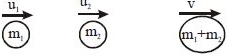
In perfectly inelastic collision both bodies will

more with same velocity

$\mathrm{m}_{1} \mathrm{u}_{1}+\mathrm{m}_{2} \mathrm{u}_{2}=\left(\mathrm{m}_{1}+\mathrm{m}_{2}\right) \mathrm{v}$

final $KE$ has some value because of velocity

Option $(2)$ is wrong

Need a full question paper?

Generate a complete, print-ready paper with questions like this in minutes — across 16+ boards, with answer keys.

Start Generating Free

Similar questions

If a particle covers half the circle of radius R with constant speed then
Which of the following graphs is correct between kinetic energy $ (E), $ potential energy $(U)$  and height $(h)$ from the ground of the particle
A particle is rotating in a circle of radius $1\,m$ with constant speed $4\,m / s$. In time $1\,s$, match the following (in $SI$ units) columns.
Colum $I$ Colum $II$
$(A)$ Displacement $(p)$ $8 \sin 2$
$(B)$ Distance $(q)$ $4$
$(C)$ Average velocity $(r)$ $2 \sin 2$
$(D)$ Average acceleration $(s)$ $4 \sin 2$
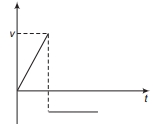
The velocity-time graph for a particle moving along $x$-axis is shown in the figure. The corresponding displacement-time graph is correctly shown by
When an ideal diatomic gas is heated at constant pressure, the fraction of the heat energy supplied which increases the internal energy of the gas, is
The main scale of a vernier calliper has $n$ divisions/ $\mathrm{cm}$. $n$ divisions of the vernler scale coincide with $(\mathrm{n}-1)$ divisions of maln scale. The least count of the vernler calliper is,
A train is moving with velocity $20\, m/sec$. on this dust is falling at the rate of $50 \,kg/minute$. The extra force required to move this train with constant velocity will be ....... $N$
Moment of inertia $(M.I.)$ of four bodies, having same mass and radius, are reported as;

$I _{1}= M$. of thin circular ring about its diameter.

$I _{2}=$ $M.I.$ of circular disc about an axis perpendicular to the disc and going through the centre,

$I _{3}=$ $M.I.$ of solid cylinder about its axis and

$I _{4}= M . I.$ of solid sphere about its diameter. Then

An object with a mass $10 \,kg$ moves at a constant velocity of $10 \,m/sec$. A constant force then acts for $4\, second$ on the object and gives it a speed of $2\, m/sec$ in opposite direction. The acceleration produced in it, is ........ $m/{\sec ^2}$
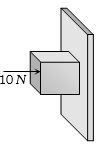
A horizontal force of $10 \,N$ is necessary to just hold a block stationary against a wall. The coefficient of friction between the block and the wall is $0.2$. the weight of the block is ........ $N$