Question
Which of the following statements is true

Answer

The centrifugal force due to spinning of earth is maximum at the equator and vanishes at the poles. So, the effective gravitational acceleration is minimum at equator and maximum at poles.

The value of acceleration at height $h$ is $g_h=\frac{ GM }{( R + h )^2}$ and at depth $d$ is $g _d=$ $\frac{ GM }{( R - d )^2}$

Thus, the value of $g$ is more at the earth's surface than at a height above or a depth below.

Need a full question paper?

Generate a complete, print-ready paper with questions like this in minutes — across 16+ boards, with answer keys.
Start Generating Free

Similar questions

Learned Indian classical vocalists do not like the accompaniment of a harmonium because
The energy of electron in the nth orbit of hydrogen atom is expressed as ${E_n} = \frac{{ - 13.6}}{{{n^2}}}eV$. The shortest and longest wavelength of Lyman series will be
The current in a $LR$  circuit builds up to $\frac{3}{4}$ th of its steady state value in $4s$. The time constant of this circuit is
If intensity of incident light is increased in $PEE$ then which of the following is true
The amplitude of wave disturbance propagating in the positive $x$-direction is given by $y=\frac{1}{(1+x)^{2}}$ at time $t=0$ and $y=\frac{1}{1+(x-2)^{2}}$ at $t=1$ s, where $x$ and $y$ are in metres. The shape of wave does not change during the propagation. The velocity of the wave will be $...\,{m} / {s}.$
A body is moving in a room with a velocity of $20\, m / s$ perpendicular to the two walls separated by $5$ meters. There is no friction and the collisions with the walls are elastic. The motion of the body is
The force of gravitation is
The time required to pass the light through a glass slab of $2 mm$ thick is (${\mu _{glass}} = 1.5$)
A body of mass $1 \ kg$ begins to move under the action of a time dependent force $\overrightarrow {\;F\;} = (2t\hat i + 3{t^2}\hat j$) $N$ where $\hat i$ and $\hat j$ are unit vectors along $x$ and $y$ axis. What power will be developed by the force at the time $t?$
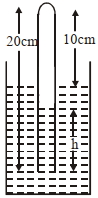
A $20 \,cm$ long tube is closed at one end. It is held vertically, and its open end is dipped in water until only half of it is outside the water surface. Consequently, water rises in it by height $h$ as shown in the figure. The value of $h$ is closest to .............. $\,m / s$ (assume that the temperature remains constant, $P _{\text {armosphere }}=10^5 \,N / m ^2$, density. of water $=10^3 \,kg / m ^3$, and acceleration due to gravity $g =10 \,m / s ^2$ )