Which of the following statement$(s)$ is/are correct?
$(A)$ If the electric field due to a point charge varies as $r^{-25}$ instead of $r^{-2}$, then the Gauss law will still be valid.
$(B)$ The Gauss law can be used to calculate the field distribution around an electric dipole.
$(C)$ If the electric field between two point charges is zero somewhere, then the sign of the two charges is the same.
$(D)$ The work done by the external force in moving a unit positive charge from point $A$ at potential $V_A$ to point $B$ at potential $V_B$ is $\left(V_B-V_A\right)$.
IIT 2011, Diffcult
Download our app for free and get started
Correct Answer - $C::D$
$(a)$ is not correct because it is valid only when $E \propto r^{-2}$
$(b)$ is not correct
$(c)$ is correct as between two point charges we will get a point where the electric field due to the two point charges cancel out each other.
$(d)$ is correct when the work done is without accelerating the charge.

Download our appand get started for free
Experience the future of education. Simply download our apps or reach out to us for more information. Let's shape the future of learning together!No signup needed.*
Similar Questions
- 1If the dielectric constant and dielectric strength be denoted by $k$ and $x$ respectively, then a material suitable for use as a dielectric in a capacitor must haveView Solution
- 2Two parallel plate capacitors $C_1$ and $C_2$ each having capacitance of $10 \mu F$ are individually charged by a $100\,V$ $D.C.$ source. Capacitor $C _1$ is kept connected to the source and a dielectric slab is inserted between it plates. Capacitor $C _2$ is disconnected from the source and then a dielectric slab is inserted in it. Afterwards the capacitor $C_1$ is also disconnected from the source and the two capacitors are finally connected in parallel combination. The common potential of the combination will be $.........V.$ (Assuming Dielectric constant $=10$ )View Solution
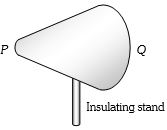
- 3Figure shows a charged conductor resting on an insulating stand. If at the point $P$ the charge density is $\sigma $, the potential is $V$ and the electric field strength is $E$, what are the values of these quantities at point $Q$View Solution
Charge density potential Electric intensity
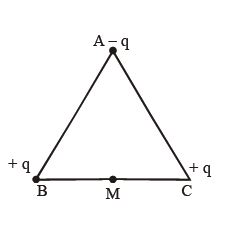
- 4Charges $-q,\, q,\,q$ are placed at the vertices $A$, $B$, $C$ respectively of an equilateral triangle of side $'a'$ as shown in the figure. If charge $-q$ is released keeping remaining two charges fixed, then the kinetic energy of charge $(-q)$ at the instant when it passes through the mid point $M$ of side $BC$ isView Solution
- 5A proton of mass $m$ and charge $e$ is projected from a very large distance towards an $\alpha$-particle with velocity $v$. Initially $\alpha$-particle is at rest, but it is free to move. If gravity is neglected, then the minimum separation along the straight line of their motion will beView Solution
- 6A capacitor with air as the dielectric is charged to a potential of $100\;volts$. If the space between the plates is now filled with a dielectric of dielectric constant $10$, the potential difference between the plates will be......$volts$View Solution
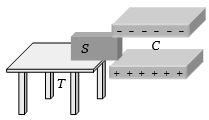
- 7A frictionless dielectric plate $S$ is kept on a frictionless table $T$. A charged parallel plate capacitance $C$ (of which the plates are frictionless) is kept near it. The plate $S$ is between the plates. When the plate $S$ is left between the platesView Solution
- 8A dipole consisting of two charge $\pm q$ separated by a distance $2 a$ is placed with its centre $D$ away from the center of a grounded sphere of radius $R ( D > > a )$. When the dipole moment vector is perpendicular to the line joining the two centres (those of the dipole and sphere) the charge induced on the sphere isView Solution
- 9Minimum number of $2\,\mu F$ and $250\, V$ capacitors used to make a combination of $12\,\mu F$ and $500\,V$ areView Solution
- 10A condenser of $2\,\mu F$ capacitance is charged steadily from $0$ to $5$ $Coulomb$. Which of the following graphs correctly represents the variation of potential difference across its plates with respect to the charge on the condenserView Solution