MCQ
Which of the following vehicles is undergoing a deacceleration?
  • A
    A car driving straight to the east on a road at a constant speed.
  • B
    A truck rounding a corner at a constant speed.
  • A van slowing down as it approaches a stop sign.
  • D
    None of these.

Answer

Correct option: C.
A van slowing down as it approaches a stop sign.
A object is said to have an acceleration if it changes its velocity either by increasing its speed, decreasing its speed or changing the direction of its velocity.
Since the car and the truck move with constant speed,
thus they have zero acceleration.
But the van is slowing down its speed,
thus it has deacceleration.

Need a full question paper?

Generate a complete, print-ready paper with questions like this in minutes — across 16+ boards, with answer keys.

Start Generating Free

Similar questions

A tap supplies water at $10\,^oC$ and another tap at $100\,^oC$. .......... $kg$ hot water must be taken so that we get $20\, kg$ water at $35\,^oC$ ?
A simple pendulum is suspended from the roof of a trolley which moves in a horizontal direction with an acceleration $a,$ then the time period is given by $\text{t}=2\pi\sqrt{\frac{1}{\text{g}}}$ where $g'$ is equal to:
An ideal gas is filled in a vessel, then
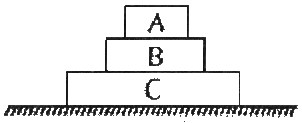
Three blocks are placed as shown in figure. Mass of $A, B$ and $C$ are $m_1, m_2$ and $m_3$ respectively. The force exerted by block ' $C$ ' on ' $B$ ' is .........
The electrical resistance $R$ of a conductor of length $l$ and area of cross section $a$ is given by $R = \frac{{\rho l}}{a}$ where $\rho$ is the electrical resistivity. What a is the dimensional formula for electrical conductivity $\sigma $ which is reciprocal of resistivity?
A mass is hanging on a spring balance which is kept in a lift. The lift ascends. The spring balance will show in its reading
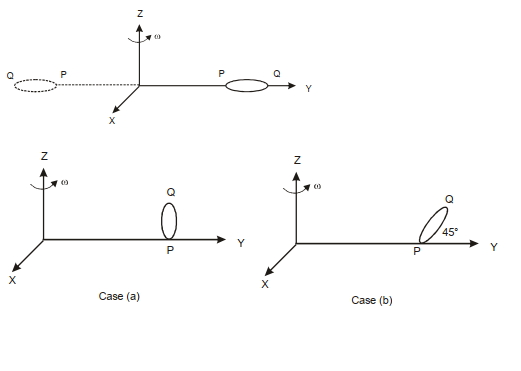
The general motion of a rigid body can be considered to be a combination of $(i)$ a motioon --- centre of mass about an axis, and $(ii)$ its motion about an instantanneous axis passing through center of mass. These axes need not be stationary. Consider, for example, a thin uniform welded (rigidly fixed) horizontally at its rim to a massless stick, as shown in the figure. Where disc-stick system is rotated about the origin ona horizontal frictionless plane with angular sp--- $\omega$, the motion at any instant can be taken as a combination of $(i)$ a rotation of the centre of mass the disc about the $z$-axis, and $(ii)$ a rotation of the disc through an instantaneous vertical axis pass through its centre of mass (as is seen from the changed orientation of points $P$ and $Q$). Both the motions have the same angular speed $\omega$ in the case. $Image$  Now consider two similar systems as shown in the figure: case $(a)$ the disc with its face ver--- and parallel to $x - z$ plane; Case $(b)$ the disc with its face making an angle of $45^{\circ}$ with $x$-y plane its horizontal diameter parallel to $x$-axis. In both the cases, the disc is weleded at point $P$, and systems are rotated with constant angular speed $\omega$ about the $z$-axis.$Image$

$1.$ Which of the following statement regarding the angular speed about the istantaneous axis (passing through the centre of mass) is correct?

$(A)$ It is $\sqrt{2} \omega$ for boht the cases

$(B)$ it is $\omega$ for case $(a)$; and $\frac{w}{\sqrt{2}}$ for case $(b)$.

$(C)$ It is $\omega$ for case $(a)$; and $\sqrt{2} \omega$ for case $(b)$.

$(D)$ It is $\omega$ for both the cases

$2.$ Which of the following statements about the instantaneous axis (passing through the centre of mass) is correct?

$(A)$ It is vertical for both the cases $(a)$ and $(b)$.

$(B)$ It is verticle for case $(a)$; and is at $45^{\circ}$ to the $x-z$ plane and lies in the plane of the disc for case $(b)$

$(C)$ It is horizontal ofr case $(a)$; and is at $45^{\circ}$ to the $x - z$ plane and is normal to the plane of the disc for case $(b)$.

$(D)$ It is vertical of case $(a)$; and is at $45^{\circ}$ to the $x - z$ plane and is normal to the plane of the disc for case $(b)$.

Give the answer question $1$ and $2.$
Calculate the acceleration (In $m/s^{2}$) of the block and trolly system shown in the figure. The coefficient of kinetic friction between the trolly and the surface is $0.05 .\left( g =10\; m / s ^{2},\right.$ mass of the string is negligible and no other friction exists).
The efficiency of carnot engine is $50\%$ and temperature of sink is $500\,K$ . If temperature of source is kept constant and its efficiency raised to $60\%$ , then the required temperature of the sink will be  .... $K$
A silver ingot weighing $2.1 kg$  is held by a string so as to be completely immersed in a liquid of relative density $0.8$. The relative density of silver is $10.5$ . The tension in the string in $kg-wt$ is