MCQ
Which of the oxide groups among the following cannot be reduced by carbon?
  • A
    $Cu_2O, SnO_2$
  • $CaO, K_2O$
  • C
    $PbO, Fe_2O_4$
  • D
    $Fe_2O_3, ZnO$

Answer

Correct option: B.
$CaO, K_2O$
b
$Ca$ and $K$ are strong reducing agents, hence their oxides can not be reduced with carbon.

Need a full question paper?

Generate a complete, print-ready paper with questions like this in minutes — across 16+ boards, with answer keys.

Start Generating Free

Similar questions

Given below are two statements: One is labelled as Assertion A and the other is labelled as Reason R.
Assertion A : $H _2 Te$ is more acidic than $H _2 S$. 
Reason R: Bond dissociation enthalpy of $H _2 Te$ is lower than $H _2 S$.
In the light of the above statements. Choose the most appropriate from the options given below.
The ${H^ + }$ ion concentration is $1.0 \times {10^{ - 6}}$ mole/litre in a solution. Its $pH $ value will be
Which of the following is not isoelectronic
The vapour pressure of $30 \% ( w / v )$ aqueous solution of glucose is $......\,mm\,Hg$ at $25^{\circ}\,C$.[Given : The density of $30 \%$ (w/v), aqueous solution of glucose is $1.2\,g\,cm ^{-3}$ and vapour pressure of pure water is $24\,mm\,Hg$.](Molar mass of glucose is $\left.180\,g\,mol ^{-1}.\right)$
Amongst the following covalent bonding is found in
Incorrect statement regarding following reactions is

$Xe{{F}_{6}}\,\xrightarrow{+\,Excess\,\,{{H}_{2}}O}\,'X'\,+\,HF$

$Xe{{F}_{6}}\,\xrightarrow{+\,2\,\,{{H}_{2}}O}\,'Y'\,+\,HF$
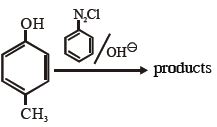
In following reaction main product will be
While preparing crystals of Mohr's salt, dil. $H _2 SO _4$ is added to a mixture of ferrous sulphate and ammonium sulphate, before dissolving this mixture in water, dil. $H _2 SO _4$ is added here to:
How many of the following reaction will form $PH_3$ gas

$(1) Ca_3P_2 + H_2O \to$

$(2)$ ${H_3}P{O_3}\xrightarrow{\Delta }$

$(3) P_4 + NaOH \to$

$(4)$ ${H_3}P{O_4}\xrightarrow{\Delta }$

$(5) HNO_3 + P_4O_{10} \to$

$(6)$ $P_4+HNO_3 \to$

Assertion : If one component of a solution obeys Raoult’s law over a certain range of composition, the other component will not obey Henry’s law in that range.

Reason : Raoult’s law is a special case of Henry’s law.