MCQ
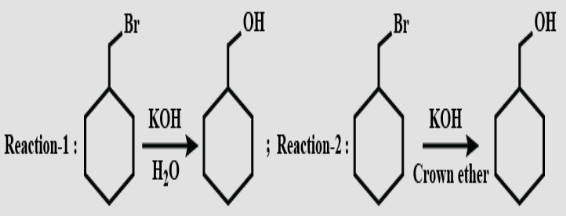
- AReaction 1
- BReaction 2
- CBoth have equal rates of reaction.
- DCannot be predicted.
Explanation:
Since given reaction is SN2 and we know that SN2 favoured in presence of polar aprotic solvent like crown-ethers, DMSO, DMF, etc not H2O which is polar protic solvent.
In reaction 2 polar solvent (crown ether) is used.
Thus reaction 2 is faster than reaction 1.
Generate a complete, print-ready paper with questions like this in minutes — across 16+ boards, with answer keys.
$M + L \rightleftharpoons ML$
$ML + L \rightleftharpoons M{L_2}$
are $4$ and $3$. Hence, overall stability constant for
$M + 2L \rightleftharpoons M{L_2}$ is
$\mathop {{H_3}C\mathop C\limits^ \ominus {H_2}}\limits_{(i)} \,,$$\mathop {{H_2}C = \mathop C\limits^ \ominus H}\limits_{(ii)} $ and $\mathop {H - C \equiv \mathop C\limits^ \ominus }\limits_{(iii)} $
is in the order of
$O(g) + e^- = O^-(g)$ $\Delta {H_{eg}} = - 142\,kJ\,mo{l^{ - 1}}$
$O^-(g) + e^- = O^{2-}(g)$ $\Delta {H_{eg}} = +844\,kJ\,mo{l^{ - 1}}$
This is because