MCQ
Which of these is a correct definition of conventional current?
  • A
    Current that flows from lower potential to higher potential.
  • B
    The current which remains static.
  • C
    Current constituted by the flow of ions.
  • D
    Current that flows from higher potential to lower potential.

Answer

  1. Current that flows from higher potential to lower potential.
Explanation:

The current that flows from a point at the higher (positive) potential to a point at lower (negative) potential is called conventional current. The direction of motion of positive charges is taken as the direction of electric current.

Need a full question paper?

Generate a complete, print-ready paper with questions like this in minutes — across 16+ boards, with answer keys.

Start Generating Free

Similar questions

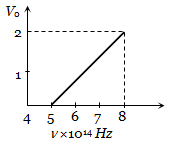
The stopping potential (  versus frequency (n) plot of a substance is shown in figure the threshold wave length is

(a) 5

(b) 6000Å

(c) 5000 Å

(d) Can not be estimated from given data

In Young's double slit experiment, the distance between the two slits is 0.1 mm and the wavelength of light used is 4 . If the width of the fringe on the screen is 4 mm, the distance between screen and slit is

(a) 0.1 mm

(b) 1 cm

(c) 0.1 cm

(d) 1 m

To maintain a steady current through the conductor, some external device must do work. What does the external device provide?
Resistance of the metal increases with temperature because:
The light source will be coherent if :

A ray of light is incident on the surface of separation of a medium at an angle 45° and is refracted in the medium at an angle 30°. What will be the velocity of light in the medium

(a) 1.98

(b)  2.12  

(c) 3.18  

(d) 3.33  

The dimensions of electric field are:

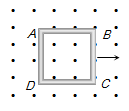
A metallic square loop ABCD is moving in its own plane with velocity v in a uniform magnetic field perpendicular to its plane as shown in the figure. An electric field is induced

(a) In AD, but not in BC

(b) In BC, but not in AD

(c) Neither in AD nor in BC

(d) In both AD and BC

A liquid can easily change its shape but a solid can not because.
  1. The density of a liquid is smaller than that of a solid.
  2. The forces between the molecules is stronger in solid than in liquids.
  3. The atoms combine to form bigger molecules in a solid.
  4. The average separation between the molecules is larger in solids.

Ratio of amplitude of interfering waves is 3 : 4. Now ratio of their intensities will be

(a)  

(b) 49 : 1

(c)  

(d) None of these