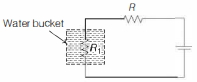
Which one is not the correct statement
Easy
Download our app for free and get started
(c) Because $1\, H.P. = 746\, J/s$ $=$ $746\, watt$

Download our appand get started for free
Experience the future of education. Simply download our apps or reach out to us for more information. Let's shape the future of learning together!No signup needed.*
Similar Questions
- 1A potentiometer has uniform potential gradient across it. Two cells connected in series $(i)$ to support each other and $(ii)$ to oppose each other are balanced over $6\,m$ and $2\,m$ respectively on the potentiometer wire. The $e.m.f.$’s of the cells are in the ratio ofView Solution
- 2$n$ equal resistors are first connected in series and then connected in parallel. What is the ratio of the maximum to the minimum resistanceView Solution
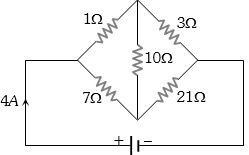
- 3In the circuit shown in figure, the current drawn from the battery is $4\,A$. If $10 \,\Omega$ resistor is replaced by $20\,\Omega$ resistor, then current drawn from the circuit will be .............. $A$View Solution
- 4A current source drives a current in a coil of resistance $R_1$ for a time $t$. The same source drives current in another coil of resistance $R_2$ for same time. If heat generated is same, find internal resistance of source.View Solution
- 5Consider a block of conducting material ofresistivity '$\rho$' shown in the figure. Current '$I$' enters at '$A$' and leaves from '$D$'. We apply superp osition principle to find voltage '$\Delta V$ ' developed between '$B$' and '$C$'. The calculation is done in the following steps:View Solution
$(i)$ Take current '$I$' entering from '$A$' and assume it to spread over a hemispherical surface in the block.
$(ii)$ Calculatefield $E(r)$ at distance '$r$' from $A$ by using Ohm's law $E = \rho j$, where j is the current per unit area at '$r$'.
$(iii)$ From the '$r$' dependence of $E(r)$, obtain the potential $V(r)$ at $r$.
$(iv)$ Repeat $(i), (ii)$ and $(iii)$ for current '$I$' leaving '$D$' and superpose results for '$A$' and '$D$'.For current entering at $A$, the electric field at a distance '$r$'
from $A$ is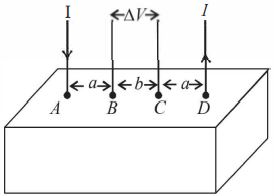
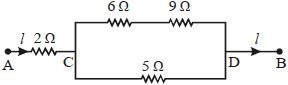
- 6In the circuit shown in figure, the $5\,\Omega $ resistance develops $20.00\,cal/s$ due to the current flowing through it. The heat developed in $2\,\Omega $ resistance (in $cal/s$ ) isView Solution
- 7A cell of $emf\;4\,V$ and internal resistance $0.5\,\Omega$ is connected to a $7.5\,\Omega$ external resistance. The terminal potential difference of the cell is $.....\,V$.View Solution
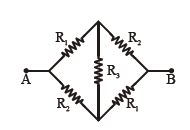
- 8The equivalent resistance between ends $A$ and $B$ isView Solution
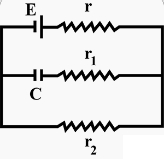
- 9In the given circuit diagram when the current reaches steady state in the circuit, the charge on the capacitor of capacitance $C$ will beView Solution
- 10View SolutionThe circuit below is used to heat water kept in a bucket. Assuming heat loss only by Newton's law of cooling, the variation in the temperature of the water in the bucket as a function of time is depicted by