MCQ
Which one of the following molecules does not possess vibrational energy?
  • A
    Oxygen
  • B
    Nitrogen
  • Argon
  • D
    $CO_2$

Answer

Correct option: C.
Argon

Need a full question paper?

Generate a complete, print-ready paper with questions like this in minutes — across 16+ boards, with answer keys.

Start Generating Free

Similar questions

Two identical  $5\,\,kg$ . blocks are moving with same speed of  $2\,\,m/s$  towards each other along a frictionless horizontal surface. The two blocks collide, stick together and come to rest. Consider to two blocks as a system, the work done on the system by the external forces will be ............. $\mathrm{Joule}$
Variation of the density of water with respect to temperature from $0^\circ C$ to $10^\circ C$ is correctly represented by:
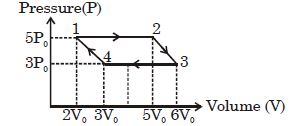
An ideal monoatomic gas is taken round the cycle $12341$ shown in the figure ( $p\,-\,V$ diagram). The work done in one cycle is ?
The radius of the orbit of a satellite is $r$ and its kinetic energy is $K.$ If the radius of the orbit is doubled, then the new kinetic energy $K'$ is:
A body starts from rest and moves with uniform acceleration for $3\ s.$ It then decelerates uniformly for $2\ s.$ and stops. If the deceleration is $3 \ ms^{-2}$ the maximum velocity of the body is$. . . ms^{-1}$
The horizontal range of a projectile fired at an angle of $15^\circ$ is $50m.$ If it is fired with the same speed at an angle of $45^\circ$ , its range will be
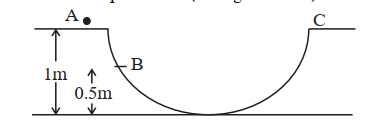
A particle is placed at the point $\mathrm{A}$ of a frictionless track $A B C$ as shown in figure. It is gently pushed toward right. The speed of the particle when it reaches the point $B$ is: $\left(\right.$ Take $g=10 \mathrm{~m} / \mathrm{s}^2$ ).
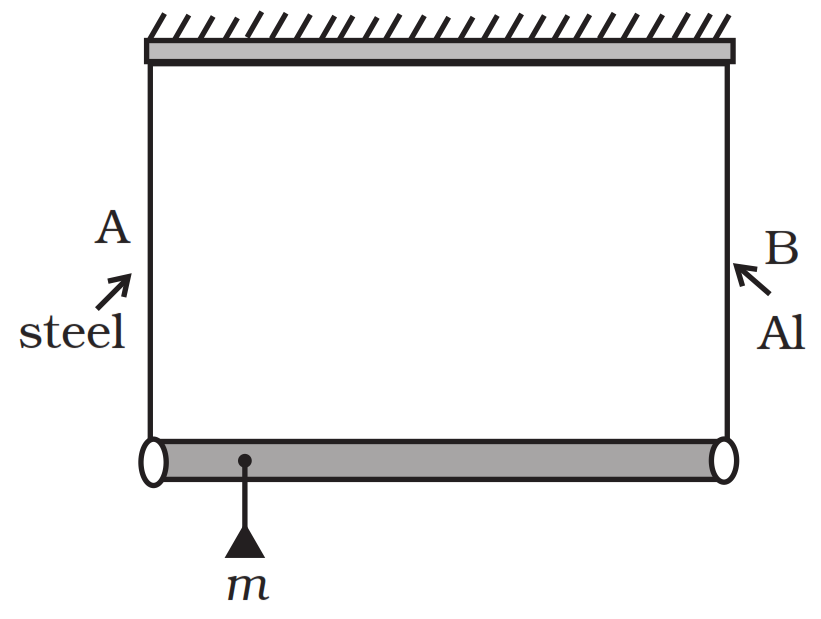
A rod of length $I$ and negligible mass is suspended at its two ends by two wires of steel $($wire $A )$ and aluminium $($wire $B)$ of equal lengths. The cross $-$ sectional areas of wires $A$ and $B$ are $1.0 mm^2$ and $2.0 mm^2$, respectively. $\left(Y_{\text {al }}=70 \times 10 Nm ^{-2}\right.$ and $\left.Y_{\text {steel }}=200 \times 10^9 Nm ^{-2}\right)$
If the intensity level of a sound wave is increased by factor 20, the corresponding change in decibels level of the sound would be
The dimension $\mathrm{ML}^{-1} \mathrm{~T}^{-2}$ can correspond to: