MCQ
Which one of the following sets includes all homologous organs?
  • A
    Hind legs of pig, duck and kangaroo
  • B
    Wings of bats, butterfly and bird
  • C
    Sting of honey bee, scorpion and snake
  • D
    Tail of rat, peacock and cockroach

Answer

  1. Hind legs of pig, duck and kangaroo

Explanation:

Homologous structures means that they had come from a common ancestor, e.g., hind legs of pig, duck and kangaroo.

Need a full question paper?

Generate a complete, print-ready paper with questions like this in minutes — across 16+ boards, with answer keys.
Start Generating Free

Similar questions

Out of the following, the colour of light having the maximum wavelength is:
  1. Violet.
  2. Indigo.
  3. Green.
  4. Orange.
A converging lens is used to produce an image of an object on a screen,object on a screen. What change is needed for the image to be formed nearer to the lens?
  1. Increase the focal length of the lens.
  2. Insert a diverging lens between the lens and the screen.
  3. Increase the distance of the object from the lens.
  4. Move the object closer to the lens.
The device used for producing electric current is called a:
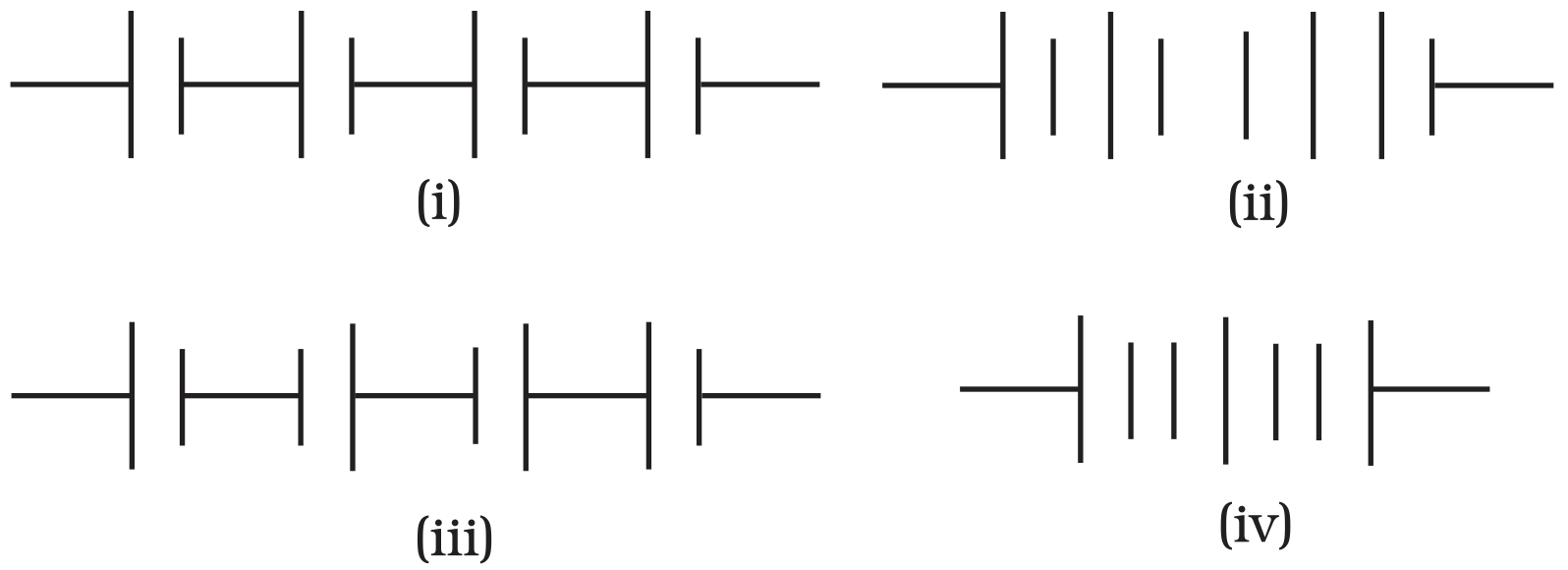
The proper representation of series combination of cells (Figure) obtaining maximum potential is:
A hollow glass prism gives:
In an electrical circuit three incandescent bulbs A, B and C of rating 40W, 60W and 100W respectively are connected in parallel to an electric source. Which of the following is likely to happen regarding their brightness?
  1. Brightness of all the bulbs will be the same.
  2. Brightness of bulb A will be the maximum.
  3. Brightness of bulb B will be more than that of A.
  4. Brightness of bulb C will be less than that of B.
Find the incorrect statement:
A. Convex mirrors are used by the dentist to see the large images of teeth of patients.
B. Convex mirrors are used as rear-view mirrors in cars, motorcycles, scooters, etc
C. Concave mirrors are used for shaving purpose.
D. Concave mirrors are used by doctors to focus light inside the ear or inside the mouth for medical examination.
The image of an object formed by a plane mirror is:
  1. Virtual.
  2. Real.
  3. Diminished.
  4. Upside-down.
A real image is formed by the light rays after reflection or refraction when they:

  1. Actually meet or intersect with each other.
  2. Actually converge at a point.
  3. Appear to meet when they are produced in the backward direction.
  4. Appear to diverge from a point. Which of the above statements are correct?

Which of the above statements are correct?

To determine the approximate focal length of the given convex lens by focussing a distant object (say, a sign board), you try to focus the image of the object on a screen. The image you obtain on the screen is always: