MCQ
Which one of the following statements is correct
  • A
    The oxidation number of oxygen in $K{O_2}$ is zero
  • The specific conductance of an electrolyte solution decreases with increase in dilution
  • C
    $S{n^{2 + }}$ oxidises $F{e^{3 + }}$
  • D
    $Zn/ZnS{O_4}$ is a reference electrode

Answer

Correct option: B.
The specific conductance of an electrolyte solution decreases with increase in dilution
b
It’s obvious.

Need a full question paper?

Generate a complete, print-ready paper with questions like this in minutes — across 16+ boards, with answer keys.

Start Generating Free

Similar questions

Which of the following ligand is not bidentate 
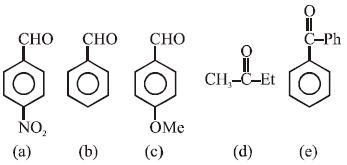
The correct order of rate of reaction towards nucleophilic addition reaction
How much amount of $\mathrm{NaCl}$ should be added to $600\; \mathrm{g}$ of water $(\rho=1.00\; \mathrm{g} / \mathrm{mL})$ to decrease the freezing point of water to $-0.2^{\circ} \mathrm{C} ?$ ............. $\mathrm{gm}$

(The freezing point depression constant for water $=2\; \mathrm{K}\; \mathrm{kg} \;\mathrm{mol}^{-1}$ )

Anomalous behaviour of oxygen is due to its
The number of electrons involved in the reduction of permanganate to manganese dioxide in acidic medium is $.......$.
$A + H_2O \to  B + HCl, B + H_2O \to  C + HCl,$ Compound $(A), (B)$ and $(C)$ will be respectively
If $5.85\,g$  of $NaCl $ (molecular weight $58.5$) is dissolved in water and the solution is made up to $0.5\,litre$, the molarity of the solution will be
Glucose is formed by hydrolysis of maltose. The enzymes used in this reaction is:
A reaction takes place in three steps with individual rate constant and activation energy as follows 

     Rate constant     Activation energy
 Step $1$        $k_1$ $E_{a1} = 180\ kJ/mol$
 Step $2$        $k_2$ $E_{a2} = 80\ kJ/mol$
 Step $3$        $k_3$ $E_{a3} = 50\ kJ/mol$

If overall rate constant, $k = {\left( {\frac{{{k_1}{k_2}}}{{{k_3}}}} \right)^{2/3}}$  ,then overall activation energy of the reaction will be  .......... $ kJ/mol$

$C{H_3} - CHO + HCN \to A$; Compound $A$ on hydrolysis gives