MCQ
Which one of the following statements is incorrect? 
  • A
    Rolling friction is smaller than sliding friction.
  • B
    Limiting value of static friction is directly proportional to normal reaction.
  • Coefficient of sliding friction has dimensions of length.
  • D
    Frictional force opposes the relative motion.
Answer

Correct option: C.
Coefficient of sliding friction has dimensions of length.
c
Coefficint of sliding friction has no dimention

$f=\mu_s N $

$\mu_s=\frac{f}{N}$

Need a full question paper?

Generate a complete, print-ready paper with questions like this in minutes — across 16+ boards, with answer keys.

Start Generating Free

Similar questions

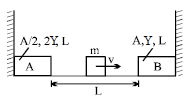
In the given figure, two elastic rods $A$ & $B$ are rigidly joined to end supports. $A$ small mass $‘m’$ is moving with velocity $v$ between the rods. All collisions are assumed to be elastic & the surface is given to be frictionless. The time period of small mass $‘m’$ will be : [$A=$ area of cross section, $Y =$ Young’s modulus, $L=$ length of each rod ; here, an elastic rod may be treated as a spring of spring constant $\frac{{YA}}{L}$ ]
The velocity $u$ and displacement $r$ of a body are related as $u^2 = kr$, where $k$ is a constant. What will be the velocity after $1\, second$ ? (Given that the displacement is zero at $t = 0$)
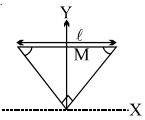
The figure shows an isosceles triangular plate of mass $M$ and base $L$. The angle at the apex is $90^o$. The apex lies at the origin and the base is parallel to $X$ -axis The moment of inertia of the plate about the $z$ -axis is
When an object is accelerated:
A circular disc $X$ of radius $R$ is made from an iron plate of thickness $t,$ and another plate $y$ of radius $4R$ is made from an iron plate of thickness $\frac {t}{4}$. The ratio of moment of inertia $\frac {I_y}{I_x}$ is
The Young's modulus of a wire of length $L$ and radius $r$ is $Y$. If the length is reduced to $\frac{L}{2}$ and radius is $\frac{r}{2}$ , then the Young's modulus will be
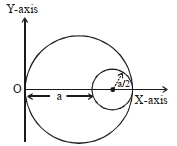
A circular hole of radius $\left(\frac{ a }{2}\right)$ is cut out of a circular disc of radius $'a'$ as shown in figure. The centroid of the remaining circular portion with respect to point $'O'$ will be :
For a heat engine the heat taken from the hot source is $Q_1$. So,
A body starts rolling down an inclined plane of length $L$ and height $h$. This body reaches the bottom of the plane in time $t$. The relation between $L$ and $t$ is 
A body of mass $m$ is taken to the bottom of a deep mine. Then