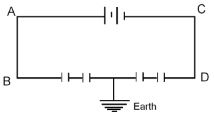
Which one statement is correct ? A parallel plate air condenser is connected with a battery. Its charge, potential, electric field and energy are ${Q_o},\;{V_o},\;{E_o}$ and ${U_o}$ respectively. In order to fill the complete space between the plates a dielectric slab is inserted, the battery is still connected. Now the corresponding values $Q,\;V,\;E$ and $U$ are in relation with the initially stated as
A$Q > {Q_o}$
B$U > {U_o}$
C$E > {E_o}$
DBoth $(a)$ and $(b)$
IIT 1985, Easy
Download our app for free and get started
DBoth $(a)$ and $(b)$
d (d) Capacitance will be increased when a dielectric is introduced in the capacitor but potential difference will remain the same because battery is still connected. So according to $q = CV$, charge will increase i.e. $Q > {Q_0}$ and $U = \frac{1}{2}Q{V_0},\,{U_0} = \frac{1}{2}{Q_0}{V_0}$ $==>$ $Q > {Q_0}$ so $U > {U_0}$
Download our app
and get started for free
Experience the future of education. Simply download our apps or reach out to us for more information. Let's shape the future of learning together!No signup needed.*
A simple pendulum of length $L$ is placed between the plates of a parallel plate capacitor having electric field $E,$ as shown in figure. Its bob has mass $m$ and charge $q.$ the time period of the pendulum is given by
There is a uniform electrostatic field in a region. The potential at various points on a small sphere centred at $P$, in the region, is found to vary between in the limits $589.0\,V$ to $589.8\, V$. What is the potential at a point on the sphere whose radius vector makes an angle of $60^o$ with the direction of the field ?........$V$
Six point charges are placed at the vertices of a regular hexagon of side $a$ as shown. If $E$ represents electric field and $V$ represents electric potential at $O$, then
An electric dipole is formed by two charges $+q$ and $-q$ located in xy-plane at $(0,2) \mathrm{mm}$ and $(0,-2) \mathrm{mm}$, respectively, as shown in the figure. The electric potential at point $\mathrm{P}(100,100) \mathrm{mm}$ due to the dipole is $V_0$. The charges $+q$ and $-q$ are then moved to the points $(-1,2) \mathrm{mm}$ and $(1,-2) \mathrm{mm}$, respectively. What is the value of electric potential at $P$ due to the new dipole?
A spherical conductor of radius $2m$ is charged to a potential of $120\, V$. It is now placed inside another hollow spherical conductor of radius $6m$. Calculate the potential to which the bigger sphere would be raised......$V$
A particle of charge $Q$ and mass $M$ moves in a circular path of radius $R$ in a uniform magnetic field of magnitude $B$. The same particle now moves with the same speed in a circular path of same radius $R$ in the space between the cylindrical electrodes of the cylindrical capacitor. The radius of the inner electrode is $R/2$ while that of the outer electrode is $ 3R/2.$ Then the potential difference between the capacitor electrodes must be