MCQ
Which pair do not have equal dimensions?
- ✓Force and impulse
- BAngular momentum and Planck constant
- CEnergy and torque
- DElastic modulus and pressure.
$\text { Torque }= kg \cdot m ^2 \cdot s ^2=\left[ ML ^2 T ^{-2}\right]$
$\text { For (B) : }\text { Force }= kg \times m / s ^2=\left[ MLT ^{-2}\right]$
$\text { Impulse }= kgm / s =\left[ MLT ^{-1}\right]$
$\text { For (C) : }\text { Angular momentum }= kgm ^2 / s =\left[ ML ^2 T ^{-1}\right]$
$\text { Planck's constant }= kgm ^2 / s =\left[ ML ^2 T ^{-1}\right]$
$\text { For (D) : }\text { Elastic modulus }= kg / m ^2=\left[ ML ^{-2}\right]$
$\text { Pressure }= kg / m ^2=\left[ ML ^{-2}\right]$
From the above data, only Force and Impulse does not have equal dimensions.
Generate a complete, print-ready paper with questions like this in minutes — across 16+ boards, with answer keys.
[Given: The acceleration due to gravity $g=10 \mathrm{~ms}^{-2}$ and $\pi=3.14$ ]
(image)
($1$) Considering the air flow to be streamline, the steady mass flow rate of air exiting the chimney is
. . . . .$\mathrm{gm} \mathrm{s}^{-1}$.
($2$) When the chimney is closed using a cap at the top, a pressure difference $\Delta P$ develops between the top and the bottom surfaces of the cap. If the changes in the temperature and density of the hot air, due to the stoppage of air flow, are negligible then the value of $\Delta P$ is. . . . .$\mathrm{Nm}^{-2}$.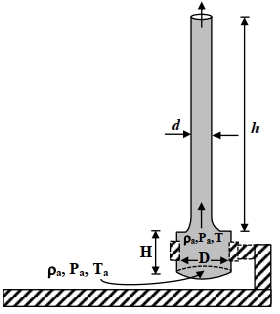
$(A)$ directly proportional to the length of the potentiometer wire
$(B)$ directly proportional to the potential gradient of the wire
$(C)$ inversely proportional to the potential gradient of the wire
$(D)$ inversely proportional to the length of the potentiometer wire
Choose the correct option for the above statements: