MCQ
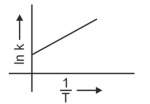
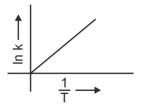
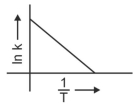
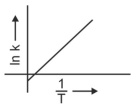
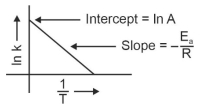
Which plot of $\ln \mathrm{k}$ vs $\frac{1}{\mathrm{~T}}$ is consistent with Arrhenius equation?
  • A

  • B


  • D

Answer

Correct option: C.

c
The Arrhenius equation is given as

$ k=A e^{-\frac{E_a}{R T}} $

$ \therefore \quad \ln k=\ln A-\frac{E_a}{R T}$

In $\mathrm{kv} / \mathrm{s} \frac{1}{\mathrm{~T}}$ gives a straight line graph with slope $=-\frac{E_a}{R}$ and intercept $=\ln \mathrm{A}$
Need a full question paper?

Generate a complete, print-ready paper with questions like this in minutes — across 16+ boards, with answer keys.
Start Generating Free

Similar questions

Assertion : Reimer-Tiemann reaction of phenol with $CCl_4$ in $NaOH$ at $340\, K$ gives salicylic acid as the major product.
Reason : The reaction occurs through intermediate formation of dichlorocarbene.
If order of a reaction is $x$ then unit of it's rate constant is
The acid which reduces Fehling solution is
Compound $(A)$ is
$150\,g$ of acetic acid was contaminated with $10.2\,g$ ascorbic acid $\left( C _{6} H _{8} O _{6}\right)$ to lower down its freezing point by $\left( x \times 10^{-1}\right)^{\circ} C$. The value of $x$ is (Nearest integer) [Given $K _{ f }=3.9\,K\,kg\,mol ^{-1}$;Molar mass of ascorbic acid $=176\,g\,mol ^{-1}$ ]
Consider the following complex ions  $ \mathrm{P}=\left[\mathrm{FeF}_6\right]^{3-} $  ,  $ \mathrm{Q}=\left[\mathrm{V}\left(\mathrm{H}_2 \mathrm{O}\right)_6\right]^{2+} $  ,  $ \mathrm{R}=\left[\mathrm{Fe}\left(\mathrm{H}_2 \mathrm{O}\right)_6\right]^{2+}$  The correct order of the complex ions, according to their spin only magnetic moment values (in $B.M.$) is :
$\begin{matrix}
   \begin{matrix}
   \,\,\,OH  \\
   |  \\
\end{matrix}  \\
   C{{H}_{3}}-C-CN  \\
   \,|  \\
   \,\,\,H  \\
\end{matrix}$ is
In winter, the normal temperature in Kullu valley was found to be $-11\,^oC$. Is a $28\%$ (by mass) aqueous solution of ethylene glycol suitable for a car radiator? $K_f$ for water $= 1.86\, K\, kg\, mol^{-1}$.
A primary amine can be converted to an alcohol by the action of
In which pair highest oxidation states of transition metals are found?