Question
Which radiation in sunlight, causes heating effect

Answer

(b)Infrared causes heating effect.

Need a full question paper?

Generate a complete, print-ready paper with questions like this in minutes — across 16+ boards, with answer keys.
Start Generating Free

Similar questions

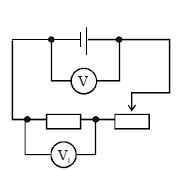
If the rheostat slider were to move from the extreme right to the far left, How will the reading of voltmeter $V_1$ change?
The potential at a point, due to a positive charge of $100\,\mu C$ at a distance of $9\,m$, is
A force $F$ is given by $F = at + b{t^2}$, where $t$ is time. What are the dimensions of $a$ and $b$
A $2100 W$ continuous flow geyser (instant geyser) has water inlet temperature $= 10^o C$ while the water flows out at the rate of $20\,\, g/sec$. The outlet temperature of water must be about ....... $^oC$ 
A firecracker is thrown with velocity of $30 \,ms ^{-1}$ in a direction which makes an angle of $75^{\circ}$ with the vertical axis. At some point on its trajectory, the firecracker splits into two identical pieces in such a way that one piece falls $27 \,m$ far from the shooting point. Assuming that all trajectories are contained in the same plane, how far will the other piece fall from the shooting point? (Take, $g=10 \,ms ^{-2}$ and neglect air resistance)
Dry ice is
In a Young's double slit experiment, the slits are $2 \,mm$ apart and are illuminated with a mixture of two wavelength ${\lambda _0} = 750\,nm$ and $\lambda = 900\,nm$. The minimum distance from the common central bright fringe on a screen $2\,m$ from the slits where a bright fringe from one interference pattern coincides with a bright fringe from the other is.....$mm$
When an ideal gas $(\gamma = 5/3$) is heated under constant pressure, then what percentage of given heat energy will be utilised in doing external work
In a zener diode, break down occurs in reverse bias due to
A brass rod of length $2\,m$ and cross-sectional area $2.0\,cm^2$ is attached end to end to a steel rod of length $L$ and cross-sectional area $1.0\,cm^2$ . The compound rod is subjected to equal and opposite pulls of magnitude $5 \times 10^4\,N$ at its ends. If the elongations of the two rods are equal, then length of the steel rod $(L)$ is ........... $m$ $(Y_{Brass}=1.0\times 10^{11}\,N/m^2$ and $Y_{Steel} = 2.0 \times 10^{11}\,N/m^2)$