Question
Which rules are followed in nuclear reactions?

Answer

The following rules are followed in nuclear reactions :
(i) Charge is conserved.
(ii) Linear and angular momentum are conserved.
(iii) The sum of mass and energy remains conserved.
(iv) Nucleon is conserved.

Need a full question paper?

Generate a complete, print-ready paper with questions like this in minutes — across 16+ boards, with answer keys.

Start Generating Free

Similar questions

A parallel beam of monochromatic light of wavelength $663\ nm$ is incident on a totally reflecting plane mirror. The angle of incidence is $60^\circ$ and the number of photons striking the mirror per second is $1.0 \times 10^{19}.$ Calculate the force exerted by the light beam on the mirror.
Kinetic energy of a neutron of mass 1.6 x $10^{-27}$ kg is 0.04 eV. Calculate de-Broglie wavelength of neutron.
Explain paramagnetism and paramagnetic substances.
Draw the energy band diagram of (i) n-type, and (ii) p-type semiconductors at temperature T > 0 K. In the case of n-type Si-semiconductor, the donor energy level is slightly below the bottom of conduction band whereas in p-type semiconductor, the acceptor energy level is slightly above the top of valence band. Explain, giving examples, what role do these energy levels play in conduction and valence bands.
Write and explain the law of conservation of electric charge.
Define the term ‘power loss’ in a conductor of resistance R carrying a current I. In what form does this power loss appear? Show that to minimise the power loss in the transmission cables connecting the power stations to homes; it is necessary to have the connecting wires carrying current at enormous high values of voltage.
Considering the case of a parallel plate capacitor being charged, show how one is required to generalize Ampere’s circuital law to include the term due to displacement current.
Write the history of magnet in brief.
Provide brief information about electro- magnetic spectrum.
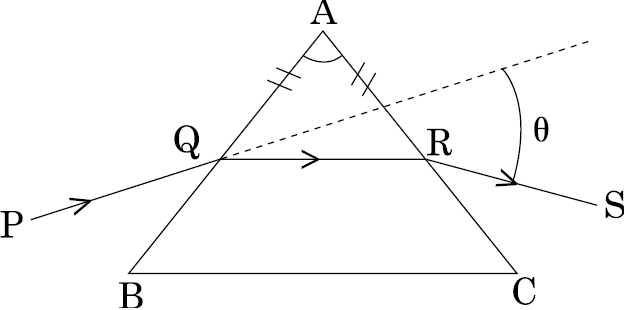
A ray $\text{PQ}$ incident on the refracting face $\text{BA}$ is refracted in the prism $\text{BAC}$ as shown in the figure and emerges from the other refracting face $\text{AC}$ as $\text{RS}$ such that $\text{AQ = AR}$. If the angle of prism $\text{A} = 60^\circ$ and refractive index of material of prism is$\sqrt{3}$, calculate angle $\theta.$