Question
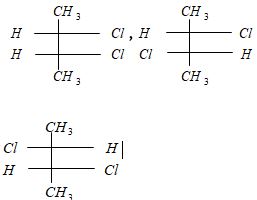
Which types of isomerism is shown by $2, 3-$ dichlorobutane
Generate a complete, print-ready paper with questions like this in minutes — across 16+ boards, with answer keys.
[Given : Molal boiling point elevation constant of water $\left(\mathrm{K}_{\mathrm{b}}\right)=0.52 \mathrm{K.} \mathrm{kg} \mathrm{mol}^{-1}$,
$1 \mathrm{~atm}$ pressure $=760 \mathrm{~mm}$ of $\mathrm{Hg}$, molar mass of water $\left.=18 \mathrm{~g} \mathrm{~mol}^{-1}\right\rfloor$
$\mathrm{MnO}_4^{-}+\mathrm{H}^{+}+\mathrm{H}_2 \mathrm{C}_2 \mathrm{O}_4 \rightleftharpoons \mathrm{Mn}^{2+}+\mathrm{H}_2 \mathrm{O}+\mathrm{CO}_2$
The standard reduction potentials are given as below $\left(\mathrm{E}_{\mathrm{red}}^{\circ}\right)$
$\mathrm{E}_{\mathrm{MmO}_4^{-} / \mathrm{Mm}^{2+}}^{\circ}=+1.51 \mathrm{~V}$
$\mathrm{E}_{\mathrm{CO}_2 / \mathrm{H}_2 \mathrm{C}_2 \mathrm{O}_4}^{\circ}=-0.49 \mathrm{~V}$
If the equilibrium constant of the above reaction is given as $K_{\text {eq }}=10^x$, then the value of $x=$____ (nearest integer)