Question
While doing an experiment with potentiometer (Fig.) it was found that the deflection is one sided and (i) the deflection decreased while moving from one end A of the wire to the end B; (ii) the deflection increased. while the jockey was moved towards the end B.
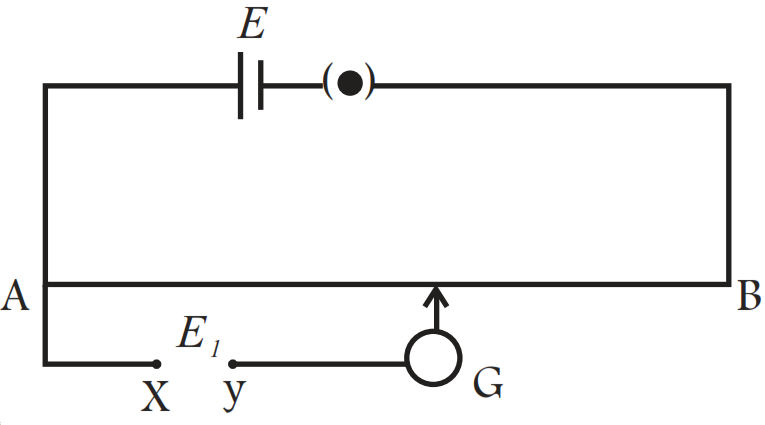
  1. Which terminal +or -ve of the cell E1, is connected at X in case (i) and how is E1 related to E?
  2. Which terminal of the cell E1 is connected at X in case (ii)?

Answer

  1. If the current in auxiliary circuit (lower circuit containing primary cell) decreases, and potential difference across A and jockey/increases. Then deflection in galvanometer is one sided and the deflection decreased, while moving from one end 'A' of the wire to the end 'S'. And clearly this is possible only when positive terminal of the cell E1 is connected at X and E1 > E.
  2. If the current in auxiliary circuit increases, and potential difference across A and jockey J increases. Then also deflection in galvanometer is one sided. And this is possible only when negative terminal of the cell E1 is connected at X.

Need a full question paper?

Generate a complete, print-ready paper with questions like this in minutes — across 16+ boards, with answer keys.

Start Generating Free

Similar questions

A bicycle is resting on its stand in the east-west direction and the rear wheel is rotated at an angular speed of 100 revolutions per minute. If the length of each spoke is 30.0cm and the horizontal component of the earth's magnetic field is 2.0 × 10⁻⁵ T, find the emf induced between the axis and the outer end of a spoke. Neglect centripetal force acting on the free electrons of the spoke.
A simple pendulum of length I is suspended through the ceiling of an elevator. Find the time period of small oscillations if the elevator,
  1. Is going up with an acceleration a0
  2. Is going down with an acceleration a0.
  3. Is moving with a uniform velocity.
Three equal masses m are placed at the three corners of an equilateral triangle of side a. Find the force exerted by this system on another particle of mass m placed at,
  1. The mid-point of a side,
  2. At the centre of the triangle.
Compare three magnetic substances on the basis of following properties :
(i) Behaviour in magnetic field
(ii) Main reason for magnet formation
(iii) Behaviour in non-uniform magnetic field
(iv) Behaviour on bringing magnetic pole near
(v) Magnitude of $\mu_r$
(vi) Number of field lines passing through substance in magnetic field
(vii) Direction of magnetisation.
A car moving at a speed of 36 km/hr is taking a turn on a circular road of radius 50m. A small wooden plate is kept on the seat with its plane perpendicular to the radius of the circular road (figure In). A small block of mass 100g is kept on the seat which rests against the plate. The friction coefficient between the block and the plate is $\mu=0.58.$
  1. Find the normal contact force exerted by the plate on the block.
  2. The plate is slowly turned so that the angle between the normal to the plate and the radius of the road slowly increases. Find the angle at which the block will just start sliding on the plate.

A concave mirror forms an image of 20cm high object on a screen placed 5.0m away from the mirror. The height of the image is 50cm. Find the focal length of the mirror and the distance between the mirror and the object.
State Biot-Savart law. Use it to derive an expression for the magnetic field at the centre of a circular loop of radius R carrying a steady current I. Sketch the magnetic field lines for such a current carrying loop.
When a p-n junction is reverse-biased, the current becomes almost constant at $25\mu\text{A}.$ When it is forwardbiased at 200mV, a current of $75\mu\text{A}$ is obtained. Find the magnitude of diffusion current when the diode is,
  1. Unbiased.
  2. Reverse-biased at 200mV.
  3. Forward-biased at 200mV.
What is Gauss theorem? With its help, obtain an expression for the electric field intensity at any point near a uniformly charged linear conductor of infinite length.###Make the necessary diagram and with the help of Gauss law, calculate the electric field intensity at any point due to a charged wire of infinite length. Plot the change in intensity with distance.###Define Gauss' law. With its help, find the value of electric field intensity at a distance from a uniformly charged linear conductor of infinite extension. Make the necessary diagram and also make a graph of the change of electric field with distance.
Is it possible that in a Coolidge tube characteristic $\text{L}_\alpha$ X-rays are emitted but not $\text{K}_\alpha$ X-rays?