Question
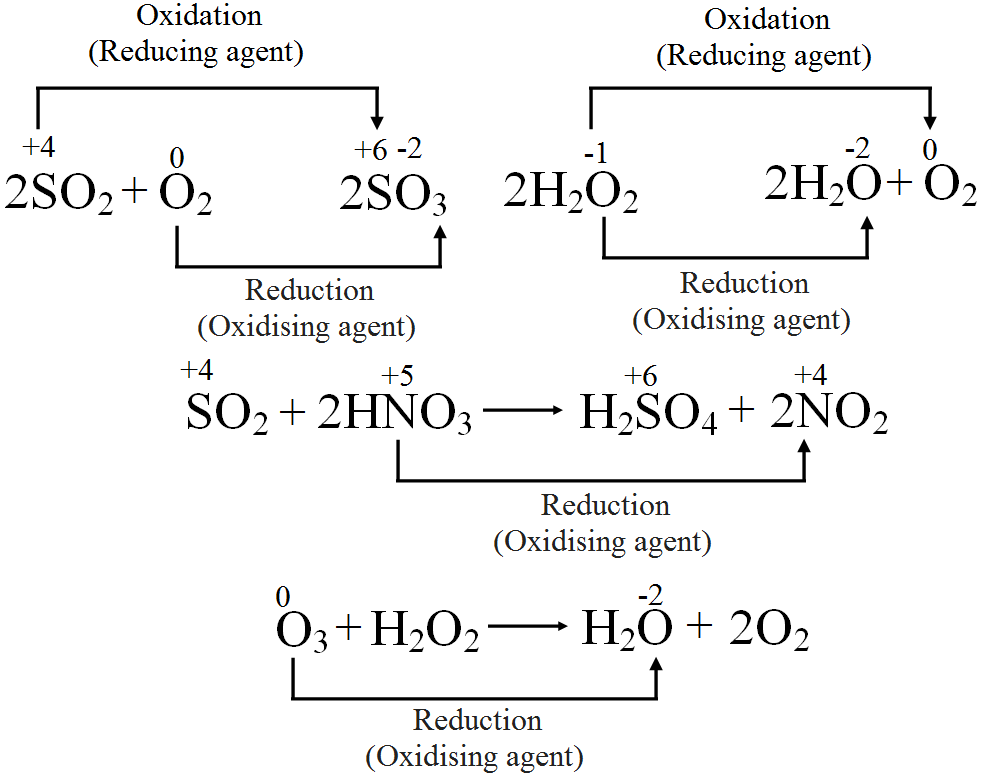
While sulphur dioxide and hydrogen peroxide can act as oxidising as well as reducing agents in their reactions, ozone and nitric acid act only as oxidants. Why?
Answer

The oxidation state of sulphur in sulphur dioxide is +4 . It can be oxidised to +6 oxidation state or reduced to +2 . Therefore, sulphur dioxide acts as a reducing agent as well as oxidising agent. Similarly, the oxidation state of oxygen in hydrogen peroxide is -1 . It can be oxidised to $\mathrm{O}_2$ (zero oxidation state) or reduced to $\mathrm{H}_2 \mathrm{O}$ or $\mathrm{OH}^{-}(-2$ oxidation state) and therefore, acts as reducing as well as oxidising agents.
However, both ozone and nitric acid can only decrease their oxidation number and therefore, act only as oxidising agents.

Need a full question paper?

Generate a complete, print-ready paper with questions like this in minutes — across 16+ boards, with answer keys.

Start Generating Free

Similar questions

Discuss the trend of the following:
The solubility and the nature of oxides, of Group 2 elements.
For the reaction: $\text{N}_2(\text{g})+3\text{H}_2(\text{g})\rightleftharpoons2\text{NH}_3(\text{g})$at 400K, $K_p = 41$. Find the value of $K_p$ for each of the following reactions at the same temperature.
  1. $\text{2NH}_3(\text{g})\rightleftharpoons\text{N}_2(\text{g})+3\text{H}_2(\text{g})$
  2. $\frac{1}{2}\text{Na}(\text{g})+\frac{3}{2}\text{H}_2(\text{g})\rightleftharpoons\text{NH}_3(\text{g})$
  3. $2\text{N}_2(\text{g})+6\text{H}_2(\text{g})\rightleftharpoons4\text{NH}_3(\text{g})$
  1. Calculate the kinetic energy of an electron in second Bohr orbit of hydrogen atom. [$a_0$ is Bohr radius].
  2. Out of the d-orbials which does not have four lobes?
  3. What is physical significance of $\Psi^2?$
  1. Two solids which have different solubilities in a solvent and which do not react when dissolved in it.
  2. Liquid that decompose at its boiling point.
  3. Steam volatile liquid and immiscible with water.
  4. Two liquids which have boiling points close to each other.
  5. Two liquids with large difference in their boiling points.
Which of the following are isoelectronic species i.e., those having the same number of electrons?
$\text{Na}^+,\text{K}^+,\text{Mg}^{2+},\text{Ca}^{2+},\text{S}^{2-},\text{Ar}.$
The ionization constant of acetic acid is $1.74 \times 10^{–5}$. Calculate the degree of dissociation of acetic acid in its $0.05M$ solution. Calculate the concentration of acetate ion in the solution and its pH.
Calculate the volume of water required to dissolve 0.1g lead (II) chloride to get a saturated solution.
($K_{sp}$ of $PbCl_2 = 3.2 \times 10^{–8}$ , atomic mass of $Pb = 207u$).
Explain briefly about the electrochemical series and give its main uses.
1. Describe the effect of
a. addition of $H _2$
b. addition of $CH _3 OH$
c. removal of CO
d. removal of $CH _3 OH$ on the equilibrium of the reaction,
$
2 H_2(g)+CO(g) \rightleftharpoons CH_3 OH(g)
$
2. What happens to an equilibrium in a reversible reaction if a catalyst is added to it?
 The solubility product of AgCl is $1.5 \times 10^{-10}$. Predict whether there will be any precipitation by mixing $50 mL$ of $0.01 M NaCl$ and $50 mL$ of $0.01 M AgNO _3$ solution.