Question 15 Marks
Whenever a reaction between an oxidising agent and a reducing agent is carried out, a compound of lower oxidation state is formed if the reducing agent is in excess and a compound of higher oxidation state is formed if the oxidising agent is in excess. Justify this statement giving three illustrations.
Answer
- C is a reducing agent while $\mathrm{O}_2$ is an oxidising agent. If excess of carbon is burnt in a limited supply of $\mathrm{O}_2, \mathrm{CO}$ is formed in which the oxidation state of C is +2 . If, however, excess of $\mathrm{O}_2$ is used, the initially formed CO gets oxidised to $\mathrm{CO}_2$ in which oxidation state of C is +4 .
$2\text{C(s)}+\text{O}_2(\text{g})\rightarrow\ \stackrel{{+2}}{\ \ 2 \text{CO(g)}};\ \ \text{C(s)}+\text{O}_2(\text{g})\rightarrow\ \stackrel{{+4}}{\ \ \text{CO}_{2}}(\text{g})\$\text{Excess})\ \ \ \ \ \ \ \ \ \ \ \ \ \ \ \ \ \ \ \ \ \ \ \ \ \ \ \ \ \ \ \ \ \ \ \ \ \ \ \ \ \ \ \ \ (\text{Excess})$
- $P_4$ is a reducing agent while $Cl_2$ is an oxidising agent. When excess of $P_4$ is used, $PCl_3$ is formed in which the oxidation state of P is +3. If, however, excess of $Cl_2$ is used, the initially formed $PCl_3$ reacts further to form $PCl_5$ in which the oxidation state of P is +5.
$\text{P}_4(\text{s})+6\text{Cl}_2(\text{g})\rightarrow\stackrel{{+3}}{4 \text{PCl}_3};\ \ \ \text{P}_4(\text{s})+10\text{Cl}_2\rightarrow\ \stackrel{{+5}}{4 \text{PCl}_5}\\ (\text{Excess})\ \ \ \ \ \ \ \ \ \ \ \ \ \ \ \ \ \ \ \ \ \ \ \ \ \ \ \ \ \ \ \ \ \ \ \ \ \ \ \ \ \ \ \ \ (\text{Excess})$
- Na is a reducing agent while $O_2$ is an oxidising agent. When excess of Na is used, sodium oxide is formed in which the oxidation state of O is -2. If, however, excess of $O_2$ is used, $Na_2O_2$ is formed in which the oxidation state of O is -1 which is higher than -2.
$4\text{Na(s)}+\text{O}_2(\text{g})\rightarrow\stackrel{{-2}}{ \text{Na}_2\text{O(s)}};\ \ 2\text{Na} (\text{s}) +2\text{O}_2(\text{g})\rightarrow\ \stackrel{{-1}}{ \text{Na}_2\text{O}_2(\text{s})}\\ (\text{Excess})\ \ \ \ \ \ \ \ \ \ \ \ \ \ \ \ \ \ \ \ \ \ \ \ \ \ \ \ \ \ \ \ \ \ \ \ \ \ \ \ \ \ \ \ \ \ \ \ \ \ \ (\text{Excess})$ View full question & answer→Question 25 Marks
Balance the following equations in basic medium by ion-electron method and oxidation number methods and identify the oxidising agent and the reducing agent.$\text{P}_4(\text{s})+\text{OH}^{-}(\text{aq})\rightarrow\text{PH}_3(\text{g})+\text{HPO}_2^-(\text{aq})$
Answer
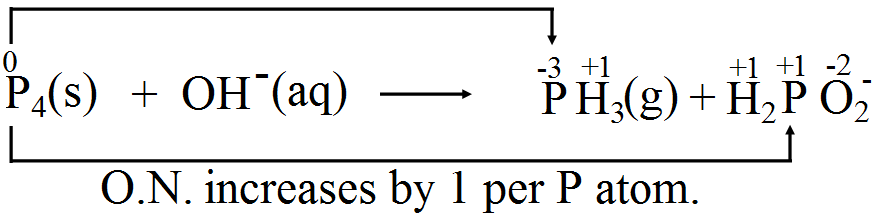
$P_4$ acts both as an oxidising as well as a reducing agent.
Oxidation number method:
Total decrease in O.N. of $P_4$ in $PH_3 = 3 \times 4 = 12$
Total increase in O.N. of $P_4$ in $\text{H}_2\text{PO}_2^{-}$ = 1 × 4 = 4
Therefore, to balance increases decreases in O.N. multiply $PH_3$ by 1 and $\text{H}_2\text{PO}_2^{-}$ by 3, we have,
$\text{P}_4(\text{s})+\text{OH}^{-}(\text{aq})\rightarrow\text{PH}_3(\text{g})+3\text{H}_2\text{PO}_2^{-}(\text{aq})$
To balance O atoms, multiply $OH^-$ by 6, we have,
$\text{P}_4(\text{s})+6\text{OH}^{-}(\text{aq})\rightarrow\text{PH}_3(\text{g})+3\text{H}_2\text{PO}_2^{-}(\text{aq})$
To balance H atoms, add $3H_2O$ to L.H.S. and $3OH^-$ to the R.H.S., we have,
$\text{P}_4(\text{s})+6\text{OH}^{-}(\text{aq})+3\text{H}_2\text{O(l)}\rightarrow\\\text{PH}_3(\text{g})+3\text{H}_2\text{PO}_2^{-}(\text{aq})+3\text{OH}^-(\text{aq})$
or $\text{P}_4(\text{s})+3\text{OH}^{-}(\text{aq})+3\text{H}_2\text{O(l)}\rightarrow\\\text{PH}_3(\text{g})+3\text{H}_2\text{PO}_2^{-}(\text{aq})\ ....(\text{i})$
Thus, eq (i) represents the correct balanced equation.
Ion electron method. The two half reactions are:
Oxidation half reaction:
$\text{P}_4(\text{s})\rightarrow\text{H}_2\text{PO}^-_2(\text{aq})\ .....(\text{ii})$
Balancing P atoms, we have,
$\ \ \ \ \stackrel{{0}}{\ \ \ \ \ \ \ \hbox{P}_4(\text{s})}\rightarrow\stackrel{{+1}}{\ \ \ \ \ \ \ 4\hbox{H}_2\text{PO}^-_2(\text{aq})}$
Balance O.N. by adding electrons,
$\text{P}_4(\text{s})\rightarrow4\text{H}_2\text{PO}^-_2(\text{aq})+4\text{e}^-$
Balance charge by adding 8 $OH^-$ ions,
$\text{P}_4(\text{s})+8\text{OH}^-(\text{aq})\rightarrow4\text{H}_2\text{PO}^-_2(\text{aq})+4\text{e}^-\ .....(\text{iii})$
O and H get automatically balanced. Thus, eq. (iii) represents the balanced oxidation half reaction.
Reduction half reaction:
$\ \ \ \ \stackrel{{0}}{\ \ \ \ \ \ \ \hbox{P}_4(\text{s})}\rightarrow\stackrel{{-3}}{\ \ \ \ \ \ \ \hbox{PH}_3(\text{g})}\ .....(\text{iv})$
Balancing P atoms, we have,
$\text{P}_4(\text{s})\rightarrow4\text{PH}_3(\text{g})$
Balance O.N. by adding electrons,
$\text{P}_4(\text{s})+12\text{e}^-\rightarrow4\text{PH}_3(\text{g})$
Balance charge by adding $12OH^-$ ions,
$\text{P}_4(\text{s})+12\text{e}^-\rightarrow4\text{PH}_3(\text{g})+12\text{OH}^-(\text{aq})$
Balance O atoms, by adding $12H_2O$ to L.H.S. of above equation.
$\text{P}_4(\text{s})+12\text{H}_2\text{O(l)}+12\text{e}^{-}\rightarrow4\text{PH}_3(\text{g})+12\text{OH}^{-}(\text{aq})\ .....(\text{v})$
To cancel out electrons, multiply eq. (iii) by 3 and add it to eq. (v), we have,
$4\text{P}_4(\text{s})+24\text{OH}^{-}(\text{aq})+12\text{H}_2\text{O(l)}\rightarrow\\4\text{PH}_3(\text{aq})+12\text{H}_2\text{PO}_2^-(\text{aq})+12\text{H}_2\text{O(l)}+12\text{OH}^{-}(\text{aq})\ ......(\text{vi})$
Or $\text{P}_4(\text{g})+3\text{OH}^{-}(\text{aq})+3\text{H}_2\text{O(l)}\rightarrow\text{PH}_3(\text{aq})+3\text{H}_2\text{PO}_2^-(\text{aq})$
Thus, eq. (vi) represents the correct balanced equation. View full question & answer→Question 35 Marks
Balance the following equations in basic medium by ion-electron method and oxidation number methods and identify the oxidising agent and the reducing agent. $Cl_2O_7(g) + H_2O_2(aq) \rightarrow ClO_2^-(aq) + O_2(g) + H^+$
Answer
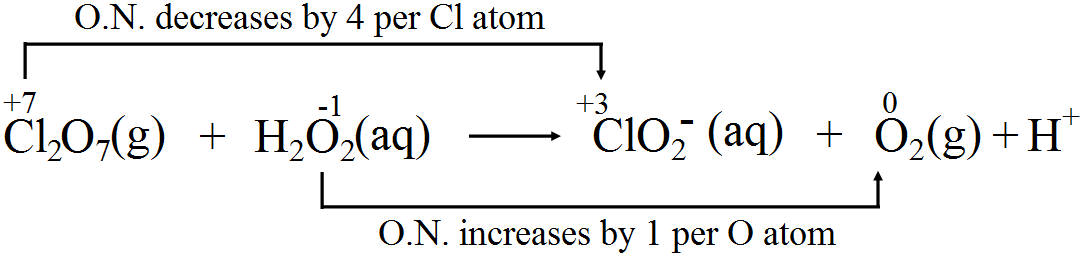
Thus, $Cl_2O_7$(g) acts an oxidising agent while $H_2O_2$(aq) as the reducing agent.
Oxidation number method:
Total decrease in O.N. of $Cl_2O_7 = 4 \times 2 = 8$
Total increase in O.N. of $H_2O_2 = 2 \times 1 = 2$
$\therefore$ To balance increase/ decrease in O.N. multiply $H_2O_2$ and $O_2$ by 4, we have,
$\text{Cl}_2\text{O}_7(\text{g})+4\text{H}_2\text{O}_2(\text{aq})\rightarrow\text{ClO}_2^-(\text{aq})+4\text{O}_2(\text{g})$
To balance Cl atoms, multiply $ClO_2^-$ by 2, we have,
$\text{Cl}_2\text{O}_7(\text{g})+4\text{H}_2\text{O}_2(\text{aq})\rightarrow2\text{ClO}_2^-(\text{aq})+4\text{O}_2(\text{g})$
To balance O atoms, add $3H_2O$ R.H.S., we have,
$\text{Cl}_2\text{O}_7(\text{g})+4\text{H}_2\text{O}_2(\text{aq})\rightarrow2\text{ClO}_2^-(\text{aq})+4\text{O}_2(\text{g})+3\text{H}_2\text{O(l)}$
To balance H atoms, add $2H_2O$ to R.H.S. and $2OH^-$ to L.H.S., we have,
$\text{Cl}_2\text{O}_7(\text{g})+4\text{H}_2\text{O}_2(\text{aq})+2\text{OH}^-(\text{aq})\rightarrow\\2\text{ClO}_2^-(\text{aq})+4\text{O}_2(\text{g})+5\text{H}_2\text{O(l)}$
This represents the balanced redox equation.
Ion electron method
Oxidation half reaction:
$\stackrel{\ \ \ \ \ \ \ \ {-1}}{\ \ \ \ \ \ \ \ \ \ \ \hbox{H}_2\text{O}_2(\text{aq})}\rightarrow\stackrel{{0}}{\ \ \ \ \ \ \ \ \hbox{O}_2{(\text{g})}}$
Balance O.N. by adding electrons,
$\text{H}_2\text{O}_2(\text{aq})\rightarrow\text{O}_2(\text{g})+2\text{e}^{-}$
Balance charge by adding $2OH^-$ ions,
$\text{H}_2\text{O}_2(\text{aq})+2\text{OH}^-(\text{aq})\rightarrow\text{O}_2(\text{g})+2\text{e}^{-}$
Balance O atoms by adding $2H_2O$,
$\text{H}_2\text{O}_2(\text{aq})+2\text{OH}^-(\text{aq})\rightarrow\text{O}_2(\text{g})+2\text{H}_2\text{O(l)}+2\text{e}^{-}$
Reduction half reaction:
$\stackrel{{+7}}{\ \ \ \ \ \ \ \ \ \ \ \hbox{Cl}_2\text{O}_7(\text{g})}\rightarrow\stackrel{{+3}}{\ \ \ \ \ \ \ \ \ \ \ \ \ \ \ \text{Cl}\hbox{O}_2^-{(\text{aq})}}$
Balance Cl atoms; $\text{Cl}_2\text{O}_7(\text{g})\rightarrow2\text{ClO}_2^-(\text{aq})$
Balance O.N. by adding electrons,
$\text{Cl}_2\text{O}_7(\text{g})+8\text{e}^{-}\rightarrow2\text{ClO}_2^-(\text{aq})$
Add $6OH^-$ ions to balance charge:
$\text{Cl}_2\text{O}_7(\text{g})+8\text{e}^{-}\rightarrow2\text{ClO}_2^-(\text{aq})+6\text{OH}^-$
Balance O atoms by adding $3H_2O$ to L.H.S., we have,
$\text{Cl}_2\text{O}_7(\text{g})+3\text{H}_2\text{O(l)}+8\text{e}^{-}\rightarrow2\text{ClO}_2^-(\text{aq})+6\text{OH}^-(\text{aq})\ .....(\text{ii})$
To cancel out electrons, multiply eq. (i) by 4 and add it to eq. (ii), we have,
$4\text{H}_2\text{O}_2(\text{aq})+8\text{OH}^{-}(\text{aq})+\text{Cl}_2\text{O}_7(\text{g})+3\text{H}_2\text{O(l)}\rightarrow\\2\text{ClO}_2^-(\text{aq})+6\text{OH}^{-}(\text{aq})+4\text{O}_2(\text{g})+8\text{H}_2\text{O(l)}$
Or $\text{Cl}_2\text{O}_7(\text{g})+4\text{H}_2\text{O}_2(\text{aq})+2\text{OH}^{-}(\text{aq})\rightarrow\\2\text{ClO}_2^-(\text{aq})+4\text{O}_2(\text{g})+5\text{H}_2\text{O(l)}$ View full question & answer→Question 45 Marks
Balance the following equations in basic medium by ion-electron method and oxidation number methods and identify the oxidising agent and the reducing agent.$N_2H_4(l) + ClO_3^-(aq) \rightarrow NO(g) + Cl^-(g)$
AnswerOxidation number method:Total increase in O.N. of N = 2 × 4 = 8
Total decreases in O.N. of Cl = 1 × 6 = 6
Therefore, to balance increase/ decrease in O.N. multiply $N_2H_4$ by 3 and $ClO_3^-$
by 4, we have,
$3\text{N}_2\text{H}_4(\text{l})+4\text{ClO}_3^-(\text{aq})\rightarrow\text{NO(g)}+\text{Cl}^-(\text{aq})$
To balance N and Cl atoms, multiply NO by 6 and $Cl^-$ by 4, we have,
$3\text{N}_2\text{H}_4(\text{l})+4\text{ClO}_3^-(\text{aq})\rightarrow6\text{NO(g)}+4\text{Cl}^-(\text{aq})$
Balance O atoms by adding $6H_2O$,
$3\text{N}_2\text{H}_4(\text{l})+4\text{ClO}_3^-(\text{aq})\rightarrow6\text{NO(g)}+4\text{Cl}^-(\text{aq})+6\text{H}_2\text{O}(\text{l})\ ....(\text{i})$
H atoms get automatically balanced and thus eq. (i) represents the correct balanced equation.
Ion electron method:
Oxidation half reaction: $\stackrel{{-2}}{\ \ \ \ \ \ \ \ \ \ \ \hbox{N}_2\text{H}_4(\text{l})}\rightarrow\stackrel{{+2}}{\ \ \ \ \ \ \hbox{NO(g)}}$
Balance N atoms, $\text{N}_2\text{H}_4(\text{l})\rightarrow2\text{NO(g)}$
Balance O.N. by adding electrons,
$\text{N}_2\text{H}_4(\text{l})\rightarrow2\text{NO(g)}+8\text{e}^-$
Balance charge by adding $8OH^-$ ions,
$\text{N}_2\text{H}_4(\text{l})+8\text{OH}^{-}(\text{aq})\rightarrow2\text{NO(g)}+8\text{e}^-$
Balance O atoms by adding $6H_2O$,
$\text{N}_2\text{H}_4(\text{l})+8\text{OH}^{-}(\text{aq})\rightarrow2\text{NO(g)}+6\text{H}_2\text{O(l)}+8\text{e}^-\ ....(\text{ii})$
Thus, eq. (ii) represents the correct balanced oxidation half equation.
Reduction half reaction
$\stackrel{{+5}}{\ \ \ \ \ \ \ \ \ \ \ \hbox{ClO}^-_3(\text{aq})}\rightarrow\stackrel{{-1}}{\ \ \ \ \ \ \ \ \hbox{Cl}^{-}{(\text{aq})}}$
Balance O.N. by adding electrons,
$\text{ClO}_3^-(\text{aq})+6\text{e}^-\rightarrow\text{Cl}^-(\text{aq})$
Balance charge by adding $OH^-$ ions,
$\text{ClO}_3^-(\text{aq})+6\text{e}^-\rightarrow\text{Cl}^-(\text{aq})+6\text{OH}^-(\text{aq})$
Balance O atoms by adding $3H_2O$,
$\text{ClO}_3^-(\text{aq})+3\text{H}_2\text{O(l)}+6\text{e}^-\rightarrow\text{Cl}^-(\text{aq})+6\text{OH}^-(\text{aq})\ .....(\text{iii})$
Thus, eq. (iii) represents the correct balanced reduction half equation.
To cancel out electrons gained and lost, multiply eq. (ii) by 3 and eq. (iii) by 4 and add, we have,
$3\text{N}_2\text{H}_4(\text{l})+4\text{ClO}_3^-(\text{aq})\rightarrow6\text{NO(g)}+4\text{Cl}^{-}(\text{aq})+6\text{H}_2\text{O(l)}\ .....(\text{iv})$
Thus, eq. (iv) represents the correct balanced equation.
View full question & answer→Question 55 Marks
The $Mn^{3+}$ ion is unstable in solution and undergoes disproportionation to give $Mn^{2+}, MnO_2,$ and $H^+$ ion. Write a balanced ionic equation for the reaction.
AnswerThe given reaction can be represented as: $\text{Mn}_{(\text{aq})}^{3+}\rightarrow\text{Mn}_{(\text{aq})}^{2+}+\text{MnO}_{2(\text{s})}+\text{H}_{(\text{aq})}^+$ The oxidation half equation is: $\stackrel{{+3}}{\ \ \ \ \ \ \ \hbox{Mn}^{3+}}_{(\text{aq})}\rightarrow\stackrel{{+4}}{\ \ \ \ \ \ \ \hbox{MnO}}_{2(\text{s})}$ The oxidation number is balanced by adding one electron as: $\text{Mn}_{(\text{aq})}^{3+}\rightarrow\text{MnO}_{2(\text{s})}+\text{e}^{-}$ The charge is balanced by adding $4H^+$^ ions as: $\text{Mn}_{(\text{aq})}^{3+}\rightarrow\text{MnO}_{2(\text{s})}+4\text{H}_{(\text{aq})}^++\text{e}^{-}$ The O atoms and H^+ ions are balanced by adding $2H_2O$ molecules as: $\text{Mn}_{(\text{aq})}^{3+}+2\text{H}_2\text{O}_{(\text{l})}\rightarrow\text{MnO}_{2(\text{s})}+4\text{H}_{(\text{aq})}^++\text{e}^{-}\ .....(\text{i})$ The reduction half equation is: $\text{Mn}^{3+}_{(\text{aq})}\rightarrow\text{Mn}^{2+}_{(\text{aq})}$ The oxidation number is balanced by adding one electron as: $\text{Mn}^{3+}_{(\text{aq})}+\text{e}^-\rightarrow\text{Mn}^{2+}_{(\text{aq})}\ .....(\text{ii})$The balanced chemical equation can be obtained by adding equation (i) and (ii) as:
$2\text{Mn}_{(\text{aq})}^{3+}+2\text{H}_2\text{O}_{(\text{l})}\rightarrow\text{MnO}_{2(\text{s})}+2\text{Mn}^{2+}_{(\text{aq})}+4\text{H}^{+}_{(\text{aq})}$
View full question & answer→Question 65 Marks
Identify the substance oxidised reduced, oxidising agent and reducing agent for each of the following reactions:
- $2AgBr(s) + C_6H_6O_2(aq) \rightarrow 2Ag(s) + 2HBr(aq) + C_6H_4O_2(aq)$
- $HCHO(l) + 2[Ag(NH_3)_2]^+(aq) + 3OH^-(aq) \rightarrow 2Ag(s) + HCOO^-(aq) + 4NH_3(aq) + 2H_2O(l)$
- $HCHO(l) + 2Cu^{2+}(aq) + 5OH^-(aq) \rightarrow Cu_2O(s) + HCOO^-(aq) + 3H_2O(l)$
- $N_2H_4(l) + 2H_2O_2(l) \rightarrow N_2(g) + 4H_2O(l)$
- $Pb(s) + PbO_2(s) + 2H_2SO_4(aq) \rightarrow 2PbSO_4(s) + 2H_2O(l)$
Answer
| S.No. |
Substance oxidised
|
Substance reduced
|
Oxidising agent
|
Reducing agent
|
| (a) |
$C_6H_6O_2(aq)$
|
$AgBr(s)$
|
$AgBr(s)$
|
$C_6H_6O_2(aq)$
|
| (b) |
$HCHO(aq)$
|
$[Ag(NH_3)_2]^+$
|
$[Ag(NH_3)_2]^+$
|
$HCHO(aq)$
|
| (c) |
$HCHO(aq)$
|
$Cu^{2+}(aq)$
|
$Cu^{2+}(aq)$
|
$HCHO(aq)$
|
| (d) |
$N_2H_4(l)$
|
$H_2O_2(l)$
|
$H_2O_2(l)$
|
$N_2H_4(l)$
|
| (e) |
$Pb(s)$
|
$PbO_2(s)$
|
$PbO_2(s)$
|
$Pb(s)$
|
View full question & answer→Question 75 Marks
Calculate the oxidation number of sulphur, chromium and nitrogen in $H_2SO_5$, $\text{Cr}_2\text{O}^{2-}_7$ and $\text{NO}^{-}_3.$ Suggest structure of these compounds. Count for the fallacy.
AnswerOxidation number of sulphur in $H_2SO_5$:Let the oxidation number of S = x
Then, $(+1) \times 2 + x + (-2) \times 5 = 0 or 2 + x - 10 = 0$
$\Rightarrow x - 8 = 0$
$\therefore$ x = +8
The maximum O.N. of S cannot be more than 6 since it has only 6 electrons in the valence shell. This fallacy is overcome if we calculate the O.N. of sulphur by chemical bonding method. The structure of $H_2SO_5$ is:
$\ \ \ \ \ \ \ \ \ \ \ \ \ \ \ \ \text{O}\\\ \ \ \ \ \ \ \ \ \ \ \ \ \ \ \ ||\\\text{H}-\text{O}-\text{S}-\text{O}-\text{O}-\text{H}\\\ \ \ \ \ \ \ \ \ \ \ \ \ \ \ \ ||\\\ \ \ \ \ \ \ \ \ \ \ \ \ \ \ \text{O}$
It has two peroxide oxygen with O.N. = -1
and three oxygens with O.N. = -2
Thus, $2 \times (+1) + x + 2(-1) + 3 \times (-2) = 0$
$+2 + x - 2 - 6 = 0$
$\Rightarrow x - 6 = 0$
$ \Rightarrow x = +6$
Thus, O.N. of sulphur in $H_2SO_5 = +6$
Oxidation number of chromium in $\text{Cr}_2\text{O}^{2-}_7:$
Let the oxidation number of chromium = x
$\therefore$ $2x + 7(-2) = -2$
$\Rightarrow 2x - 14 = -2$
$\Rightarrow 2x = -2 + 14$
$\Rightarrow 2x = +12$
$\Rightarrow x = +6$
Thus, the oxidation number of chromium = +6
Oxidation number of nitrogen in $\text{NO}^{-}_3:$
Let the oxidation number of nitrogen = x
Then, $x + (-2) \times 3 = -1$
$\Rightarrow x - 6 = -1$
$\Rightarrow x = -1 + 6$
$\Rightarrow x = +5$
Thus, the oxidation number of nitrogen = +5
View full question & answer→Question 85 Marks
Suggest a list of the substances where carbon can exhibit oxidation states from $-4$ to $+4$ and nitrogen from $-3$ to $+5$.
Answer
|
Compound
|
O.N. of Carbon
|
| $CH_4$ |
-4 |
| $CH_3CH_3$ |
-3 |
| $CH_2 = CH_2$ or $CH_3Cl$ |
-2 |
| $\text{CH}\equiv\text{CH}$ |
-1 |
| $CH_2Cl_2$ or $C_6H_{12}O_6$ |
0 |
| $C_2Cl_2$ or $C_6Cl_6$ |
+1 |
| $CO$ or $CHCl_3$ |
+2 |
| $C_2Cl_6$ or $(COOH)_2$ |
+3 |
| $CO_2$ or $CCl_4$ |
+4 |
View full question & answer→Question 95 Marks
While sulphur dioxide and hydrogen peroxide can act as oxidising as well as reducing agents in their reactions, ozone and nitric acid act only as oxidants. Why?
AnswerThe oxidation state of sulphur in sulphur dioxide is +4 . It can be oxidised to +6 oxidation state or reduced to +2 . Therefore, sulphur dioxide acts as a reducing agent as well as oxidising agent. Similarly, the oxidation state of oxygen in hydrogen peroxide is -1 . It can be oxidised to $\mathrm{O}_2$ (zero oxidation state) or reduced to $\mathrm{H}_2 \mathrm{O}$ or $\mathrm{OH}^{-}(-2$ oxidation state) and therefore, acts as reducing as well as oxidising agents.
However, both ozone and nitric acid can only decrease their oxidation number and therefore, act only as oxidising agents.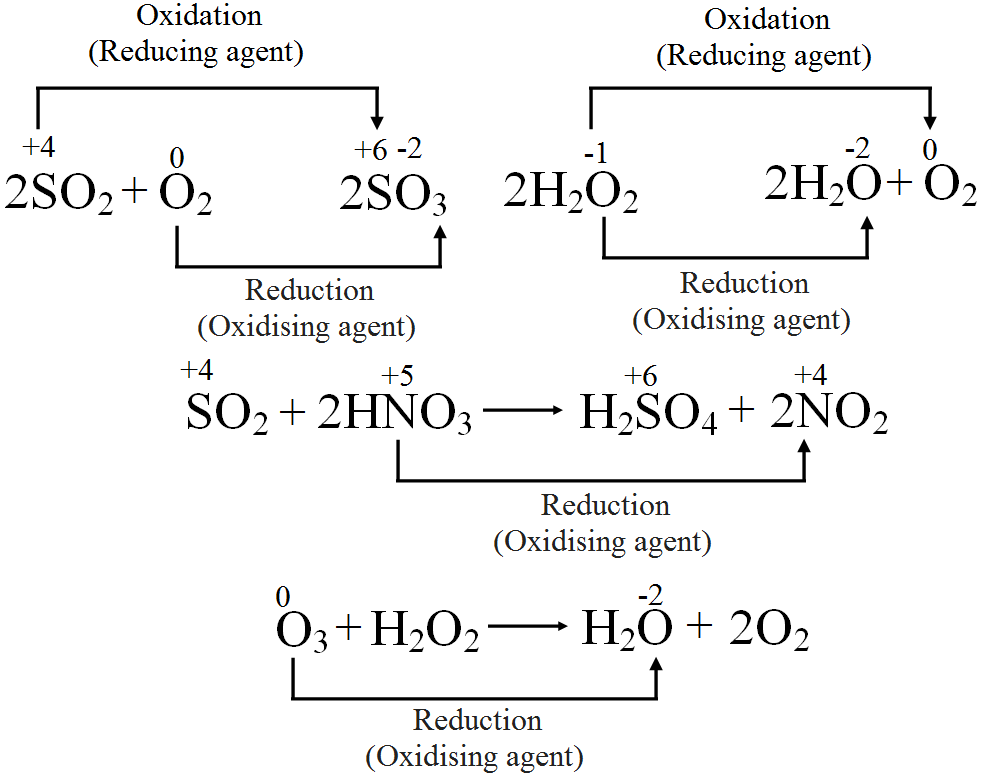
View full question & answer→Question 105 Marks
What sorts of informations can you draw from the following reaction?
$(CN)_2(g) + 2OH^-(aq) \rightarrow CN^-(aq) + CNO^-(aq) + H_2O(l)$
AnswerThe oxidation numbers of carbon in $(CN)^2, CN^-$ and $CNO^-$ are +3, +2 and +4 respectively. These are obtained as shown below: Let the oxidation number of C be x. $(CN)_2 2(x – 3) = 0$
$\therefore x = 3CN^-$
$x – 3 = -1 $
$\therefore x = 2CNO^-$
$x - 3 - 2 = -1$
$\therefore$ x = 4
The oxidation number of carbon in the various species is: $\Big(\stackrel{{+3}}{\ \ \ \ \ \hbox{CN}}\Big)_{2(\text{g})}+2\text{OH}^-_{(\text{aq})}\rightarrow\stackrel{{+2}}{\ \ \ \hbox{CN}^-_{\text{(aq)}}}+\stackrel{{+4}}{\ \ \ \ \ \ \ \ \ \ \ \ \ \hbox{CNO}^-_{\text{(aq)}}}+\text{H}_2\text{O}_{\text{(i)}}$ It can be easily observed that the same compound is being reduced and oxidised simultaneously in the given equation. A reaction in which the same compound is reduced and oxidised is known as disproportionation reactions. Thus, it can be said that the alkaline decomposition of cyanogen is an example of disproportionation reaction.
View full question & answer→Question 115 Marks
Justify giving reactions that among halogens, fluorine is the best oxidant and among hydrohalic compounds, hydroiodic acid is the best reductant.
AnswerThe halogens $(X_2)$ have strong electron accepting tendency and have positive standard oxidation potential values. They are therefore, powerful oxidising agents. The decreasing order of oxidising powers of halogens is:$\ \ \ \ \text{X}_2:\text{F}_2\ \ \ \ \ >\ \ \ \ \ \ \text{Cl}_2\ \ \ \ \ \ >\ \ \ \ \ \text{Br}_2\ \ \ \ \ >\ \ \ \ \text{I}_2\\\text{E}^\circ:+2.87\text{V}\ \ \ \ \ +1.36\text{V}\ \ \ \ \ \ \ \ +1.09\text{V}\ \ \ \ \ +0.54\text{V}$
Fluorine is the strongest oxidising agent (oxidant) because it can liberate the other halogens from their respective compounds. For example,
$2KCl + F_2 \rightarrow 2KF + Cl_2 2KBr + F_2 \rightarrow 2KF + Br_2 2KI + F_2 \rightarrow 2KF + I_2$ Among halogen acids (HX), the HI is the strongest reducing agent or reductant because it has minimum bond dissociation energy.
|
Halogen acid:
|
HF
|
HCl
|
HBr
|
HI
|
|
Bond dissociation:
|
566
|
431
|
366
|
299
|
|
enthalpy (kl mol)
|
|
|
|
|
The iodination of methane is of reversible nature because HI produced in the reaction being a reducing agent converts iodomethane back to methane.
$ \ \ \ \ \ \ \ \ \ \ \ \ \ \ \ \ \ \ \ \ \ \ \ \ \text{CH}_4+\text{I}_2\rightarrow\text{CH}_3\text{I}+\text{HI}\\\ \ \ \ \ \ \ \ \ \ \ \ \ \ \ \ \ \ \ \ \ \ \ \ \text{CH}_3\text{I}+\text{HI}\rightarrow\text{CH}_4+\text{I}_2\\\ \ \ \ \ \ \ \ \ \ \ \ \ \ \ \ \ \ \ \ \ \ \ \ \overline{\ \ \ \ \ \ \ \ \ \ \ \ \ \ \ \ \ \ \ \ \ \ \ \ \ \ \ \ \ \ \ \ \ \ \ \ \ \ \ \ \ \ \ }\\\text{Net reaction: } \ \text{CH}_4+\text{I}_2\rightleftharpoons\text{CH}_3\text{I}+\text{HI}$ View full question & answer→Question 125 Marks
Balance the following redox reactions by ion-electron method:
$MnO_4^-(aq) + I^-(aq) \rightarrow MnO_2(s) + I_2(s)$ (in basic medium).
AnswerStep 1: The two half reactions involved in the given reaction are: Oxidation half reaction: $\stackrel{{-1}}{\ \ \ \ \ \ \ \hbox{I}_{(\text{aq})}}\rightarrow\stackrel{{0}}{\ \ \ \ \ \hbox{I}_{2(\text{s})}}$ Reduction half reaction: $\stackrel{{+7}}{\ \ \ \ \ \ \ \ \ \ \ \ \hbox{MnO}^{-}_{4(\text{aq})}}\rightarrow\stackrel{{+4}}{\ \ \ \ \ \ \ \ \ \ \ \hbox{MnO}_{2(\text{aq})}}$
Step 2: Balancing I in the oxidation half reaction, we have: ${ 2\hbox{I}^{-}_{(\text{aq})}}\rightarrow\stackrel{}{\ \ \ \ \ \hbox{I}_{2(\text{s})}}$Now, to balance the charge, we add $2e^-$ to the RHS of the reaction.
${ 2\hbox{I}^{-}_{(\text{aq})}}\rightarrow\stackrel{}{\ \ \ \ \ \hbox{I}_{2(\text{s})}}+2\text{e}^{-}$
Step 3: In the reduction half reaction, the oxidation state of Mn has reduced from +7 to +4. Thus, 3 electrons are added to the LHS of the reaction. $\text{MnO}^{-}_{4(\text{aq})}+3\text{e}^{-}\rightarrow\text{MnO}_{2(\text{aq})}$ Now, to balance the charge, we add 4 OH^– ions to the RHS of the reaction as the reaction is taking place in a basic medium. $\text{MnO}^{-}_{4(\text{aq})}+3\text{e}^{-}\rightarrow\text{MnO}_{2(\text{aq})}+4\text{OH}^{-}$
Step 4: In this equation, there are 6 O atoms on the RHS and 4 O atoms on the LHS. Therefore, two water molecules are added to the LHS. $\text{MnO}^{-}_{4(\text{aq})}+2\text{H}_2\text{O}+3\text{e}^{-}\rightarrow\text{MnO}_{2(\text{aq})}+4\text{OH}^{-}$
Step 5: Equalising the number of electrons by multiplying the oxidation half reaction by 3 and the reduction half reaction by 2, we have: $6\text{I}^{-}_{(\text{aq})}\rightarrow3\text{I}_{2(\text{s})}+6\text{e}^{-}$
$2\text{MnO}^{-}_{4(\text{aq})}+4\text{H}_2\text{O}+6\text{e}^{-}\rightarrow2\text{MnO}_{2(\text{s})}+8\text{OH}^{-}_{(\text{aq})}$
Step 6: Adding the two half reactions, we have the net balanced redox reaction as: $6\text{I}^{-}_{(\text{aq})}+2\text{MnO}_{4(\text{aq})}^-+4\text{H}_2\text{O}_{(\text{l})}\rightarrow3\text{I}_{2(\text{s})}+2\text{MnO}_{2(\text{s})}+8\text{OH}^{-}_{(\text{aq})}$
View full question & answer→Question 135 Marks
Chlorine is used to purify drinking water. Excess of chlorine is harmful. The excess of chlorine is removed by treating with sulphur dioxide. Present a balanced equation for this redox change taking place in water.
AnswerThe given redox reaction can be represented as:$\text{Cl}_{2(\text{s})}+\text{SO}_{2(\text{aq})}+\text{H}_2\text{O}_{(\text{l})}\rightarrow\text{Cl}^-_{(\text{aq})}+\text{SO}^{2-}_{4(\text{aq})}$
The oxidation half reaction is:
$\stackrel{{+4}}{\ \ \ \ \ \ \ \ \ \ \ \hbox{SO}_{2(\text{aq})}}\rightarrow\stackrel{{+6}}{\ \ \ \ \ \ \ \ \ \ \ \hbox{SO}^{2-}_{4(\text{aq})}}$
The oxidation number is balanced by adding two electrons as:
$\text{SO}_{2(\text{aq})}\rightarrow\text{SO}^{2-}_{4(\text{aq})}+2\text{e}^-$
The charge is balanced by adding $4H^+$ ions as:
$\text{SO}_{2(\text{aq})}\rightarrow\text{SO}^{2-}_{4(\text{aq})}+4\text{H}^+_{(\text{aq})}+2\text{e}^-$
The O atoms and $H^+$ ions are balanced by adding $2H_2O$ molecules as:
$\text{SO}_{2(\text{aq})}+2\text{H}_2\text{O}_{(\text{l})}\rightarrow\text{SO}^{2-}_{4(\text{aq})}+4\text{H}^+_{(\text{aq})}+2\text{e}^-\ .....(\text{i})$
The reduction half reaction is:
$\text{Cl}_{2(\text{s})}\rightarrow\text{Cl}^-_{(\text{aq})}$
The chlorine atoms are balanced as:
$\stackrel{{0}}{\ \hbox{Cl}}_{2(\text{s})}\rightarrow\stackrel{{-1}}{\ \ \ \ \ \ \ \ \hbox{Cl}^-_{(\text{aq})}}$
The oxidation number is balanced by adding electrons
$\text{Cl}_{2(\text{s})}+2\text{e}^-\rightarrow2\text{Cl}^-_{(\text{aq})}\ .....(\text{ii})$
The balanced chemical equation can be obtained by adding equation (i) and (ii) as:
$\text{Cl}_{2(\text{s})}+\text{SO}_{2(\text{aq})}+2\text{H}_2\text{O}_{(\text{l})}\rightarrow\ 2\text{Cl}^-_{(\text{aq})}+\text{SO}^{2-}_{4(\text{aq})}+4\text{H}^+_{(\text{aq})}$
View full question & answer→Question 145 Marks
Predict the products of electrolysis in the following:
An aqueous solution of $CuCl_2$ with platinum electrodes.
AnswerIn aqueous solutions, $\mathrm{CuCl}_2$ ionizes to give $\mathrm{Cu}^{2+}$ and $\mathrm{Cl}^{-}$ions as: $\mathrm{CuCl}_{2(\mathrm{aq})} \rightarrow \mathrm{Cu}_{(\mathrm{aq})}^{2+}+2 \mathrm{Cl}_{(\mathrm{aq})}^{-}$
On electrolysis, either of $\mathrm{Cu}^{2+}$ ions or $\mathrm{H}_2 \mathrm{O}$ molecules can get reduced at the cathode. But the reduction potential of $\mathrm{Cu}^{2+}$ is more than that of $\mathrm{H}_2 \mathrm{O}$ molecules.
$\mathrm{Cu}_{(\mathrm{aq})}^{2+}+2 \mathrm{e}^{-} \rightarrow \mathrm{Cu}_{(\mathrm{aq})} ; \mathrm{E}^{\circ}=+0.34 \mathrm{~V}$
$\mathrm{H}_2 \mathrm{O}_{(\mathrm{l})}+2 \mathrm{e}^{-} \rightarrow \mathrm{H}_{2(\mathrm{~g})}+2 \mathrm{OH}^{-} ; \mathrm{E}^{\circ}=-0.83 \mathrm{~V}$
Hence, $\mathrm{Cu}^{2+}$ ions are reduced at the cathode and get deposited.
Similarly, at the anode, either of $\mathrm{Cl}^{-}$or $\mathrm{H}_2 \mathrm{O}$ is oxidized. The oxidation potential of $\mathrm{H}_2 \mathrm{O}$ is higher than that of $\mathrm{Cl}^{-}$.
$2 \mathrm{Cl}_{(\mathrm{aq})}^{-} \rightarrow \mathrm{Cl}_{2(\mathrm{~g})}+2 \mathrm{e}^{-} ; \mathrm{E}^{\circ}=-1.36 \mathrm{~V}$
$2 \mathrm{H}_2 \mathrm{O}_{(\mathrm{l})} \rightarrow \mathrm{O}_{2(\mathrm{~g})}+4 \mathrm{H}_{(\mathrm{aq})}^{+}+4 \mathrm{e}^{-} ; \mathrm{E}^{\circ}=-1.23 \mathrm{~V}$
But oxidation of $\mathrm{H}_2 \mathrm{O}$ molecules occurs at a lower electrode potential than that of $\mathrm{Cl}^{-}$ions because of over-voltage (extra voltage required to liberate gas). As a result, $\mathrm{Cl}^{-}$ions are oxidized at the anode to liberate $\mathrm{Cl}_2$ gas.
View full question & answer→Question 155 Marks
How do you count for the following observations?
When concentrated sulphuric acid is added to an inorganic mixture containing chloride, we get colourless pungent smelling gas $HCl$, but if the mixture contains bromide then we get red vapour of bromine. Why?
AnswerWhen conc. $\mathrm{H}_2 \mathrm{SO}_4$ is added to an inorganic mixture containing bromide, initially HBr is produced. HBr , being a strong reducing agent reduces $\mathrm{H}_2 \mathrm{SO}_4$ to $\mathrm{SO}_2$ with the evolution of red vapour of bromine. $2 \mathrm{NaBr}+2 \mathrm{H}_2 \mathrm{SO}_4 \rightarrow$ $2 \mathrm{NaHSO}_4+2 \mathrm{HBr}$
$2\text{HBr}+\text{H}_2\text{SO}_4\rightarrow\text{Br}_2+\text{SO}_2+2\text{H}_2\text{O}\\\ \ \ \ \ \ \ \ \ \ \ \ \ \ \ \ \ \ \ \ \ \ \ \ \ \ \ \ \ \ (\text{red vapour})$
But, when conc. $\mathrm{H}_2 \mathrm{SO}_4$ is added to an inorganic mixture containing chloride, a pungent smelling gas $(\mathrm{HCl})$ is evolved. HCl , being a weak reducing agent, cannot reduce $\mathrm{H}_2 \mathrm{SO}_4$ to $\mathrm{SO}_2$.
$2 \mathrm{NaCl}+2 \mathrm{H}_2 \mathrm{SO}_4 \rightarrow 2 \mathrm{NaHSO}_4+2 \mathrm{HCl}$
View full question & answer→Question 165 Marks
Arrange the following metals in the order in which they displace each other from the solution of their salts.Al, Cu, Fe, Mg and Zn.
AnswerWe know that,
$\text{E}^\circ_{\text{Al}^{3+}/\text{Al}}=-1.66\text{V,}\ \text{E}^\circ_{\text{Cu}^{2+}/\text{Cu}}=+0.34\text{V,}$
$\text{E}^\circ_{\text{Fe}^{2+}/\text{Fe}}=-0.44\text{V},\ \text{E}^\circ_{\text{Mg}^{2+}/\text{Mg}}=-2.36\text{V}$
and $\text{E}^\circ_{\text{Zn}^{2+}/\text{Zn}}=-0.76\text{V}$
Since a metal with lower electrode potential is a stronger reducing agent, therefore, Mg can displace all the above metals from their aqueous solutions, Al can displace all metals except Mg from the aqueous solutions of their salts. Zn can displace all metals except Mg and Al from the aqueous solutions of their salts while Fe can displace only Cu from the aqueous solution of its salts. Thus, the order in which they can displace each other from the solution of their salts is Mg, Al, Zn, Fe, Cu.
View full question & answer→Question 175 Marks
How do you count for the following observations?
Though alkaline potassium permanganate and acidic potassium permanganate both are used as oxidants, yet in the manufacture of benzoic acid from toluene we use alcoholic potassium permanganate as an oxidant. Why? Write a balanced redox equation for the reaction.
AnswerIn the manufacture of benzoic acid from toluene, alcoholic potassium permanganate is used as an oxidant because of the following reasons.
i. In a neutral medium, $\mathrm{OH}^{-}$ions are produced in the reaction itself. As a result, the cost of adding an acid or a base can be reduced.
ii. $\mathrm{KMnO}_4$ and alcohol are homogeneous to each other since both are polar. Toluene and alcohol are also homogeneous to each other because both are organic compounds. Reactions can proceed at a faster rate in a homogeneous medium than in a heterogeneous medium. Hence, in alcohol, $\mathrm{KMnO}_4$ and toluene can react at a faster rate.
The balanced redox equation for the reaction in a neutral medium is give as below:

View full question & answer→Question 185 Marks
Predict the products of electrolysis in the following:A dilute solution of $H_2SO_4$ with platinum electrodes.
Answer$\mathrm{H}_2 \mathrm{SO}_4$ ionizes in aqueous solutions to give $\mathrm{H}^{+}$and $\mathrm{SO}_4^{2-}$ ions. $\mathrm{H}_2 \mathrm{SO}_{4(\mathrm{aq})} \rightarrow 2 \mathrm{H}_{(\mathrm{aq})}^{+}+\mathrm{SO}_{4(\mathrm{aq})}^{2-}$
On electrolysis, either of $\mathrm{H}^{+}$ions or $\mathrm{H}_2 \mathrm{O}$ molecules can get reduced at the cathode. But the reduction potential of $\mathrm{H}^{+}$ ions is higher than that of $\mathrm{H}_2 \mathrm{O}$ molecules.
$2 \mathrm{H}_{(\mathrm{aq})}^{+}+2 \mathrm{e}^{-} \rightarrow \mathrm{H}_{2(\mathrm{~g})} ; \mathrm{E}^{\circ}=0.0 \mathrm{~V}$
$2 \mathrm{H}_2 \mathrm{O}_{(\mathrm{aq})}+2 \mathrm{e}^{-} \rightarrow \mathrm{H}_{2(\mathrm{~g})}+2 \mathrm{OH}_{(\mathrm{aq})}^{-} ; \mathrm{E}^{\circ}=-0.83 \mathrm{~V}$
Hence, at the cathode, $\mathrm{H}^{+}$ions are reduced to liberate $\mathrm{H}_2$ gas.
On the other hand, at the anode, either of $\mathrm{SO}_4^{2-}$ ions or $\mathrm{H}_2 \mathrm{O}$ molecules can get oxidized. But the oxidation of $\mathrm{SO}_4^{2-}$ involves breaking of more bonds than that of $\mathrm{H}_2 \mathrm{O}$ molecules. Hence, $\mathrm{SO}_4^{2-}$ ions have a lower oxidation potential than $\mathrm{H}_2 \mathrm{O}$. Thus, $\mathrm{H}_2 \mathrm{O}$ is oxidized at the anode to liberate $\mathrm{O}_2$ molecules.
View full question & answer→Question 195 Marks
In Ostwald’s process for the manufacture of nitric acid, the first step involves the oxidation of ammonia gas by oxygen gas to give nitric oxide gas and steam. What is the maximum weight of nitric oxide that can be obtained starting only with 10.00g of ammonia and 20.00g of oxygen?
AnswerThe balanced chemical equation for the given reaction is given as:
|
$4NH_{3(g)}$
|
$+$
|
$5O_{2(g)}$
|
$\rightarrow $
|
$4NO_{(g)}$
|
$+$
|
$6H_2O_{(g)}$
|
|
$4 \times 17g$
|
|
$5 \times 32g$
|
|
$4 \times 30g$
|
|
$6 \times 18g$
|
|
$= 68g$
|
|
$= 160g$
|
|
$= 120g$
|
|
$= 108g$
|
Thus, 68 g of $NH _3$ reacts with 160 g of $O _2$.
Therefore, 10 g of $NH _3$ reacts with $\frac{160 \times 10}{68} g$ of $O _2$, or 23.53 g of $O _2$.
But the available amount of $O _2$ is 20 g .
Therefore, $O _2$ is the limiting reagent (we have considered the amount of $O _2$ to calculate the weight of nitric oxide obtained in the reaction).
Now, 160 g of $O _2$ gives 120 g of NO.
Therefore, 20 g of $O _2$ gives $\frac{120 \times 20}{160} g$ of N , or 15 g of NO .
Hence, a maximum of 15 g of nitric oxide can be obtained. View full question & answer→Question 205 Marks
Explain redox reactions on the basis of electron transfer. Give suitable examples.
Answer
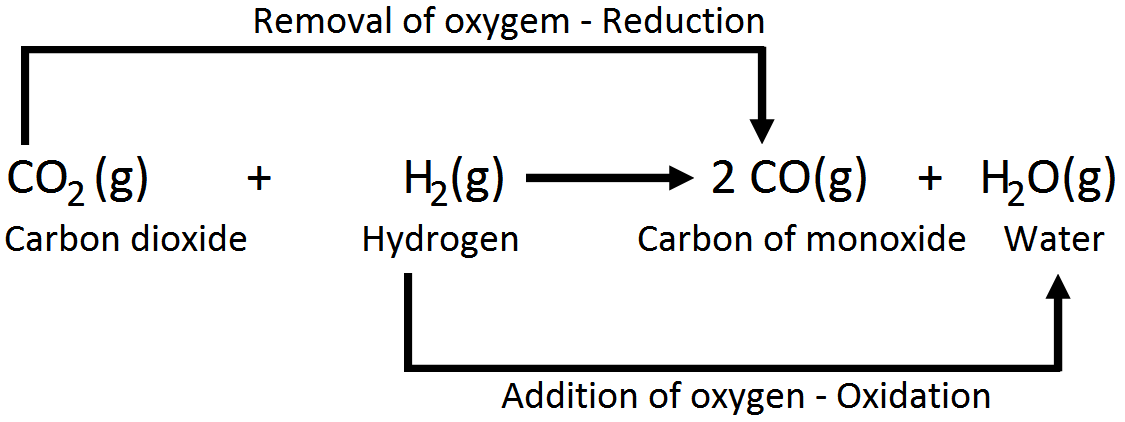
Redox reactions are the reactions in which the oxidation and reduction process are carried out simultaneously i.e. one reactant is getting reduced while the other gets oxidized. Such reactions are called oxidation reduction reactions or redox reactions .
Oxidation- Oxidation is defined as a process that involves a gain of oxygen or a loss of hydrogen and loss of electrons.
Reduction- It is defined as a process that involves gain of hydrogen and electrons and loss of oxygen.
View full question & answer→Question 215 Marks
Balance the following ionic equations. $\text{MnO}^{-}_4+\text{SO}^{2-}_3+\text{H}^+\xrightarrow{ \ \ \ \ \ \ \ \ \ }\text{Mn}^{2+}+\text{SO}^{2-}_4+\text{H}_2\text{O}$
Answer
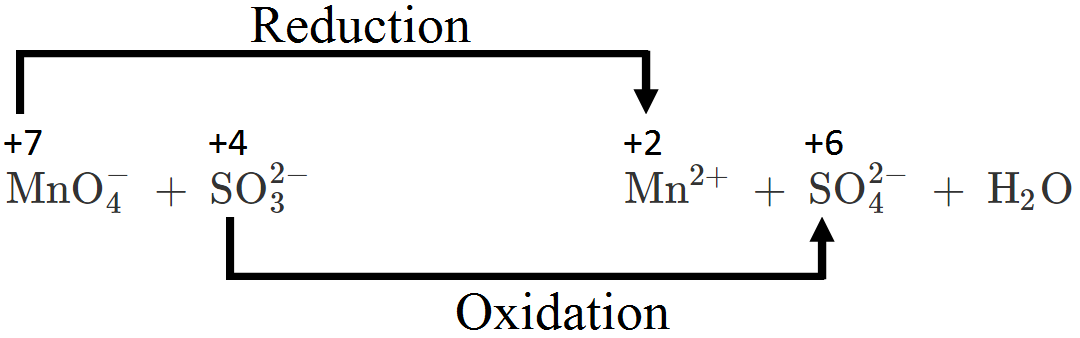
Dividing the equation into two half reactions:
Oxidation half reaction: $\text{SO}^{2-}_3\xrightarrow{ \ \ \ \ \ \ \ }\text{SO}^{2-}_4$
Reduction half reaction: $\text{MnO}^-_4\xrightarrow{ \ \ \ \ \ \ \ }\text{Mn}^{2+}$
Balancing oxidation and reduction half reactions separately as:
Oxidation half reaction
$\text{SO}^{2-}_3\xrightarrow{ \ \ \ \ \ \ \ }\text{SO}^{2-}_4$
$\text{SO}^{2-}_3\xrightarrow{ \ \ \ \ \ \ \ \ \ }\text{SO}^{2-}_4+2\text{e}^{-}$
Since the reaction occurs in acidic medium,
$\text{SO}^{2-}_3\xrightarrow{ \ \ \ \ \ \ \ \ }\text{SO}^{2-}_4+2\text{e}^-+2\text{H}^+$
$\text{SO}^{2-}_3+\text{H}_2\text{O}\xrightarrow{ \ \ \ \ \ \ \ }\text{SO}^{2-}_4+2\text{H}^++2\text{e}^-...\text{(i)}$
Reduction half reaction
$\text{MnO}^-_4\xrightarrow{ \ \ \ \ \ \ \ }\text{Mn}^{2+}$
$\text{MnO}^-_4+5\text{e}^-\xrightarrow{ \ \ \ \ \ \ \ \ }\text{Mn}^{2+}$
$\text{MnO}^-_4+8\text{H}^++5\text{e}^-\xrightarrow{ \ \ \ \ \ \ \ }\text{Mn}^{2+}+4\text{H}_2\text{O}...(\text{ii})$
To balance the electrons, multiply eq. (i) by 5 and eq. (ii) by 2 and add
$2\text{MnO}^-_4+5\text{SO}^{2-}_3+6\text{H}^+\xrightarrow{ \ \ \ \ \ \ \ }2\text{Mn}^{2+}5\text{SO}^{2-}_4+3\text{H}_2\text{O}$ View full question & answer→Question 225 Marks
Write balanced chemical equation for the following reactions:
Permanganate ion $(\text{MnO}^-_4)$ reacts with sulphur dioxide gas in acidic medium to produce $Mn2+$ and hydrogensulphate ion.
(Balance by ion electron method)
Answer$2\text{MnO}^-_4+5\text{SO}_2+2\text{H}_2\text{O}+\text{H}^+\xrightarrow{ \ \ \ \ \ \ \ \ }5\text{HSO}^-_4+2\text{Mn}^{2+}$
Balancing by ion-electron method:
$\stackrel{+7}{\text{Mn}}\stackrel{-2}{\text{O}^-_4}+\stackrel{+4-2}{\text{SO}_2}\xrightarrow{ \ \ \ \ \ \ \ \ \ }\stackrel{+2}{\text{Mn}^{2+}}+\stackrel{+1}{\text{H}}\stackrel{+6-2}{\text{SO}^-_4}\text{(Skeletal equation)}$
$\text{Oxidation half:} \ \ \text{ SO}_2\xrightarrow{ \ \ \ \ \ \ \ }\text{HSO}^-_4$
$\text{Reduction half}: \ \ \text{MnO}^-_4\xrightarrow{ \ \ \ \ \ \ \ }\text{Mn}^{2+}$
$\text{Oxidation half}: \ \ \text{SO}_2\xrightarrow{ \ \ \ \ \ \ \ \ }\text{HSO}^-_4+2\text{e}^-$
$\text{SO}_2+2\text{H}_2\text{O}\xrightarrow{ \ \ \ \ \ \ \ \ }\text{HSO}^-_4+3\text{H}^++2\text{e}^-...(\text{i})$
(Add 2 $H_2O$ molecules to balance O atoms)
$\text{MnO}^-_4+5\text{e}^-\xrightarrow{ \ \ \ \ \ \ \ \ \ }\text{Mn}^{2+}$
$\text{MnO}^-_4+8\text{H}^++5\text{e}^-\xrightarrow{ \ \ \ \ \ \ \ \ \ \ }\text{Mn}^{2+}+4\text{H}_2\text{O } ...(\text{ii})$
(Add 4 $H_2O$ molecules to balance O atoms and H atoms)
Add oxidation and reduction half
$[\text{SO}_2+2\text{H}_2\text{O}\xrightarrow{ \ \ \ \ \ \ \ }\text{HSO}^-_4+3\text{H}^++2\text{e}^-]\times5 \\ [\text{MnO}^-_4+8\text{H}^++5\text{e}^-\xrightarrow{ \ \ \ \ \ \ \ \ \ }\text{Mn}^{2+}+4\text{H}_2\text{O}]\times{2} \\ \underline{ \ \ \ \ \ \ \ \ \ \ \ \ \ \ \ \ \ \ \ \ \ \ \ \ \ \ \ \ \ \ \ \ \ \ \ \ \ \ \ \ \ \ \ \ \ \ \ \ \ \ \ \ \ \ \ \ \ \ \ \ \ \ \ \ \ \ \ \ \ \ \ \ \ \ \ \ \ \ \ \ \ \ \ } \\ 2\text{MnO}^-_4+5\text{SO}_2+2\text{H}_2\text{O}+\text{H}^+\xrightarrow{ \ \ \ \ \ \ \ \ \ }5\text{HSO}^-_4+2\text{Mn}^{2+}$
View full question & answer→Question 235 Marks
Balance the following ionic equations. $\text{Cr}_2\text{O}^{2-}_7+\text{Fe}^{2+}+\text{H}^+\xrightarrow{ \ \ \ \ \ \ \ \ }\text{Cr}^{3+}+\text{Fe}^{3+}+\text{H}_2\text{O}$
Answer
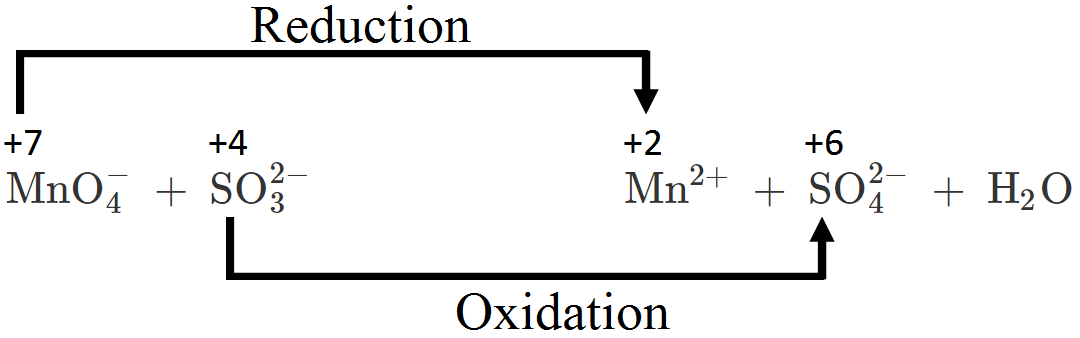
Step-1: Separate the equation into two half reactions.
The oxidation number of various atoms are shown below:
$\stackrel{+6 \ \ -2 \ \ \ \ \ \ \ }{\text{Cr}_2\text{O}^{2-}_7}+\stackrel{+2 \ \ \ \ \ \ \ }{\text{Fe}^{2+}}+\stackrel{+1 \ \ \ }{\text{H}^+}\xrightarrow{ \ \ \ \ \ \ \ \ }\stackrel{+3}{\text{Cr}^{3+}}+\stackrel{+3}{\text{Fe}^{3+}}+\stackrel{+1 \ \ -2}{\text{H}_2\text{O}}$
In this case, chromium undergose reduction, oxidation number decreases from $+6(\text{in }\text{Cr}_2\text{O}^{2-}_7)\text{ to}+3(\text{in Cr}^{3+})$
$Fe^{2+} (O.N. = +2)$ changes to $Fe^{3+}$ (O.N. = +3). The species undergoing oxidation and reduction are:
Oxidation: $\text{Fe}^{2+}\xrightarrow{ \ \ \ \ \ \ \ }\text{Fe}^{3+}$
reduction: $\text{Cr}_2\text{O}^{2-}_7\xrightarrow{ \ \ \ \ \ \ \ \ }\text{Cr}^{3+}$
Step-2: Balance each half reaction separately as:
- $\text{Fe}^{2+}\xrightarrow{ \ \ \ \ \ \ \ \ }\text{Fe}^{3+}$
- Balance all atoms other than H and O. This step is not needed, because, it is already balanced.
- The oxidation number on left is +2 and on right is +3. To account for the difference, the electron is added to the right as: $\text{Fe}^{2+}\xrightarrow{\ \ \ \ \ \ \ \ }\text{Fe}^{3+}+\text{e}^-$
- Charge is already balanced.
- No need to add H or O.
The balanced half equation is:
$\text{Fe}^{2+}\xrightarrow{ \ \ \ \ \ \ \ }\text{Fe}^{3+}+\text{e}^-...(\text{i})$
Consider the second half equation
$\text{Cr}_2\text{O}^{2-}_7\xrightarrow{ \ \ \ \ \ \ \ \ }\text{Cr}^{3+}$
- Balance the atoms other than H and O.
$\text{Cr}_2\text{O}^{2-}_7\xrightarrow{ \ \ \ \ \ \ \ \ }2\text{Cr}^{3+}$
- The oxidation number of chromium on the left is +6 and on the right is +3. Each chromium atom must gain three electrons. Since there are two Cr atoms, add $6e^–$ on the left.
$\text{Cr}_2\text{O}^{2-}_7+6\text{e}^-\xrightarrow{ \ \ \ \ \ \ \ \ }2\text{Cr}^{3+}$
- Since the reaction takes place in acidic medium add $14H^+$ on the left to equate the net charge on both sides.
$\text{Cr}_2\text{O}^{2-}_7+6\text{e}^-+14\text{H}^+\xrightarrow{ \ \ \ \ \ \ \ \ \ }2\text{Cr}^{3+}$
- To balance FI atoms, add $7H_2O$ molecules on the right.
$\text{Cr}_2\text{O}^{2-}_7+6\text{e}^-+14\text{H}^+\xrightarrow{ \ \ \ \ \ \ \ \ }2\text{Cr}^{3+}+7\text{H}_2\text{O}...(\text{ii})$
This is the balanced half equation.
Step-3: Now add up the two half equations. Multiply eq. (i) by 6 so that electrons are balanced.
$ \ \ \ \ \ \ \ \ \ \ \ \ \ \ \ \ \ \ \ \ \ \ \ \ \ \ \ \ \ \ \ \ \ \ \ \ \text{Fe}^{2+}\xrightarrow{ \ \ \ \ \ \ \ \ \ }\text{Fe}^{3+}+\text{e}^-\times6\\ \ \ \ \ \ \ \ \ \text{Cr}_2\text{O}^{2-}_7+6\text{e}^-+14\text{H}\xrightarrow{ \ \ \ \ \ \ \ \ \ }2\text{Cr}^{3+}+7\text{H}_2\text{O} \ \ \ \ \ \ \ \ \ \ \ \ \ \ \ \ \ \ \ \ \\ \underline{ \ \ \ \ \ \ \ \ \ \ \ \ \ \ \ \ \ \ \ \ \ \ \ \ \ \ \ \ \ \ \ \ \ \ \ \ \ \ \ \ \ \ \ \ \ \ \ \ \ \ \ \ \ \ \ \ \ \ \ \ \ \ \ \ \ \ \ \ \ \ \ \ \ \ \ \ \ \ \ \ \ \ \ \ \ \ \ \ \ \ \ \ \ \ \ \ \ \ \ } \\6\text{Fe}^{2+}+\text{Cr}_2\text{O}^{2-}_7+14\text{H}^+\xrightarrow{ \ \ \ \ \ \ \ \ \ \ \ }6\text{Fe}^{3+}+2\text{Cr}^{3+}+7\text{H}_2\text{O}\ \ \ \ \ \ \ \ \ \ \ \ \ \ \ \ \ \ \ \ \ \ \ \ \ \ \ \ \ \ \ \ \ \ \ \ \ \ \ \ \ \ \ \ \ \ \ \ \ \ \ \ \ \ \ \ \ \ \ \ \ \ \ \ \ $ View full question & answer→Question 245 Marks
Which method can be used to find out strength of reductant/oxidant in a solution? Explain with an example.
AnswerIn redox systems, the titration method can be adopted to determine the strength of a reductant/ oxidant using a redox sensitive indicator. The usage of indicators in redox titration is illustrated below:
(i) In one situation, the reagent itself is intensely coloured, e.g.. permanganate ion, $\mathrm{MnO}_4^{-}$. Here, $\mathrm{MnO}_4^{-}$acts as the self indicator. The visible end point in this case is achieved after the last of the reductant $\left(\mathrm{Fe}^{2+}\right.$ or $\left.\mathrm{C}_2 \mathrm{O}_4^{2-}\right)$ is oxidised and the first lasting tinge of pink colour appears at $\mathrm{MnO}_4^{-}$ concentration as low as $10^{-5} \mathrm{~mol}\left(10^{-6} \mathrm{~mol} \mathrm{~L}^1\right)$. This ensures a minimal 'overshoot' in colour beyond the equivalence point, the point where the reductant and the oxidant are equal in terms of their mole stoichiometry.
View full question & answer→MCQ 255 Marks
Calculate the oxidation number of each sulphur atom in the following compounds :
- ✓
$\ce{Na_2S_2O_3}$
- B
$\ce{Na_2S_4O_6}$
- C
$\ce{Na_2SO_3}$
- D
$\ce{Na_2SO_4}$
AnswerCorrect option: A. $\ce{Na_2S_2O_3}$
Structure of $\ce{Na_2S_2O_3}$ is
$ \ \ \ \ \ \ \ \ \ \ \ \ \ \ \ \ \ \ \text{S}^1\\ \ \ \ \ \ \ \ \ \ \ \ \ \ \ \ \ \ \uparrow\\\text{Na}-\text{O}-\text{S}^2-\text{O}-\text{Na}\\ \ \ \ \ \ \ \ \ \ \ \ \ \ \ \ \ \ \ ||\\ \ \ \ \ \ \ \ \ \ \ \ \ \ \ \ \ \ \text{O}$
The oxidation state of $S_1$ is $-2.$
Let oxidation state of $S_2$ be $x.$
$2\times(+1)+3(-2)+\text{x}+1\times(-2)=0\ \ \text{(For Na}) \ \ \ (\text{For O}) \ \ (\text{For coordinate S})\\+2-6+\text{x}-2=0$
Thus, the oxidation states of two $S$ atoms in $\ce{Na_2S_2O_3} $ are $-2$ and $+6.$
- $\ce{Na_2S_4O_6}$
$ \ \ \ \ \ \ \ \ \ \ \ \ \ \ \ \ \ \ \text{O} \ \ \ \ \ \ \ \ \ \ \ \ \ \ \ \ \ \ \ \ \ \ \ \text{O}\\ \ \ \ \ \ \ \ \ \ \ \ \ \ \ \ \ \ \ || \ \ \ \ \ \ \ \ \ \ \ \ \ \ \ \ \ \ \ \ \ \ \ \ ||\\\text{Na}-\text{O}-\text{S}^1-\text{S}^2-\text{S}^3-\text{S}^4-\text{O}-\text{Na}\\ \ \ \ \ \ \ \ \ \ \ \ \ \ \ \ \ \ \ || \ \ \ \ \ \ \ \ \ \ \ \ \ \ \ \ \ \ \ \ \ \ \ \ ||\\ \ \ \ \ \ \ \ \ \ \ \ \ \ \ \ \ \ \text{O} \ \ \ \ \ \ \ \ \ \ \ \ \ \ \ \ \ \ \ \ \ \ \ \ \text{O}$
From the left, $S^1 = (-2) + (-2) + (-1) = +5$
$S^2= 0$
$S^3= 0$
$S^4= +5$
- $\ce{Na_2SO_3}$
$2 \times (+1) + x + 3 \times (-2) = 0$
$x = +4$
- $\ce{Na_2SO_4}$
$+2 + x + (-8) = 0$
$x = +6$ View full question & answer→Question 265 Marks
- $\text{Cu}|\text{Cu}^{2+}(1\text{M})||\text{Ag}^+(1\text{M})|\text{Ag}$
$\text{E}^0_\frac{\text{Cu}^{2+}}{\text{Cu}}=0.34\text{V}$
$\text{E}^0_\frac{\text{Ag}^+}{\text{Ag}}=+0.80\text{V}$
- Write reaction at anode and cathode.
- Write net cell reaction.
- Calculate e.m.f. of the cell.
- What is meant by E.M.F of cell? How is it measured?
Answer
-
- $\text{Cu}\text{(S)}\xrightarrow{ \ \ \ \ }\text{Cu}^{2+}\text{(aq)}+2\text{e}^-$ At anode
$2\text{Ag}^+\text{(aq)}+2\text{e}^-\xrightarrow{ \ \ \ \ \ \ }2\text{Ag}\text{(s)}$ At cathode
- $\text{Cu}\text{(s)}+2\text{Ag}^+\text{(aq)}\xrightarrow{ \ \ \ \ \ }\text{Cu}^{2+}\text{(aq)}+2\text{Ag(s)}$
$\text{E}^0_\text{cell}=\text{E}^0_\frac{\text{Ag}+}{\text{Ag}}-\text{E}^0_\frac{\text{Cu}^{2+}}{\text{Cu}}$
$=+0.80\text{V}-0.34\text{V}$
$=0.46\text{V}$
- It is equal to maximum potential difference when no current is drawn from the cell.
View full question & answer→Question 275 Marks
|
S. No
|
Column I
|
Column II
|
|
1.
|
$[Mn(CO)_5]^-$
|
+6
|
|
2.
|
$[Mn_2(CO)_{10}]$
|
+2
|
|
3.
|
$K_4[Mn(CN)_6]$
|
0
|
|
4.
|
$K_2MnO_4$
|
-1
|
Answer
|
S. No
|
Column I
|
Column II
|
|
1.
|
$[Mn(CO)_5]^-$
|
-1 |
|
2.
|
$[Mn_2(CO)_{10}]$
|
0 |
|
3.
|
$K_4[Mn(CN)_6]$
|
+2 |
|
4.
|
$K_2MnO_4$
|
+6 |
View full question & answer→Question 285 Marks
Find out the oxidation number of chlorine in the following compounds and arrange them in increasing order of oxidation number of chlorine. $\mathrm{NaClO}_4, \mathrm{NaClO}_3, \mathrm{NaClO}, \mathrm{KClO}_2, \mathrm{Cl}_2 \mathrm{O}_7, \mathrm{ClO}_3, \mathrm{Cl}_2 \mathrm{O}, \mathrm{NaCl}, \mathrm{Cl}_2, \mathrm{ClO}_2$. Which oxidation state is not present in any of the above compounds?
Answer
|
$\stackrel{ \ \ \ \ \ \ \ \ \ \ \ +1 \ \ \ +7 \ \ \ \ \ \ \ \ \ \ \ \ \ \ \ \ \ \ \ \ \ \ \ }{\text{NaCl}\text{O}^{-2}_4}$
|
Oxidation
|
Oxidation no. of chlorine = +7
|
|
$\stackrel{ \ \ \ \ \ \ \ \ \ \ \ +1 \ \ \ +1 \ \ \ \ \ \ \ \ \ \ \ \ \ \ \ \ \ \ \ \ \ \ \ }{\text{NaCl}\text{O}^{-2}_3}$
|
Oxidation
|
Oxidation no. of chlorine = +5
|
|
$\stackrel{ \ \ \ \ \ \ \ \ \ \ \ +1 \ \ \ +1 \ \ \ \ \ \ \ \ \ \ \ \ \ \ \ \ \ \ \ \ \ \ \ }{\text{NaCl}\text{O}^{-2}}$
|
Oxidation
|
Oxidation no. of chlorine = +1
|
|
$\stackrel{ \ \ \ \ \ \ \ \ \ \ \ +1 +3 \ \ \ \ \ \ \ \ \ \ \ \ \ \ \ \ \ \ \ \ \ \ }{\text{KCl}\text{O}^{-2}_2}$
|
Oxidation
|
Oxidation no. of chlorine = +3
|
|
$ \ \ \ \ \ \ \ \stackrel{ +7 \ \ \ \ \ \ \ \ \ \ \ \ \ }{\text{Cl}_2\text{O}^{-2}_7}$
|
Oxidation
|
Oxidation no. of chlorine = +7
|
|
$ \ \ \ \ \ \ \ \stackrel{ +1 \ \ \ \ \ \ \ \ \ \ \ \ \ }{\text{Cl}_2\text{O}^{-2}}$
|
Oxidation
|
Oxidation no. of chlorine = +6
|
|
$ \ \ \ \ \ \ \ \stackrel{ +1 \ \ \ \ \ \ \ \ \ \ \ \ \ }{\text{Cl}_2\text{O}^{-2}}$
|
Oxidation
|
Oxidation no. of chlorine = +1
|
|
$\text{NaCl}$
|
Oxidation
|
Oxidation no. of chlorine = -1
|
|
$\text{Cl}_2$
|
Oxidation
|
Oxidation no. of chlorine = 0
|
|
$ \text{ClO}^{-2}_2$
|
Oxidation
|
Oxidation no. of chlorine = +4
|
$\mathrm{NaCl}, \mathrm{Cl}_2, \mathrm{ClO}_2, \mathrm{NaClO}, \mathrm{KClO}_2, \mathrm{ClO}_2, \mathrm{NaClO}_3, \mathrm{ClO}_3, \mathrm{Cl}_2 \mathrm{O}_7, \mathrm{NaClO}_4$. View full question & answer→Question 295 Marks
|
S. No
|
Column I
|
Column II
|
|
1.
|
$Cl_2O$
|
+7
|
|
2.
|
$Cl_2O_7$
|
+4
|
|
3.
|
$ClO_2$
|
+1
|
|
4.
|
$Cl_2O_6$
|
+6
|
Answer
|
S. No
|
Column I
|
Column II
|
|
1.
|
$Cl_2O$
|
+1 |
|
2.
|
$Cl_2O_7$
|
+7 |
|
3.
|
$ClO_2$
|
+4 |
|
4.
|
$Cl_2O_6$
|
+6
|
View full question & answer→Question 305 Marks
- $\text{MnO}_4^{2-}$ undergoes disproportionation reaction in acidic medium but does not, give reason.
- Give one example each of the following redox reaction:
- Combination reaction.
- Decomposition reaction.
- Metal displacement reaction.
Answer
- In $\text{MnO}_4^{2-}$ Mn is in +6 oxidation state, it can increase to +7 and decrease to +4 therefore, undergoes disproportionation reaction oxidation as well reduction simultaneously, in $\text{MnO}_4^-$ Mn is in +7. highest oxidation state, can undergo reduction only.
-
- Combination reaction:
$\text{S}+\text{O}\xrightarrow{ \ \ \ \ \ }\text{SO}_2\\ 0\ \ \ \ \ \ 0\ \ \ \ +4,-2$
- Decomposition reaction:
$2\text{H}_2\text{O}_2\xrightarrow{ \ \ \ }2\text{H}_2\text{O}+\text{O}_2\\ +1-1 \ \ \ \ -2$
- Metal displacement reaction:
$\text{Mg}\text{(s)}+\text{CuSO}_4\text{(aq)}\xrightarrow{ \ \ \ \ \ \ }\text{MgSO}_4\text{(aq)}+\text{Cu}\\ \ 0 \ \ \ \ \ \ \ \ \ \ \ +2\ \ \ \ \ \ \ \ \ \ \ \ \ \ \ \ \ \ \ \ \ \ +2\ \ \ \ \ \ \ \ \ \ \ \ \ \ \ \ \ \ \ \ 0 $ View full question & answer→Question 315 Marks
Using electron transfer concept, identify the oxidant and reductant in the following redox reactions.
- $\text{Zn(s)}+2\text{H}^+\text{(aq)}\xrightarrow{\ \ \ \ \ \ \ \ \ }\text{Zn}^{2+}\text{(aq)}+\text{H}_2\text{(g)}$
- $2[\text{Fe}(\text{CN})_6]^{4-}\text{(aq)}+\text{H}_2\text{O}_2\text{(aq)}+2\text{H}^+\text{(aq)}\\\xrightarrow{\ \ \ \ \ \ }2[\text{Fe}\text{(CN)}_6]^{3-}\text{(aq)}+2\text{H}_2\text{O}\text{(l)}$
- $2[\text{Fe(CN)}_6]^{3-}\text{(aq)}+2\text{OH}^-\text{(aq)}+\text{H}_2\text{O}_2(\text{aq})\\\xrightarrow{\ \ \ \ \ \ \ \ }2[\text{Fe(CN)}_6]^{4-}\text{(aq)}+\text{O}_2 (\text{g}) +2\text{H}_2\text{(l)}$
- $\text{BrO}^-_3\text{(aq)}+\text{F}_2\text{(g)}+\text{2OH}^-\text{(aq)}\xrightarrow{\ \ \ \ \ \ \ \ }\\\text{BrO}^-_4\text{(aq)}+\text{F}^-\text{(aq)}+\text{H}_2\text{O(l)}$
- $2\text{NaClO}_3(\text{aq})+\text{I}_2\text{(aq)}\xrightarrow{\ \ \ \ \ \ \ }\text{2NaIO}_3\text{(aq)}+\text{Cl}_2\text{(g)}$
AnswerOxidants:
i. $\mathrm{H}^{+}$
ii. $\mathrm{H}_2 \mathrm{O}_2$
iii. $\left[\mathrm{Fe}(\mathrm{CN})_6\right]^{3-}$
iv. $\mathrm{F}_2$
v. $\mathrm{NaClO}_3$
Reductants:
i. Zn
ii. $\left[\mathrm{Fe}(\mathrm{CN})_6\right]^{4-}$
iii. $\mathrm{H}_2 \mathrm{O}_2$
iv. $\mathrm{BrO}_3^{-}$
v. $2l^2$
View full question & answer→Question 325 Marks
- Identify the oxidising agent and reducing agent in the following reactions:
- $\text{MnO}_2+4\text{HCl}\xrightarrow{ \ \ \ \ \ \ \ }\text{MnCl}_2+\text{Cl}_2+2\text{H}_2\text{O}$
- $2\text{MnO}_4^-10\text{Cl}^-+16\text{H}^+\\ \xrightarrow{ \ \ \ \ }2\text{Mn}^{2+}+5\text{Cl}_2+8\text{H}_2\text{O}$
- Calculate the oxidation number of underlined elements in the following speries.
$\text{Pb}_3\text{O}_4,$ $\text{H}_2\text{Cl}$, $\text{PO}_4^{3-}$Answer
-
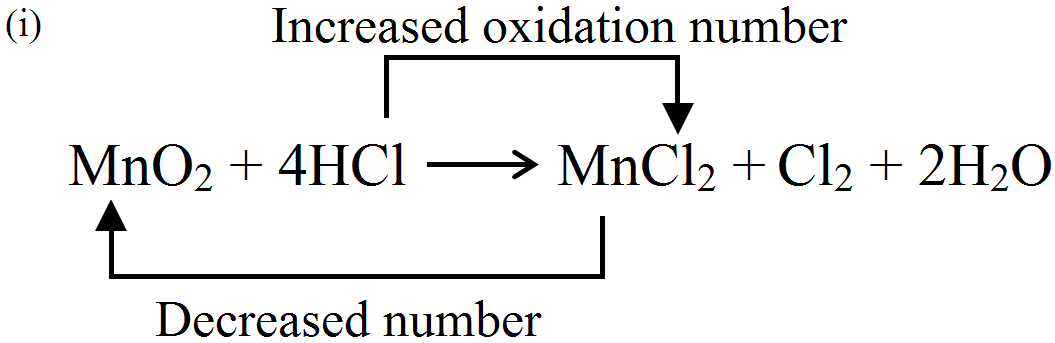
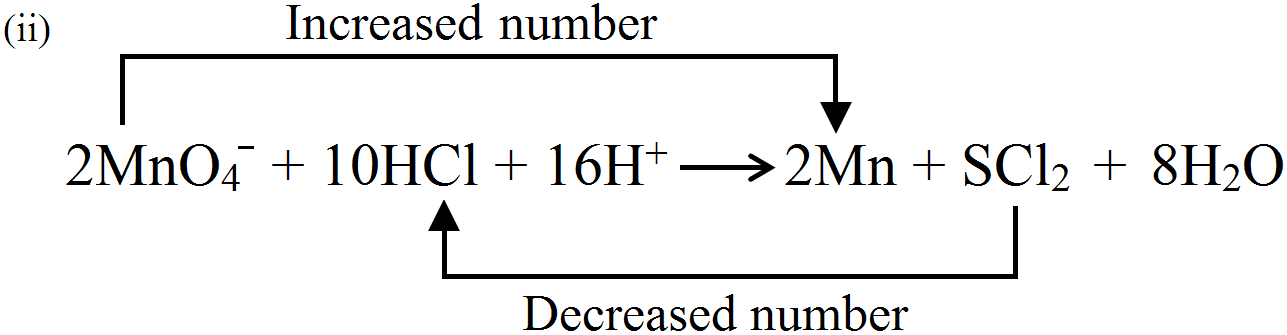
-
- 3x + 4(-2) = 0
⇒ 3x - 8 = 0
$\Rightarrow\text{x}=\frac{8}{3}$
- x + 2 + (1) + 2(-1) = 0
x + 2 - 2 = 0
⇒ x = 0
- x + 4(-2) = 0
⇒ x + 4(-2) = 0
⇒ x - 8 = 0
⇒ x = 8 View full question & answer→Question 335 Marks
Consider the cell reaction of an electrochemical cell:
$\text{Ni}\text{(s)}+2\text{Ag}^+\text{(aq)}\xrightarrow{\ \\ \ \ \ \ }\text{Ni}^{2+}\text{(aq)}+2\text{Ag}\text{(s)}$
Answer the following questions:
- Write anode and cathode half reactions.
- Mention the direction of flow of electrons.
- How is the electroneutrality maintained in solution of two half cells?
- Write the formula for calculating standard e.m.f of this cell.
- How does e.m.f. change when concentration of $Ag^+$ is decreased?
Answer
- At anode: $\text{Ni}\text{(s)}\xrightarrow{\ \\ \ \ \ \ }\text{Ni}^{2+}\text{(aq)}+2\text{e}^-$
At cathode: $2\text{Ag}^+\text{(aq)}+2\text{e}^-\xrightarrow{ \ \ \ \ \ \ }2\text{Ag}\text{(s)}$
- Electrons will flow from nickel to silver i.e. anode to cathode.
- Salt bridge contains $KCI, K^+ $ will neutralize negative ion in cathodic half cell and $Cl^-$ will neutralise $Ni^2^+$ in anodic half cells to maintain electroneutrality.
- $\text{E}^\circ_\text{cell}=\text{E}^\circ_\text{cathode}-\text{E}^\circ_\text{anode}$
- E.M.F of cell will decrease when concentration of $Ag^+$ is decreased.
View full question & answer→Question 345 Marks
Classify the following substances into oxidising and reducing agents:
- Carbon.
- Ozone.
- Nascent hydrogen.
- Nitric acid.
- Chlorine.
Answer
- Carbon has a high affinity towards oxygen so it is generally used as reducing agent. However, in case of highly reactive metals, it cannot be used as a reducing agent.
- Ozone being a source of oxygen generally behaves as an oxidising agent.
- As, we know addition of hydrogen is called reduction. So, nascent hydrogen behaves as a reducing agent.
- Nitric acid is a good oxidant i.e. oxidising agent as it readily provides oxygen.
- Chlorine can behave as oxidant as well as reductant depending upon the nature of other reactant.
View full question & answer→Question 355 Marks
- Consider the following redox reaction that produce electricity in a galvanic cell:
- $2\text{Fe}^{3+}+2\text{Cl}^-\xrightarrow{ \ \ \ \ \ \ \ \ \\ }2\text{Fe}^2+\text{Cl}_2\text{(g)}$
- $\text{Cd}\text{(s)}+\text{I}_2\xrightarrow{ \ \ \ \ \ \ \ }\text{Cd}^{2+}+2\text{I}^-$
- $2\text{Cr}\text{s}+3\text{Cu}^{2+}\xrightarrow{ \ \ \ \ \ \ \\ \ \ }+3\text{Cu}\text{(s)}+2\text{Cr}^{3+}$
Write the anode and cathode reaction for galvanic cell.
- Split the following redox reaction into the oxidation and reduction hay reactions:
- $\text{Zn}+\text{Cu}^{2+}\xrightarrow{ \ \ \ \ \ \ \ \\}2\text{n}^{2+}+\text{Cu} $
- $\text{Sn}^2+2\text{Hg}^+\xrightarrow{ \ \ \ \\ \ \ \ }\text{Sn}^{4+}+\text{Hg}_2^{2+}$
Answer
-
- Anode: $2\text{Cl}^-\xrightarrow{ \ \ \ \ \ \ }\text{Cl}_2+2\text{e}^-$
Cathode: $\text{Fe}^{3+}+\text{e}^-\xrightarrow{ \ \ \ \ }\text{Fe}^{2+}$
- Anode: $\text{Cd}\xrightarrow{ \ \ \ \ \\ }\text{Cd}^2+\text{de}^-$
Cathode: $\text{I}_2+2\text{e}^-\xrightarrow{ \ \ \ \ \ \ }2\text{I}^-$
- Anode: $\text{Cr}\xrightarrow{ \ \ \ \ \ }\text{Cr}^{3+}+3\text{e}^-$
Cathode: $\text{Cu}^{2+}\xrightarrow{ \ \ \ \ \ }2\text{e}^-+\text{Cu}$
-
- Oxidation half reaction
$\text{Zn}\xrightarrow{ \ \ \ \ \ \ }2\text{n}^{2+}+2\text{e}^-$
Reduction half reaction
$\text{Cu}^{2+}+2\text{e}^-\xrightarrow{ \ \ \ \ \ \ \ }\text{Cu}$
- Oxidation half reaction
$\text{Sn}^{2+}\xrightarrow{ \ \ \ \ \ \ }\text{Sn}^{4+}+2\text{e}^-$
Reduction half reaction
$\text{Cu}^{2+}+2\text{e}^-\xrightarrow{ \ \ \ \\ \ }\text{Cu}$
- Oxidation half reaction
$\text{Sn}^{2+}\xrightarrow{ \ \ \ \ \ }\text{Sn}^{4+}+2\text{e}^-$
$2\text{Hg}^{2+}+2\text{e}^-\xrightarrow{ \ \ \ \ \ \ }\text{Hg}_2^{2+}$ View full question & answer→Question 365 Marks
- Use the following reactions to arrange the elements A, B, C and D in order of their redox reactivity:
- $A + B^+ \rightarrow At + B$
- $B + D^+ \rightarrow B^+ +D$
- $C^+ + D \rightarrow$ No reaction
- $B^+C^+ \rightarrow B^+ + C$
- On the basis of above redox activity series, predict which of the following reactions would you expect to occur?
- $A^+ + C \rightarrow A^+ C^+$
- $A^+ + D \rightarrow A^+ D^+$
Answer
- The electrochemical series or redox activity is based on the decreasing order of reduction potentials. This means that the species which gets reduced is higher in the electrochemical series as compared to the other which is to be oxidised (lose electrons).
In reaction (a), $B^+$ gets reduced by A and therefore B is higher than A in electrochemical series.
In reaction (b), $D^+$ gets reduced by B and therefore, D is higher in the electrochemical series than B.
In reaction (c), $C^+$ does not get reduced by D, therefore, C is lower than D in electrochemical series. But according to reaction (d), $C^+$ gets reduced by B and therefore, C is higher in electrochemical series than B.
Thus, the correct order is,
D > C > B > A
- Both reactions do not occur because A cannot be reduced by C as well as D.
View full question & answer→