Question
$B_1, B_2$ and $B_3$ are three identical bulbs connected as shown in Figure. When all the three bulbs glow, a current of 3 A is recorded by the ammeter A
.
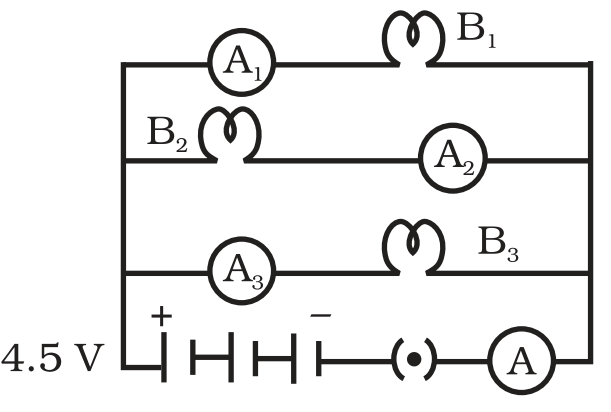
i. What happens to the glow of the other two bulbs when the bulb $B_1$ gets fused?
ii. What happens to the reading of $A_1, A_2, A_3$ and $A$ when the bulb $B_2$ gets fused?
iii. How much power is dissipated in the circuit when all the three bulbs glow together?

Answer

i. The glow of bulb depends upon the energy disspated per second i.e. $P =\frac{ V ^2}{ R }$. Since V and R of both the bulbs $B_2$ and $B_3$ remain the same even if bulb $B$, gets fused so glow of $B_2$ and $B_3$ remain the same.
ii. Since bulbs are identical, so their resistance is equal (i.e. resistance of each bulb $=R \Omega$ ).
When all bulbs glow, net resistnace of the circuit is given by,
$\frac{1}{R^{\prime}}=\frac{1}{R}+\frac{1}{R}+\frac{1}{R}=\frac{3}{R}$
Or, $R ^{\prime}=\frac{ R }{3}$
$I=3 A, V=4.5 V$
Using, $V= R ^{\prime}$, we get
$4.5=3 \times \frac{R}{3} \text { or } R=4.5 \Omega$
When $B _2$ gets fused, only two bulbs $B _1$ and $B _2$ in parallel are in the circuit.
$\therefore$ Net resistance of the circuit is given by,
$\frac{1}{R}=\frac{1}{4.5}+\frac{1}{4.5}=\frac{2}{4.5} \text { or } R=\frac{4.5}{2} \Omega$
$\therefore I=\frac{V}{R}=\frac{4.5 \times 2}{4.5}=2 A$
Thus, reading of ammeter $A=2 A$
Since $B_1$ and $B_3$ are in parallel and have same resistance, so $2 A$ current will be equally distributed between $B_1$ and $B_3$. Therefore, reading of ammeter $A_1=1 A$ Reading of ammeter $A_3=1 A$ Circuit containing $B_2$ is broken, so no current flows through this circuit. Hence reading of ammeter $A_2=$ zero.
iii. Power dissipated in the circuit,
$P=V \times I$
$=4.5 \times 3=13.5 W$

Need a full question paper?

Generate a complete, print-ready paper with questions like this in minutes — across 16+ boards, with answer keys.

Start Generating Free

Similar questions

What is the difference in colours of the Sun observed during sunrise/ sunset and noon? Give explanation for each.
Give the various functions of brain.
Evolution indicates the forever evolving life on the Earth. Give a statement supporting the above claim.
When a mixture of gases $X$ and $Y$ is compressed to 300atm pressure and then passed over a catalyst consisting of a mixture of zinc oxide and chromium oxide (heated to a temperature of $300^{\circ} C$ ), then an organic compounds $Z$ having the molecular formula $CH _4 O$ is formed. X is a highly poisonous gas which is formed in appreciable amounts when a fuel burns in a limited supply of air; Y is a gas which can be made by the action of a dilute acid on an active metal; and Z is a liquid organic compound which can react with sodium metal to produce hydrogen gas:
a. What are $X , Y$ and Z ?
b. Write a balanced chemical equation of the reaction which takes place when $X$ and $Y$ combine to form $Z$. Indicate the conditions under which the reaction occurs.
  1. Draw a diagram of human alimentary canal and label on it: Oesophagus, Gallbladder, Liver and Pancreas.
  2. Explain the statement, ‘Bile does not contain any enzyme but it is essential for digestion.’
  1. Define optical centre of a spherical lens.
  2. A divergent lens has a focal length of 20cm. At what distance should an object of height 4cm from the optical centre of the lens be placed so that its image is formed 10cm away from the lens. Find the size of the image also.
  3. Draw a ray diagram to show the formation of image in above situation.
An organic compound $A$ with molecular form $C _4 H _8 O _2$ on alkaline hydrolysis gives two compound $B$ and C . C on acidification with dil. HCl gives D. Oxidation of B with $K _2 Cr _2 O _7 / H _2 SO _4$ also gives D. Identify $A , B , C$ and D and explain all the reactions involved.
There are four organisms A, B, C and D. The organism A eats only the flesh of other animals as food. The organism B can eat grains, fruits and vegetables as well as meat and fish. The organism C can make the food itself from simple inorganic substances present in the environment by utilising sunlight energy. On the other hand, organism D eats only plants and their products as food.
  1. Which organism is
  1. Omnivore,
  2. Herbivore,
  3. Carnivore?
  1. Which organism is an autotroph?
  2. Which organism is/ are heterotroph (s)?
  3. Which organism can be a producer?
  4. Which organism is/ are consumer (s)?
Give one example each of organisms which could be like A, B, C and D.
$a.$ Draw a ray diagram for showing the convergence of a parallel beam of light by a concave mirror and mark the
positions of pole and the centre of curvature in it
$b. $ An object $4 \ cm$ in size is placed at $25 \ cm$ in front of a concave mirror of focal length $15 \ cm.$ At what distance
from the mirror should a screen be placed in order to obtain a sharp image? Find the nature and size of the image.
$c.$ List any two uses of a concave mirror
An element X which is a yellow solid at room temperature shows catenation and allotropy. X forms two oxides which are also formed during the thermal decomposition of ferrous sulphate crystals and are the major air pollutants.
  1. Identify the element X.
  2. Write the electronic configuration of X.
  3. Write the balanced chemical equation for the thermal decomposition of ferrous sulphate crystals?
  4. What would be the nature (acidic/ basic) of oxides formed?
  5. Locate the position of the element in the Modern Periodic Table.