Question
Why does a driver prefer to use a convex mirror as a rear-view mirror in a vehicle?

Answer

A driver prefers to use a convex mirror as a rear-view mirror because:
  1. A convex mirror always produces an erect image of the objects.
  2. A convex mirror has wider field of view.

Need a full question paper?

Generate a complete, print-ready paper with questions like this in minutes — across 16+ boards, with answer keys.
Start Generating Free

Similar questions

If current flows through two lamps arranged: (a) in series, (b) in parallel, and the filament of one lamps breaks, what happens to the other lamp ? Explain your answer.
If the object is moved further away from the mirror, what changes are there in the position and size of the image?
It is desired to obtain an erect image of an object, using concave mirror of focal length of 12cm.
Will the image be smaller or larger than the object? Draw ray diagram to show the formation of image in this case.
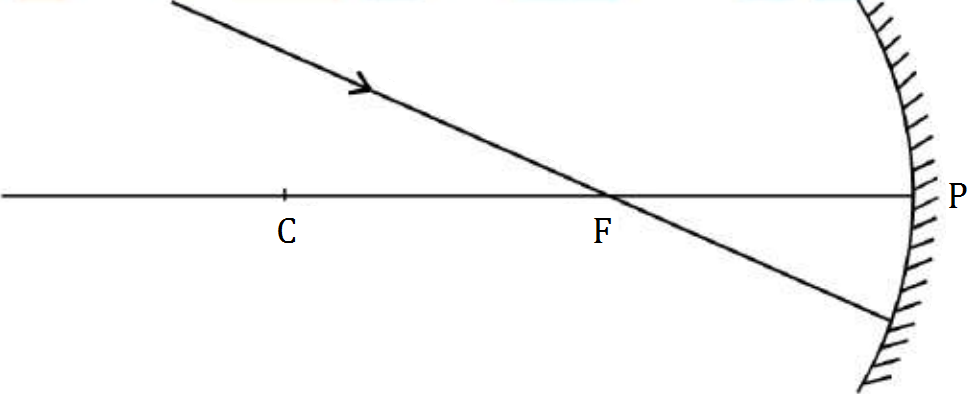
Redraw the following diagram on your answer-sheet and show the path of the reflected ray. Also mark the angle of incidence $(\angle\text{i})$ and the angle of reflection $(\angle\text{r})$ on the diagram.
Among animals, the predators (like lions) have their eyes facing forward at the front of their heads, whereas the animals of prey (like rabbit) usually have eyes at the sides of their head. Why is this so?
Calculate the energy released in joules when 5g of a material is completely converted into energy during a nuclear reaction.
An object lies at a distance of 2f from a concave lens of focal length f. Draw a ray-diagram to illustrate the image formation.
A convex lens of power 5D and a concave lens of power 7.5D are placed in contact with each other. What is the:
  1. Power of this combination of lenses?
  2. Focal length of this combination of lenses?
How does the convex eye-lens differ from the ordinary convex lens made of glass?
Which of the following are conductors and which are insulators? Sulphur, Silver, Copper, Cotton, Aluminium, Air, Nichrome, Graphite, Paper, Porcelain, Mercury, Mica, Bakelite, Polythene, Manganin.