Questions · Page 1 of 2

Answer the questions.[Phy-2M]

🎯

Test yourself on this topic

50 questions · timed · auto-graded

Question 12 Marks
Write the word AMBULANCE as it would appear when reflected in a plane mirror. Why is it sometimes written in this way (as its mirror image) on the front of an ambulance?
Answer


Because while driving our car. if we see in our rear-view mirror that the hospital van is coming from behind, then we get the laterally inverted image ofand read its as AMBULANCE and give way for it to pass throught.

View full question & answer
Question 22 Marks
Write down a formula for the magnification produced by a concave mirror.
  1. In terms of height of object and height of image.
  2. In terms of object distance and image distance.
Answer
The formula for the magnification (m) produced by a concave mirror,

  1. In terms of the height of an object (h) and the height of an image (h') is as follows:

$\text{Magnification (m)} = \frac{\text{height of image}}{\text{height of object}} = \frac{\text{h}'}{\text{h}}$

  1. In terms of the object distance (u) and the image distance (v) is as follows:

$\text{Magnification (m)} = −\frac{\text{image distance}} {\text{object distance}} =\frac{\text{v}}{\text{u}}​​​​​​​$ 

View full question & answer
Question 32 Marks
With the help of a ray diagram, determine the position, nature and size of the image formed of an object placed at the centre of curvature of a concave mirror.
Answer
When an object is placed at the centre of curvature (C) of a concave mirror, the image formed is:
  1. At the centre of curvature (C).
  2. Real and inverted.
  3. Of same size as the object.
View full question & answer
Question 42 Marks
With the help of a labelled ray diagram, describe how a converging mirror can be used to give an enlarged upright image of an object.
Answer


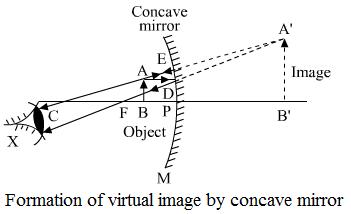
For obtaining an enlarged upright image of an object, the object is placed between focus (F).
View full question & answer
Question 52 Marks
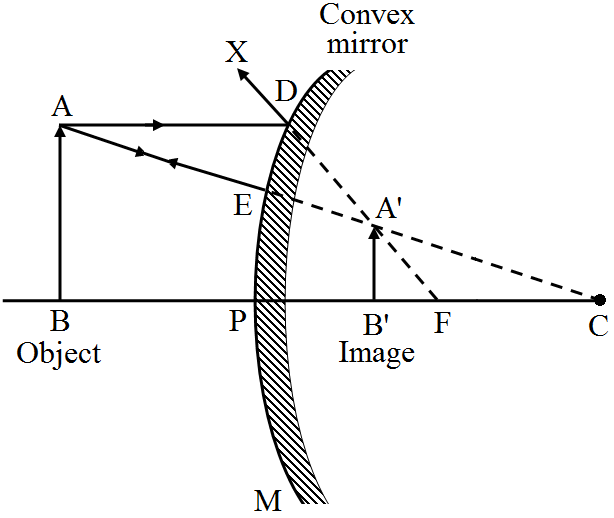
Why does a driver prefer to use a convex mirror as a rear-view mirror in a vehicle?
Answer
A driver prefers to use a convex mirror as a rear-view mirror because:
  1. A convex mirror always produces an erect image of the objects.
  2. A convex mirror has wider field of view.
View full question & answer
Question 62 Marks
Why can you not use a concave mirror as a rear-view mirror in vehicles?
Answer
We cannot use a concave mirror as a rear-view mirror in vehicles because a concave mirror produces inverted images of distant objects. So, all the vehicles will be seen running upside down in the mirror.
View full question & answer
Question 72 Marks
Which type of mirror is used in a solar furnace? Support your answer with reason.
Answer
Concave mirror is used in a solar furnace. The solar furnace is placed at the focus of a large concave reflector. When parallel rays of light from the sun fall on the surface of the concave mirror, rays gets reflected and meet at the focus of the mirror due to the converging nature of concave mirror. Thus, the furnace kept at the focus becomes very hot. Even steel can be melted in this furnace.
View full question & answer
Question 82 Marks
Which kind of mirror is used in the headlights of a car? Why is it used for this purpose?
Answer
Concave mirror is used in the headlights of a car. This is because when a lighted bulb is placed at the focus of a concave mirror reflector, then the diverging light rays of the bulb are collected by the concave reflector and then reflected to produce a strong, parallel-sided beam of light (which travels a considerable distance in the darkness of night).
View full question & answer
Question 92 Marks
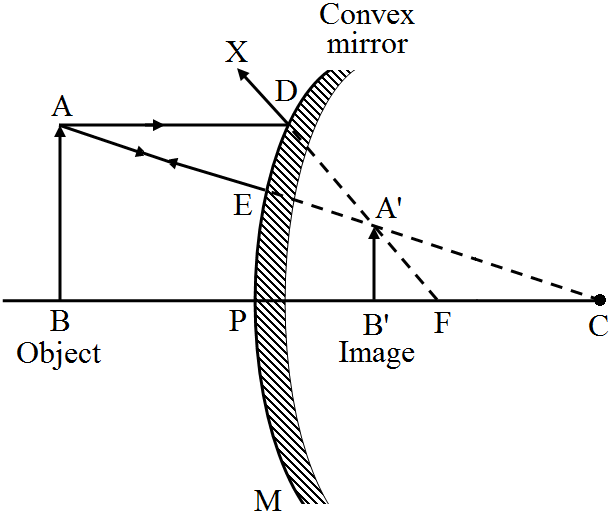
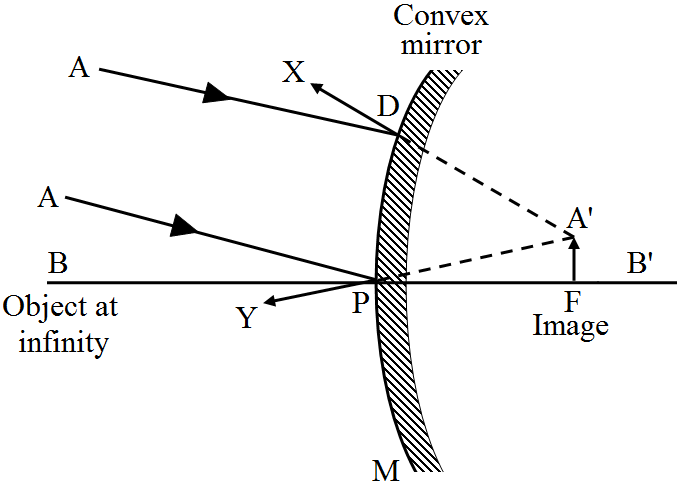
Where would the image be formed by a convex mirror if the object is placed:
  1. Between infinity and pole of the mirror?
  2. At infinity?
Draw labelled ray-diagrams to show the formation of image in both the cases.
Answer
  1. Image will form between pole and focus.


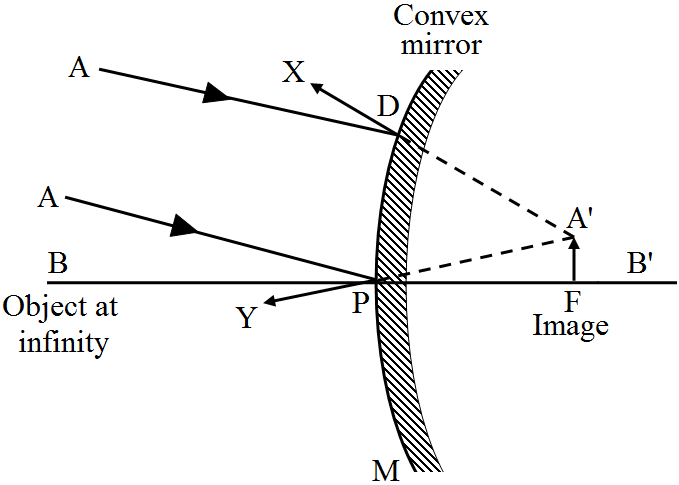
  1. At focus.

View full question & answer
Question 102 Marks
When an object is placed at a distance of 15cm from a concave mirror, its image is formed at 10cm in front of the mirror. Calculate the focal length of the mirror.
Answer
u = -15cm, v = -10cm

f = ?

We know that

$\frac{1}{\text{v}}+\frac{1}{\text{u}}=\frac{1}{\text{f}}$ 

$\Rightarrow\frac{1}{(-10)}+\frac{1}{(-15)}=\frac{1}{\text{f}}$

$\Rightarrow\frac{1}{\text{f}}=\frac{1}{10}-\frac{1}{15}= \frac{-3-2}{30}=-\frac{5}{30}=-\frac{1}{6}$

$\therefore \text{f}=-6\text{cm}$

$\therefore $ The focal length of the concave mirror is 6cm.

View full question & answer
Question 112 Marks
What is the relation between the focal length and radius of curvature of a spherical mirror (concave mirror or convex mirror)? Calculate the focal length of a spherical mirror whose radius of curvature is 25cm.
Answer
For a spherical mirror the principal focus (F) lies exactly mid-way between the pole (P) and centre of curvature (C). So, the focal length (f) of a spherical mirror is equal to half of its radius of curvature (R).
$\text{f}=\frac{\text{R}}{2}$
R= 25cm (Given)
f = ?
We know that
$\text{f}=\frac{\text{R}}{2}$
$=\frac{25}{2}$
$\text{f} = 12.5\text{cm}$
View full question & answer
Question 122 Marks
What is the position of the image when an object is placed at a distance of 20cm from a concave mirror of focal length 20cm?
Answer
Object distance, u = -20cm
Focal length, f = -20cm (concave mirror)
lmage distance, v = ?
$\frac{1}{\text{v}}+ \frac{1}{\text{u}}=\frac{1}{\text{f}}$
$\Rightarrow\frac{1}{\text{v}}+ \frac{1}{(-20)}=\frac{1}{\text{(-20)}}$
$\Rightarrow \frac{1}{\text{v}}=0$
$\therefore \text{v}=\text{infinity}$
View full question & answer
Question 132 Marks
What is the nature of image formed by a concave mirror if the magnification produced by the mirror is:
  1. +4,
  2. -2?
Answer
  1. If m = +4, then the image is virtual and erect.
  2. If m = +4, then the image is real and inverted.
View full question & answer
Question 142 Marks
What is the difference between a real image and a virtual image? Give one example of each type of image.
Answer
Real image can be obtained on a screen because light rays actually pass through a real image but virtual image cannot be formed on screen because light rays do not actually pass through a virtual image.
Example:
The image formed on a cinema screen is an example of real image.
The image formed by a plane mirror is a virtual image.
View full question & answer
Question 152 Marks
What is meant by:
  1. Principal focus of a convex mirror.
  2. Focal length of a convex mirror?
Answer
  1. Principal focus of a convex mirror: The principal focus of a convex mirror is a point on its principal axis from which a beam of light rays, initially parallel to the axis, appears to diverge after being reflected from the convex mirror.

  2. Focal length of a concave mirror: The focal length of a convex mirror is the distance from the pole (P) to its principal focus (F).

View full question & answer
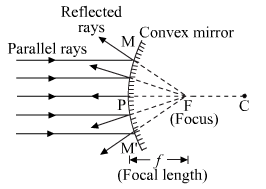
Question 162 Marks
What is meant by:
Draw diagram to show the action of convex mirror on a beam of parallel light rays. Mark on this diagram principal axis, focus F, centre of curvature C, pole P and focal length ƒ, of the convex mirror.
View full question & answer
Question 172 Marks
What are the important differences between looking at a photograph of your face and looking at yourself in a plane mirror?
Answer
A image of our face in a plane mirror is laterally inverted, so left is right and right is left. However, in a photograph of our face this is not the case. A mirror surface is smooth, so the reflection by a mirror is a regular reflection. A parallel beam of light incident on it, gets scattered by making reflected rays in different directions.
View full question & answer
Question 182 Marks
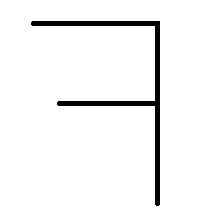
The letter F is placed in front of a plane mirror:
  1. How would its image look like when seen in a plane mirror?
  2. What is the name of the phenomenon involved?
Answer
  1.  


  1. Lateral inversion.
View full question & answer
Question 192 Marks
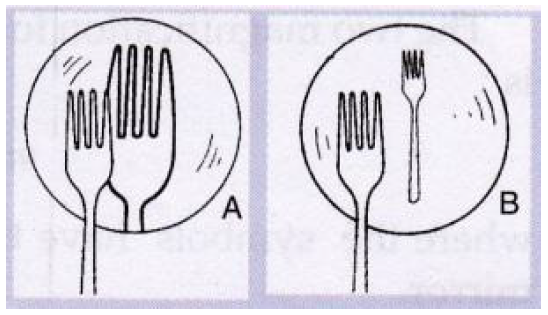
The diagrams show the appearance of a fork when placed in front of and close to two mirrors A and B, turn by turn.

  1. Which mirror is convex.
  2. Which mirror is concave.

Give reasons for your choice.

Answer
  1. Mirror B is convex, as it forms a small image.
  2. Mirror A is concave, as it forms a large image.
View full question & answer
Question 202 Marks
The boy walks towards the mirror at a speed of 1m/ s. At what speed does his image approach him?
Answer
When the boy walks towards the mirror at a speed of 1m/ s, his image will also appear to move towards the mirror at the same speed of 1m/ s. So, the speed at which his image approach him will be 2m/ s + 2m/ s = 4m/ s.
View full question & answer
Question 222 Marks
State the uses of plane mirrors.
Answer
Uses of Plane mirrors:
  1. Plane mirrors are used to see ourselves. The mirrors on our dressing table and in bathrooms are plane mirrors.
  2. Plane mirrors are fitted at blind turns of some busy roads so that drivers can see the vehicles coming from the other side and prevent accidents.
  3. Plane mirrors are used to make periscopes.
  4. Plane mirrors are fixed on the inside walls of certain shops to make them look bigger.
View full question & answer
Question 232 Marks
Name the type of mirror used by dentists. How does it help?
Answer
Concave mirror is used by dentists. The dentist holds a small concave mirror in such a way that the tooth lies within its focus. A magnified image of the tooth is then seen by the dentist in the concave mirror. Since the tooth looks much bigger, it becomes easy to examine the defect in the tooth.
View full question & answer
Question 242 Marks
Name the two types of spherical mirrors. What type of mirror is represented by the:
  1. Back side of a shining steel spoon?
  2. Front side of a shining steel spoon?
Answer
Two types of spherical mirrors are:
  1. Concave mirror.
  2. Convex mirror.
Type of mirror represented by the:
  1. Back side of a shining steel spoon – convex mirror.
  2. Front side of a shining steel spoon – concave mirror.
View full question & answer
Question 252 Marks
If the object is moved further away from the mirror, what changes are there in the position and size of the image?
Answer
If the object is moved further away from the mirror, the image is formed nearer to the mirror and the size goes on decreasing.
View full question & answer
Question 262 Marks
If the magnification of a body of size 1m is 2, what is the size of the image?
Answer
Size of object, h1 = 1m
Magnification, m = 2
Size of image, h2 = ?
$\text{m}=\frac{\text{h}_2}{\text{h}_1}$
$2=\frac{\text{h}_2}{1}$
$\text{h}_2= 2\text{m}$
View full question & answer
Question 272 Marks
If an object is placed at a distance of 8cm from a concave mirror of focal length 10cm, discuss the nature of the image formed by drawing the ray diagram.
Answer
The focal length of the mirror is PF = 10cm.

The object is placed at B such that PB = 8cm. This means that the object lies between the pole and focus of the concave mirror. The image formed is virtual, erect and magnified.

View full question & answer
Question 282 Marks
How will you distinguish between a plane mirror, a concave mirror and a convex mirror without touching them?
Answer
We can distinguish between a plane mirror, a concave mirror and a convex mirror by bringing our face close to each mirror, turn by turn. If the image is of the same size as our face, it is a plane mirror. If the image is magnified, it is a concave mirror. If the image is diminished, it is a convex mirror.
View full question & answer
Question 292 Marks
Give two uses of a convex mirror. Explain why you would choose convex mirror for these uses.
Answer
Two uses of convex mirror:
  1. A convex mirror is used as a rear-view mirror in vehicles because it forms erect and dimished images of the objects and has a wider field of view.
  2. Big convex mirrors are used as security mirror in shops so that a large number of goods displayed in the shop can be seen in the convex mirror.
View full question & answer
Question 302 Marks
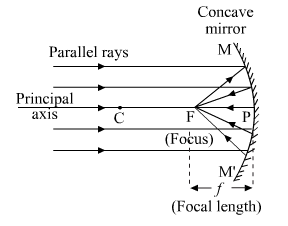
Explain with a suitable diagram, how a concave mirror converges a parallel beam of light rays. Mark clearly the pole, focus and centre of curvature of concave mirror in this diagram.
Answer


All the light rays which are parallel to the principal axis of a concave mirror, converge at the the principal focus (F) after reflection from the mirror. Since a concave mirror converges a parallel beam of light rays, it is also called a converging mirror.
View full question & answer
Question 312 Marks
Explain why, concave mirrors are used as shaving mirrors.
Answer
Concave mirrors are used as shaving mirrors. This is because when the face is placed close to a concave mirror (so that the face is within its focus) the concave mirror produces a magnified and erect image of the face. Since a large image of the face is seen in the concave mirror, it becomes easier to make a smooth shave.
View full question & answer
Question 322 Marks
Explain why, a ray of light passing through the centre of curvature of a concave mirror gets reflected back along the same path.
Answer
A ray of light passing through the centre of curvature of a concave mirror is reflected back along the same path because it strikes the concave mirror at right angles to its surface due to which the angle of incidence and angle of reflection both are 0°.
View full question & answer
Question 332 Marks
Explain how to read the following message which was found on some blotting paper:
Answer
Place a plane mirror in front of the message and see the image of the message. The mirror now reads as 'meet me at midnight'. The phenomenon of lateral inversion is used here.
View full question & answer
Question 342 Marks
Draw diagram to represent the action of a concave mirror on a beam of parallel light rays. Mark on this diagram principal axis, focus F, centre of curvature C, pole P and focal length ƒ, of the concave mirror.
View full question & answer
Question 352 Marks
Draw a ray diagram showing how a concave mirror can be used to produce a real, inverted and diminished image of an object.
View full question & answer
Question 362 Marks
Draw a labelled ray diagram to show the formation of image of an object by a convex mirror. Mark clearly the pole, focus and centre of curvature on the diagram.
Answer
Virtual and erect.

Formation of image by a convex mirror when the object is at infinity palced any where between the pole of mirror the pole of mirror and infinity.

Formation of image by a convex mirror when the object is at infinity (Iarge distance).
View full question & answer
Question 372 Marks
Draw a diagram to represent a convex mirror. On this diagram mark principal axis, principal focus F and the centre of curvature C if the focal length of convex mirror is 3cm.
View full question & answer
Question 382 Marks
Describe with the help of a diagram, the nature, size and position of the image formed when an object is placed beyond the centre of curvature of a concave mirror.
Answer
When an object is placed beyond the centre of curvature (C) of a concave mirror, the image is:
  1. Between the focus and centre of curvature.
  2. Real and inverted.
  3. Smaller than the object (or diminished).
View full question & answer
Question 392 Marks
Describe with a suitable diagram, how a convex mirror diverges a parallel beam of light rays. Mark clearly the pole, focus and centre of curvature of convex mirror in this diagram.
Answer


All the light rays which are parallel to the principal axis of a convex mirror, appear to diverge from the principal focus (F) after reflection from the mirror. Since a convex mirror diverges a parallel beam of light rays, it is also called a diverging mirror.
View full question & answer
Question 402 Marks
Describe the nature of image formed when the object is placed at a distance of 20cm from a concave mirror of focal length 10cm.
Answer
Hence, u = -20cm ; f = -10cm
$\frac{1}{\text{v}}+\frac{1}{\text{u}}=\frac{1}{\text{f}}$
$ \Rightarrow\frac{1}{\text{v}}+\frac{1}{(-20)}=\frac{1}{-10}$
$ \Rightarrow\frac{1}{\text{v}}= \frac{1}{-20}-\frac{1}{-10}=\frac{1}{-20}$
$\therefore\text{v}=-20\text{cm}$
So, image will be real and inverted.
View full question & answer
Question 412 Marks
Define:
  1. Principal focus of a concave mirror.
  2. Focal length of a concave mirror.
Answer
  1. Principal focus of a concave mirror: The principal focus of a concave mirror is a point on its principal axis to which all the light rays which are parallel and close to the axis, converge after reflection from the concave mirror.
  2. Focal length of a concave mirror: The focal length of a concave mirror is the distance between its pole and the principal focus.
View full question & answer
Question 422 Marks
Briefly describe how you would find the focal length of a concave mirror quickly but approximately.
Answer
When the object is at a considerable distance (or at infinity) from a concave mirror, then its image is formed at the focus. This fact can be used to find out the focal length of a concave mirror quickly but approximately.We focus a distant object (several metres away) like a window or tree on a screen by using a concave mirror whose focal length is to be determined. The sharp image of window or tree will be formed at the focus of the concave mirror. That is, the distance of image (or screen) from the concave mirror will be equal to the focal length of concave mirror. This distance can be measured with a scale. It will give us the approximate focal length of the concave mirror.
View full question & answer
Question 432 Marks
A wall reflects light and a mirror also reflects light. What difference is there in the way they reflect light?
Answer
A wall has a rough surface, so the reflection by a wall is a diffuse reflection. A parallel beam of light incident on it is reflected in different directions.
View full question & answer
Question 442 Marks
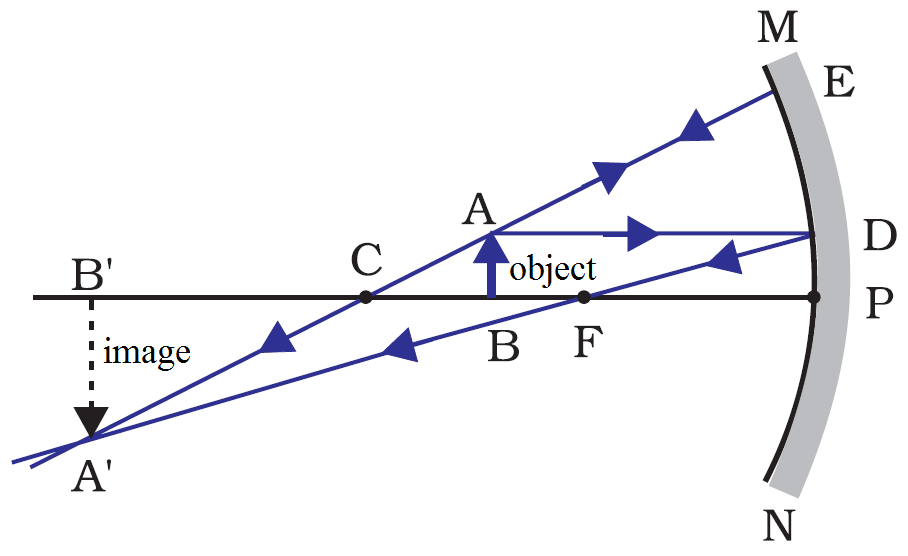
An object is placed just outside the principal focus of concave mirror. Draw a ray diagram to show how the image is formed, and describe its size, position and nature.
Answer


The image is real, inverted and magnified. It is formed beyond the centre of curvature of the mirror.
View full question & answer
Question 452 Marks
An object is placed at a distance of 6cm from a convex mirror of focal length 12cm. Find the position and nature of the image.
Answer
u = -6cm, f = 12cm, v = ?
We know that 
$\frac{1}{\text{v}}+\frac{1}{\text{u}}=\frac{1}{\text{f}}$
$\Rightarrow\frac{1}{\text{v}}+\frac{1}{-6}=\frac{1}{12}$
$\Rightarrow\frac{1}{\text{v}}=\frac{1}{12}+\frac{1}{6}=\frac{3}{12}=\frac{1}{4}$
$\therefore\text{v}=\frac{1}{4}\text{cm}$
Image will be formed 4cm the mirror.
Since the image is formed behind the convex mirror, it is virtual and erect.
View full question & answer
Question 462 Marks
An object 1cm tall is placed 30cm in front of a convex mirror of focal length 20cm. Find the size and position of the image formed by the convex mirror.
Answer
h1 = 1cm, u = -30cm, f = 20cm, h2 = ?, v = ?
$\frac{1}{\text{v}}+\frac{1}{\text{u}}=\frac{1}{\text{f}}$
$\frac{1}{\text{v}}+\frac{1}{-30}=\frac{1}{20}$
$\frac{1}{\text{v}}=\frac{1}{30}+\frac{1}{20}$
$\text{v}=12\text{cm}$
The image is formed 12cm behind the mirror.
$\text{m}=-\frac{\text{v}}{\text{u}}=\frac{\text{h}_2}{\text{h}_1}$
$\text{m}=-\frac{12}{-30}=\frac{\text{h}_2}{14}$
${\text{h}_2}=0.4\text{cm}$
View full question & answer
Question 472 Marks
An extended object in the form of an arrow pointing upward has been placed in front of plane mirror. Draw a labelled ray-diagram to show the formation of its image.
View full question & answer
Question 482 Marks
A large concave mirror has a radius of curvature of 1.5m. A person stands 10m in front of the mirror. Where is the person’s image?
Answer
R = -1.5cm (concave mirror)

u
= -10cm

$\text{f}=\frac{\text{R}}{2}=\frac{1.5}{2}=0.75\text{cm}$

$\frac{1}{\text{v}}+\frac{1}{\text{u}}=\frac{1}{\text{f}}$ 

$\Rightarrow \frac{1}{\text{v}}+\frac{1}{\text{(-10)}}=\frac{1}{(-0.75)}$

$\Rightarrow \frac{1}{\text{v}}=\frac{1}{10}-\frac{1}{0.75}=\frac{1}{10}-\frac{100}{75}$ 

$\frac{1}{10}-\frac{4}{3}=\frac{3-40}{30}=-\frac{37}{30}$

$\therefore\text{v}=-\frac{30}{37}=-0.81\text{cm}$

The person's image will be 0.81m in frond of concave mirror.

View full question & answer
Question 492 Marks
A convex mirror used as a rear-view mirror in a car has a radius of curvature of 3m. If a bus is located at a distance of 5m from this mirror, find the position of image. What is the nature of the image?
Answer
R = 3m, u = 5m,
$\frac{\text{R}}{2}=\frac{3}{2}=1.5\text{cm}$
We know that
$\frac{1}{\text{v}}+\frac{1}{\text{u}}=\frac{1}{\text{f}}$
$\Rightarrow\frac{1}{\text{v}}+\frac{1}{-5}=\frac{1}{1.5}$
$\Rightarrow\frac{1}{\text{v}}=\frac{1}{-5}+\frac{2}{3}=\frac{3+10}{15}=\frac{13}{10}$
$\therefore \text{v}=\frac{15}{13}\text{m}=1.15\text{cm}$
The image is formed 1.15m behind the mirror.
The image is virtual and erect.
View full question & answer
Question 502 Marks
A communications satellite in orbit sends a parallel beam of signals down to earth. If these signals obey the same laws of reflection as light and are to be focussed onto a small receiving aerial, what should be the best shape of the metal 'dish' used to collect them?
Answer
A communications satellite sends a parallel beam of signals down to the Earth. If these signals are to be focussed onto a small receiving aerial, then the best shape of the metal dish that can be used to collect them would be concave. The metal dish will behave like a concave mirror, which is a converging mirror.
View full question & answer
Answer the questions.[Phy-2M] - Science STD 10 Questions - Vidyadip