Question
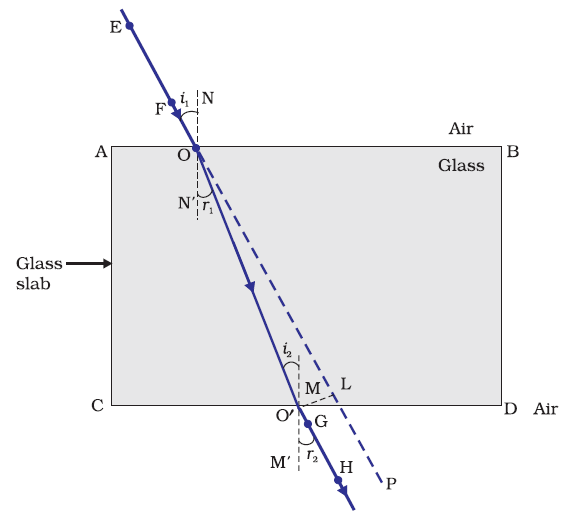
Why does a light ray incident on a rectangular glass slab immersed in any medium emerges parallel to itself? Explain using a diagram.
Answer

Perform an experiment to demonstrate that light bends from its path, when it falls obliquely on the surface of a glass slab. Also show that angle of incidence is about equal to the emergent angle.
  1. Take a glass slab and place it on a white sheet of paper fixed on a drawing board.
  2. Mark the boundary ABCD of the glass slab.
  3. Fix two pins $P_1$ and $P_2$, vertically on the drawing board such that line joining the pins is inclined to the edge $A B$ of the glass slab (Figure).

4. Now, look through the glass slab from opposite side so that the images of pins $P _1$ and $P _2$ are seen exactly in line. Fix two pins $P_3$ and $P_4$, vertically on the drawing board such that pins $P_3, P_4$ and image of $P_1$ and $P_2$ are exactly in one line.
5. Remove the glass slab and all pins. Join the points $P_1$ and $P_2$ with a line and extend this line to touch the edge $A B$ at $P$. Similarly join the points $P_3$ and $P_4$ with a line and extend the line to touch the edge $D C$ at $Q$.
6. Join points $P$ and $Q$ with a straight line.
7. Draw normal $N N^{\prime}$ at $P$ on the edge $A B$ and a normal $N_1 N_1{ }^{\prime}$ at $Q$ on the edge $D C$.
8. Measure $\angle P _2 PN$ and $\angle P _3 QN _1^{\prime}$ using a protractor or dee.

This experiment shows that when light falls obliquely on a glass slab, it bends along PQ from its original path along PL . Also $\angle P _2 PN \approx \angle P _3 QN _1^{\prime}$. That is, angle of incidence is about equal to the emergent angle.Note: Distance between pins $P_1$ and $P_2$, and between $P_3$ and $P_4$ must be large.

Need a full question paper?

Generate a complete, print-ready paper with questions like this in minutes — across 16+ boards, with answer keys.

Start Generating Free

Similar questions

Name five stimuli which act on plants. Name the type of tropism produced by each one of these stimuli.
A small part of the shoot of a plant is removed with a sharp knife. When the lower end of this small part of the shoot is buried in moist soil, it gradually develops roots and shoots and grows to become a new plant.
  1. What is the name of this method of propagating plants?
  2. What care should be taken while removing a small part of the shoot from the parent plant with a knife?
  3. Name any two plants which provide us with food directly or indirectly and are grown by this method.
  4. Give one advantage of this method of producing new plants.
  5. State whether it is a sexual method of reproduction or an asexual method. Why?
  6. What special name can be given to the genetically identical new plants produced by this technique?
Two very small organisms X and Y both reproduce by the method of budding. Organism X is industrially very important because it is used in making alcohol from sugar. It is also used in making bread. Organism Y Lives in freshwater. If organism Y gets cut into a number of parts accidently, each cut part can grow to form complete organism.
  1. What are organisms X and Y?
  2. What is the name of the process in which X converts sugar into alcohol?
  3. To which class of organisms does X belong?
  4. Name an important body feature of organism Y.
  5. Which organism is multicellular and which one is unicellular?
Draw a diagram of the human heart and label its parts.
An organic compound A (molecular formula $C _2 H _4 O _2$ ) reacts with Na metal to form a compound B and evolves a gas which burns with a pop sound. Compound A on treatment with an alcohol C in the presence of a little of concentrated sulphuric acid forms a sweetsmelling compound D (molecular formula $C _3 H _6 O _2$ ). Compound D on treatment with NaOH solution gives back B and C . Identify $A , B , C$ and D .
With the help of a labelled circuit diagram illustrate the pattern of field lines of the magnetic field around a current carrying straight long conducting wire. How is the right hand thumb rule useful to find direction of magnetic field associated with a current carrying conductor?
A and B are the two systems of control and coordination in the human body. The messages in system A are transmitted in the form of chemical substances C which travel comparatively slowly through the blood stream. The substances C are made in tissues D present in the head and trunk of human body. The messages in system b are transmitted very quickly in the form of electrical impulses through fibres E. The effect of messages transmitted by system b usually lasts for a much shorter time as compared to those transmitted by system A.
  1. Name the system A. What does system A consist of?
  2. Name the chemical substance C.
  3. What is tissue D? Name any five such tissues in the human body.
  4. Name the system B. What does system B consist of?
  5. Name the fibres E.
  6. State whether system A controls the working of system B or system B controls the working of system A.
The top part A of the flask-shaped reproductive organ X in the flower of a plant secrets a surgery substance into its lower part B which goes towards the bottom part C of the flask-shaped organ. When a tiny grain D coming from the top part E of another reproductive organ Y i the flower falls on part A, it grows a long tube F through the organ X i response to the sugary substance and reaches the bottom part C of flask-shaped organ to carry out fertilisation.
  1. Name parts (i) organ X, and (ii) organ Y, inside the flower?
  2. Name parts (i) A (ii) B, and (iii) C, of flask-shaped organ.
  3. Name (i) grain D, and (ii) part E of organ Y.
  4. Name the tube F.
  5. What is the phenomenon of growing a long tube in response to sugary substance in the process of fertilisation in a flower known as?
Plants do not have any nervous or muscle tissue, still, they have the ability to sense touch. How?
Define pollination. Explain the different types of pollination. List two agents of pollination? How does suitable pollination lead to fertilization?