Question
Why does a person sitting in one train think that the other train is at rest, when both trains are moving on parallel tracks with the same speed and in the same direction?

Answer

This is because the relative velocity of the train in which the person is sitting w.r.t. the other train is zero.
For example, let the velocity of A train = 60km/ hr due east
Velocity of B train = 60km/ hr due east
$\therefore$ Relative velocity of A train w.r.t. B train = 60 - 60 = 0

Need a full question paper?

Generate a complete, print-ready paper with questions like this in minutes — across 16+ boards, with answer keys.
Start Generating Free

Similar questions

Why does a cycle tube burst in summer?
The odometer of Raja's car reads 1700km at the start of a trip and 2500km at the end of the trip. The trip took 16h. What is the average speed of Raja's car in ms-1?
A lady walking towards east on a road with velocity of 10m/ s encounters rain falling vertically with a velocity of 30m/ s. At what angle she should hold her umbrella to protect herself from the rain?
Find the height to which water at 4°C will rise in a capillary tube of 10-3m diameter. Take g = 9.8ms-2. Angle of contact, $\theta=0$ and T = 0.072Nm-1.
If water in one flask and castor oil in other are violently shaken and kept on a table, which will come to rest earlier?
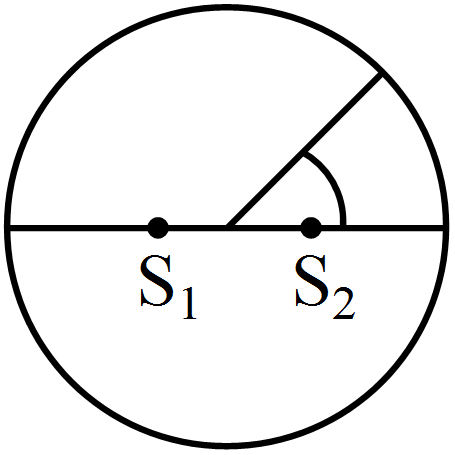
Figure, shows two coherent sources S1 and S2 which emit sound of wavelength $\lambda$ in phase. The separation between the sources is $3\lambda.$ A circular wire of large radius is placed in such a way that S1S2 lies in its plane and the middle point of S1S2 is at the centre of the wire. Find the angular positions $\theta$ on the wire for which constructive interference takes place.

Explain why in a sound wave, a displacement node is a pressure antinode and vice versa.
The heart rate (number of heart beats per minute) scales as $\frac{1}{\text{L}}$ where L is the characteristic length of the mammal. Can you explain this?
If the scale factor of a human relative to a rhesus monkey is about 2.5, what is the monkey's heart rate?
When a stress of $2 \times 10^6 N / m ^2$ is applied on a copper wire ( $Y =1^{11} N / m ^2$ ), what will be the percentage increase in its length?
Is it possible to add two vectors of unequal magnitudes and get zero? Is it possible to add three vectors of equal magnitudes and get zero?