Question
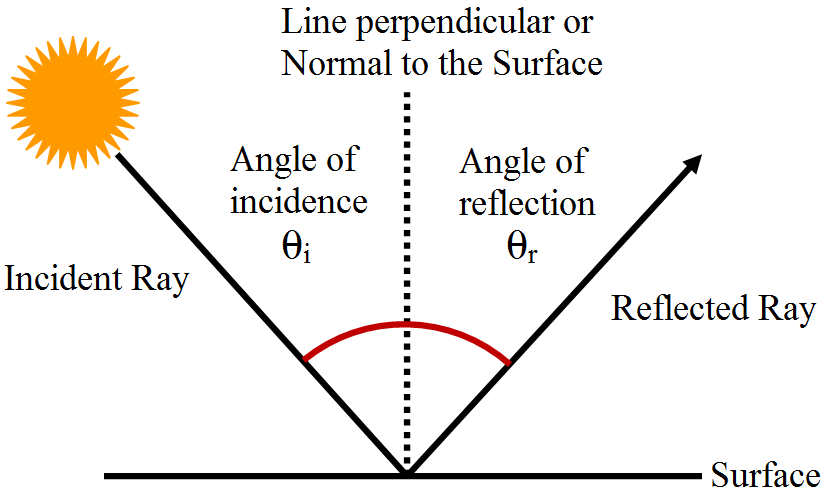
Why does a ray falling normally on a plane mirror, retrace its path?
Answer

The ray traces its path when it falls normally on a plane mirror because the angle of incidence is equal to the angle of reflection.
Explanation: According to the 'law of reflection' the angle of 'incidence' is always equals to the "angle of reflection". If a ray falls normally it means it is falling on the 'plane mirror' at right angle. So the 'angle of incidence' is 90 degrees and so is the 'angle of reflection.

Need a full question paper?

Generate a complete, print-ready paper with questions like this in minutes — across 16+ boards, with answer keys.

Start Generating Free

Similar questions

An object is 24cm away from a concave mirror and its image is 16cm from the mirror. Find the focal length and radius of curvature of the mirror, and the magnification of the image.
An electric heater is connected to the 230V mains supply. A current of 8A flows through the heater.
  1. How much charge flows around the circuit each second?
  2. How much energy is transferred to the heater each second?
The electrical resistivities of four materials P, Q, R and S are given below:

$\begin{matrix}\text{P}&6.84\times10^{-8}\Omega\text{m}\\\text{Q}&1.70\times10^{-8}\Omega\text{m}\\\text{R}&1.0\times10^{15}\Omega\text{m}\\\text{S}&11.0\times10^{-7}\Omega\text{m}\end{matrix}$

Which material will you use for making:
  1. Heating element of electric iron.
  2. Connecting wires of electric iron.
  3. Covering of connecting wires?
Give reason for your choice in each case.

(i) Explain why the refractive index of any material with respect to air is always greater 1 .
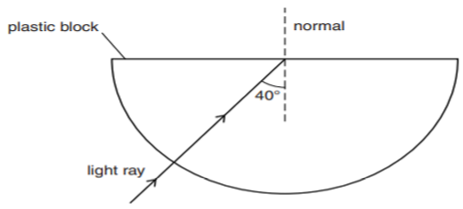
(ii) In the figure below a light ray travels from air into the semi-circular plastic block. Give a reason why the ray does not deviate at the semi-circular boundary of the plastic block.
Image
(iii) Complete the ray diagram of the above scenario when the light ray comes out of the plastic block from the top flat end.
  1. An object 3cm high is placed 24cm away from a convex lens of focal length 8cm. Find by calculations, the position, height and nature of the image.
  2. If the object is moved to a point only 3 cm away from the lens, what is the new position, height and nature of the image?
  3. Which of the above two cases illustrates the working of a magnifying glass?
An object of height 4cm is placed at a distance of 15cm in front of a concave lens of power, -10 dioptres. Find the size of the image.
Describe the working of a hydrogen bomb.
A short-sighted person has a near point of 15cm and a far point of 40cm.
  1. Can he see clearly an object at a distance of:
  1. 5cm?
  2. 25cm?
  3. 50cm?
  1. To see clearly an object at infinity, what kind of spectacle lenses does he need?
What is a source of energy? What are the two main categories of the sources of energy?
What is a solenoid? Draw a sketch to show the magnetic field pattern produced by a current-carrying solenoid.