MCQ
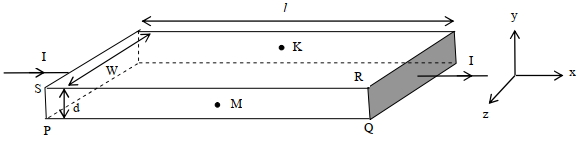
In a thin rectangular metallic strip a constant current $I$ flows along the positive $x$-direction, as shown in the figure. The length, width and thickness of the strip are $\ell$, w and $d$, respectively. A uniform magnetic field $\vec{B}$ is applied on the strip along the positive $y$-direction. Due to this, the charge carriers experience a net deflection along the $z$ direction. This results in accumulation of charge carriers on the surface $P Q R S$ and appearance of equal and opposite charges on the face opposite to $PQRS$. A potential difference along the $z$-direction is thus developed. Charge accumulation continues until the magnetic force is balanced by the electric force. The current is assumed to be uniformly distributed on the cross section of the strip and carried by electrons.

$1.$ Consider two different metallic strips ($1$ and $2$) of the same material. Their lengths are the same, widths are $w_1$ and $w_2$ and thicknesses are $d_1$ and $d_2$, respectively. Two points $K$ and $M$ are symmetrically located on the opposite faces parallel to the $x$ - $y$ plane (see figure). $V _1$ and $V _2$ are the potential differences between $K$ and $M$ in strips $1$ and $2$ , respectively. Then, for a given current $I$ flowing through them in a given magnetic field strength $B$, the correct statement$(s)$ is(are)

$(A)$ If $w _1= w _2$ and $d _1=2 d _2$, then $V _2=2 V _1$

$(B)$ If $w_1=w_2$ and $d_1=2 d_2$, then $V_2=V_1$

$(C)$ If $w _1=2 w _2$ and $d _1= d _2$, then $V _2=2 V _1$

$(D)$ If $w _1=2 w _2$ and $d _1= d _2$, then $V _2= V _1$

$2.$ Consider two different metallic strips ($1$ and $2$) of same dimensions (lengths $\ell$, width w and thickness $d$ ) with carrier densities $n_1$ and $n_2$, respectively. Strip $1$ is placed in magnetic field $B_1$ and strip $2$ is placed in magnetic field $B_2$, both along positive $y$-directions. Then $V_1$ and $V_2$ are the potential differences developed between $K$ and $M$ in strips $1$ and $2$, respectively. Assuming that the current $I$ is the same for both the strips, the correct option$(s)$ is(are)

$(A)$ If $B_1=B_2$ and $n_1=2 n_2$, then $V_2=2 V_1$

$(B)$ If $B_1=B_2$ and $n_1=2 n_2$, then $V_2=V_1$

$(C)$ If $B _1=2 B _2$ and $n _1= n _2$, then $V _2=0.5 V _1$

$(D)$ If $B_1=2 B_2$ and $n_1=n_2$, then $V_2=V_1$

Give the answer question $1$ and $2.$ 
  • A
    $CB,BC$
  • B
    $BD,AB$
  • C
    $AB,AD$
  • $AD,AC$

Answer

Correct option: D.
$AD,AC$
d
$1.$ $I _1= I _2$

$\Rightarrow neA _1 v _1= neA _2 V _2$

$\Rightarrow d _1 w _1 v _1= d _2 w _2 V _2$

Now, potential difference developed across MK

$V = Bvw$

$\Rightarrow \frac{ V _1}{ V _2}=\frac{ v _1 w _1}{ v _2 w _2}=\frac{ d _2}{ d _1}$

hence correct choice is $A$ and $D$

$2.$ As $I _1= I _2$ $n _1 w _1 d _1 v_1= n _2 w _2 d _2 v _2$

Now, $\frac{V_2}{V_1}=\frac{B_2 v_2 w_2}{B_2 v_1 w_1}=\left(\frac{B_2 w_2}{B_1 w_1}\right)\left(\frac{ n _1 w_1 d _1}{ n _2 w_2 d _2}\right)=\frac{ B _2 n _1}{ B _1 n _2}$

$\therefore$ Correct options are $A$ and $C$

Need a full question paper?

Generate a complete, print-ready paper with questions like this in minutes — across 16+ boards, with answer keys.

Start Generating Free

Similar questions

When the current through a solenoid increases at a constant rate, the induced current
A square loop of side $1\,m$ and resistance $1\,\Omega$ is placed in a magnetic field of $0.5\,T$. If the plane of loop is perpendicular to the direction of magnetic field, the magnetic flux through the loop is $\dots\dots$ webar
The electric field associated with an electromagnetic wave propagating in a dielectric medium is given by $\vec{E}=30(2 \hat{x}+\hat{y}) \sin \left[2 \pi\left(5 \times 10^{14} t-\frac{10^7}{3} z\right)\right] \mathrm{V} \mathrm{m}^{-1}$. Which of the following option($s$) is(are) correct?

[Given: The speed of light in vacuum, $c=3 \times 10^8 \mathrm{~ms}^{-1}$ ]

($A$) $B_x=-2 \times 10^{-7} \sin \left[2 \pi\left(5 \times 10^{14} t-\frac{10^7}{3} z\right)\right] \mathrm{Wbm}^{-2}$.

($B$) $B_y=2 \times 10^{-7} \sin \left[2 \pi\left(5 \times 10^{14} t-\frac{10^7}{3} z\right)\right] \mathrm{Wbm}^{-2}$

($C$) The wave is polarized in the $x y$-plane with polarization angle $30^{\circ}$ with respect to the $x$-axis.

($D$) The refractive index of the medium is $2$ .

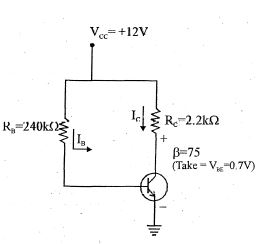
The value of $I_c$ for the configuration shown is....$ mA$
In Young's double slit experiment, the intensity at a point where path difference is $\frac{\lambda}{6}$ is $l$. If $l_0$ denotes the maximum intensity, $\frac{l}{l_0}$.
The initial activity of a certain radioactive isotope was measured as $16000\ counts\  min^{-1}$. Given that the only activity measured was due to this isotope and that its activity after $12\, h$ was $2000\ counts\ min^{-1}$, its half-life, in hours, is nearest to
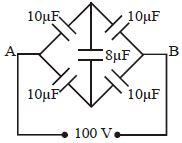
Five capacitors are connected to a $DC$ potential of $100\,V$ as shown in the adjoining figure. Find charge in $10\,μF$ capacitor.......$\mu C$
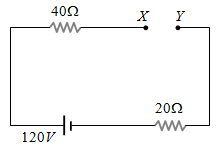
In the circuit shown, potential difference between X and Y will be
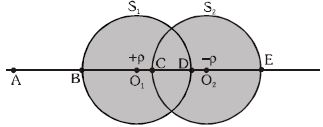
Two uniform spherical charge regions $S_1$ and $S_2$ having positive and negative charges overlap each other as shown in the figure. Point $O_1$ and $O_2$ are their centres and points $A, B, C$ and $D$ are on the line joining centres $O_1$ and $O_2$. Electric field from $C$ to $D$
Which of the following waves are not electromagnetic?