Question
why does common salt get wet during the rainy season?

Answer

Table salt turns moist and ultimately forms a solution on exposure to air especially during the rainy season. Although pure sodium chloride is not deliquescent, the commercial version of the salt contains impurities (such as magnesium chloride) which are deliquescent substances.

Need a full question paper?

Generate a complete, print-ready paper with questions like this in minutes — across 16+ boards, with answer keys.
Start Generating Free

Similar questions

Correct the following statement:
Hydrochloric acid is prepared in the laboratory by passing hydrogen chloride directly through water.
How much calcium oxide is obtained by heating $82 g$ of calcium nitrate? Also, find the volume of $NO _2$ evolved:
$
2 Ca \left( NO _3\right)_2 \longrightarrow 2 CaO +4 NO _2+ O _2
$
What do you observe when Ammonia is passed over heated lead oxide.
A student puts his signature with graphite pencil. If the mass of carbon in the signature is $10^{-12} g$. Calculate the number of carbon atoms in the signature.
Write balanced chemical equations for the following reactions.
(i) Formation of an acid salt from sulphuric acid by a sodium salt.
(ii) Formation of black spot on a piece of wood due to conc. sulphuric acid.
(iii) Formation of sulphur dioxide gas using a metal below hydrogen in activity series.
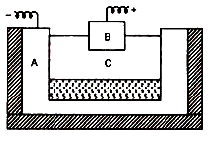
The following is a sketch of an electrolytic cell used in the extraction of aluminium :

(a) What is the substance of which the electrode A and B are made?
(b) At which electrode (A or B) is aluminium formed?
(c) What are the two aluminium compounds in the electrolyte C?
(d) Why is it necessary for electrode B to be continuously replaced?
What is meant by the term "electrovalency"? State why sodium (at. no. 11] has electrovalency +1 and chlorine (at. no. 17) has electrovalency of -1.
What is passive iron? How is passivity removed?
What is the Vital force theory? Why was it discarded?
With the help of equations, give an outline for the manufacture of sulphuric acid by the contact process.