Question
Why does the boundary between liquid phase and gaseous phase disappear on heating a liquid upto critical temperature in a closed vessel? In this situation what will be the state of the substance?

Answer

When a liquid is heated up to its critical temperature in a closed vessel, it does not pass through a two phase region and substances remain in one phase. There is a continuity between a gaseous and liquid state. The term fluid is used for either a liquid or a gas to recognize this continuity. Liquid and gas can be distinguished only when the fluid is below its critical temperature and the surfaces separating them can be seen.
At critical temperature, liquid passes into gaseous state continuously and the surface separating the two phases disappears. A gas below the critical temperature can be liquefied by applying pressure.

Need a full question paper?

Generate a complete, print-ready paper with questions like this in minutes — across 16+ boards, with answer keys.
Start Generating Free

Similar questions

If 2L of $N_2$ is mixed with 2L of H at a constant temperature and pressure, then what will be the volume of $NH_3$​​​​​​​ formed?
  1. How is diborane prepared in the laboratory? Draw its structure.
  2. Explain why $\mathrm{CO}_2$ is a gas whereas $\mathrm{SiO}_2$ is a solid.
Phosphoric acid is preferred over sulphuric acid in preparing hydrogen peroxide from peroxides. Why?
If a trivalent atom replaces a few silicon atoms in three dimensional network of silicon dioxide, what would be the type of charge on overall structure?
Which of the following are isoelectronic species i.e., those having the same number of electrons?
$\text{Na}^+,\text{K}^+,\text{Mg}^{2+},\text{Ca}^{2+},\text{S}^{2-},\text{Ar}.$
The electronic configuration of some elements are given below:
a. $1 s^2, 2 s^2, 2 p^6, 3 s^2$
b. $1 s^2, 2 s^2, 2 p^6$
c. $1 s^2, 2 s^2, 2 p ^2$
d. $1 s^2, 2 s^2, 2 p ^6, 3 s^1$
e. $1 s^2, 2 s^2, 2 p^5$
Answer the following questions:
i. Name the elements.
ii. Which of these have the lowest Ionization enthalpy?
iii. Which is a halogen?
iv. Which is an alkali metal?
v. Which is an inert gas?
Which of the two: $\mathrm{O}_2 \mathrm{NCH}_2 \mathrm{CH}_2 \mathrm{O}$ - or $\mathrm{CH}_3 \mathrm{CH}_2 \mathrm{O}$ - is expected to be more stable and why?
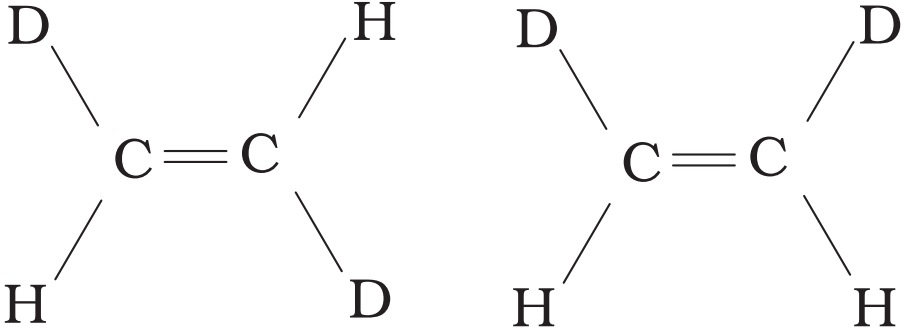
What is the relationship between the members of following pairs of structures? Are they structural or geometrical isomers or resonance contributors?
Hydrogen reacts with nitrogen to produce ammonia according to the equation:
$3H_2(g) + N_2(g) → 2NH_3(g)$
Determine How much ammonia would be produced if 100g of $N_2$ reacts?
Explain the term 'standard molar free energy of formation' of a compound. Calculate the equilibrium constant for the reaction: $2 SO _2(g)+ O _2(g) \rightleftharpoons 2 SO _3(g)$ at $25^{\circ} C$.
Given: $\Delta_{ f } G ^{\circ} SO _3(g)=-371.1 kJ mol { }^{-1}, \Delta_{ f } G ^{\circ} SO _2(g)=-300.2 kJ mol { }^{-1}, R =8.31 JK ^{-1} mol^{-1}$.