Question
  1. How is diborane prepared in the laboratory? Draw its structure.
  2. Explain why $\mathrm{CO}_2$ is a gas whereas $\mathrm{SiO}_2$ is a solid.
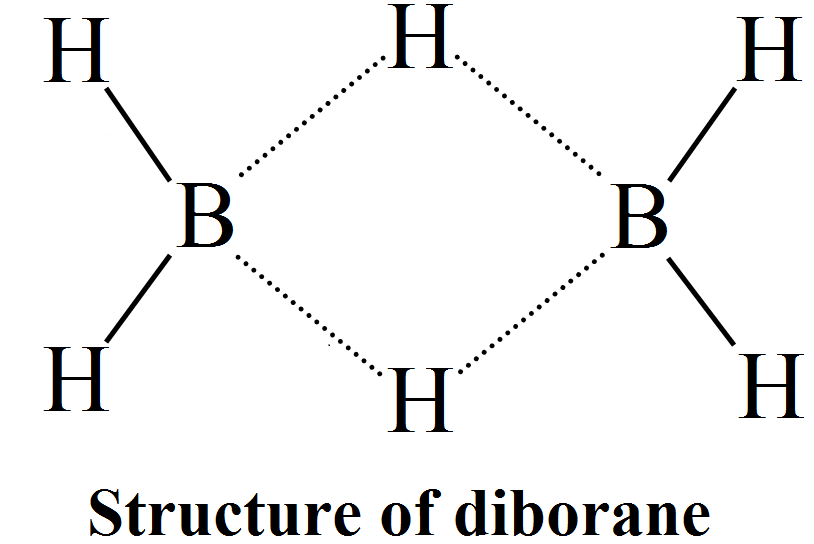
Answer

  1. $2\text{naBH}_4+\text{I}_2\xrightarrow{\ \ \ \ \ \ \ }\text{B}_2\text{H}_6+2\text{NaI}+\text{H}_2$
  1. $\mathrm{CO}_2$ exists as descrete molecules which are held together by weak van der Waals' forces of attraction whereas $\mathrm{SiO}_2$​​​​​​​ is three dimensional covalent solid.

Need a full question paper?

Generate a complete, print-ready paper with questions like this in minutes — across 16+ boards, with answer keys.

Start Generating Free

Similar questions

How does $\mathrm{H}_2 \mathrm{O}_2$ behave as a bleaching agent?
Account for the following:
i. Which is smaller $\mathrm{Fe}^{2+}$ or $\mathrm{Fe}^{3+}$, why?
ii. Chlorine (Cl) have more negative electron gain enthalpy than Fluorine (F).
[Atomic no.: $\mathrm{F}=9, \mathrm{Cl}=17]$
iii. Anions are bigger in size than their parent atom.
If ice and water are in equilibrium at $0^{\circ} C$ then $\Delta H =6.0 kJ mol ^{-1}$. Find value of $\Delta S$ and $\Delta G$.
One mole of ethanol is vaporized at boiling point $78^{\circ} C$. If its latent heat of vaporisation is 866 joule per mole, then calculate the entropy change accuring in it.
  1. What is the common between $d_{xy}$ and $d_{x^2 - y^2}$​​​​​​​ orbitals?
  2. What is the difference between them?
  3. What is the angle between the lobes of the above two orbitals?
Write down the outermost electronic configuration of alkali metals. How will you justify their placement in group 1 of the periodic table?
Which of the two: $\mathrm{O}_2 \mathrm{NCH}_2 \mathrm{CH}_2 \mathrm{O}$ - or $\mathrm{CH}_3 \mathrm{CH}_2 \mathrm{O}$ - is expected to be more stable and why?
What could be the harmful effects of improper management of industrial and domestic solid waste in a city?
What is meant by entropy? Predict the sign of entropy change in each of the following:
  1. $\left.\mathrm{H}_2 \text { (at } 298 \mathrm{~K}, 1 \mathrm{~atm}\right) \rightarrow \mathrm{H}_2 \text { (at } 298 \mathrm{~K}, 10 \text { atm) }$
  2. $\mathrm{H}_2 \mathrm{O}(\text { at } 298 \mathrm{~K}, 1 \mathrm{~atm}) \rightarrow \mathrm{H}_2 \mathrm{O} \text { (at } 330 \mathrm{~K}, 1 \text { atm) }$
  3. $2 \mathrm{NH}_4 \mathrm{NO}_3(\mathrm{~s}) \rightarrow 2 \mathrm{~N}_2(\mathrm{~g})+4 \mathrm{H}_2 \mathrm{O}(\mathrm{g})+\mathrm{O}_2(8)$
  4. Crystallization of copper sulphate from its saturated solution.
  5. $2\text{SO}_2(\text{g})+\text{O}_2(\text{g})\rightleftharpoons2\text{SO}_3(\text{g}).$
Oxidation of sulphur dioxide into sulphur trioxide in the absence of a catalyst is a slow process but this oxidation occurs easily in the atmosphere. Explain how does this happen. Give chemical reactions for the conversion of $\mathrm{SO}_2$ into $\mathrm{SO}_3$.