Question
Phosphoric acid is preferred over sulphuric acid in preparing hydrogen peroxide from peroxides. Why?

Answer

In the preparation of $\mathrm{H}_2 \mathrm{O}_2$ from barium peroxide and sulphuric acid, the use of sulphuric acid has a disadvantage as it catalyses the decomposition of $\mathrm{H}_2 \mathrm{O}_2$ formed. In place of $\mathrm{H}_2 \mathrm{O}_2$, weak acids like ortho phosphoric acid, carbonic acid are preferred. All heavy metal impurities present in $\mathrm{BaO}_2$ are removed as insoluble phosphates and decomposition of $\mathrm{H}_2 \mathrm{O}_2$ is prevented.

Need a full question paper?

Generate a complete, print-ready paper with questions like this in minutes — across 16+ boards, with answer keys.
Start Generating Free

Similar questions

i. What will be the minimum pressure required to compress $500 dm ^3$ of air at 1 bar to $200 dm ^3$ at $30^{\circ} C$.
ii. Critical temperature for $CO _2$ and $CH _4$ are $31.1^{\circ} C$ and $-81.9^{\circ} C$ respectively. Which of these has stronger intermolecular forces and why?
Complete the following reactions:
  1. $\text{Zn}+\text{NaOH}\xrightarrow{\ \ \ \ \ \ \ }$
  2. $\text{MnO}_4^-+\text{H}_2\text{O}_2\xrightarrow{\ \ \ \ \ \ \ \ \ }$
  3. $\text{Ca(HCO}_3)_2+\text{Ca(OH)}_2\xrightarrow{\ \ \ \ \ \ \ \ \ \ }$
Explain the shape of $BrF_5$.
1. Give the mathematical expression of enthalpy.
2. Neither q nor W is a state function but $q + W$ is a state function. Explain why?
3. The standard heat of formation of $Fe _2 O _3$ (s) is $824.2 kJ mol ^{-1}$ Calculate heat change for the reaction.
$
4 Fe(s)+3 O_2(g) \rightarrow 2 Fe_2 O_3(s)
$
Show that the circumference of the Bohr orbit for the hydrogen atom is an integral multiple of the de Broglie wavelength associated with the electron revolving around the orbit.
An alkyl halide ' A ' of formula $\mathrm{C}_6 \mathrm{H}_{13} \mathrm{Cl}$ on treatment with alcoholic KOH gives two isomeric alkenes ' B ' and ' C ' with molecular formula $\mathrm{C}_6 \mathrm{H}_{12}$. Both alkenes on hydrogenation give 2, 3-dimethyl butane. Predict the structure of 'A', 'B' and ' C '.
Give reasons:
  1. Beryllium halides are polymeric.
  2. $Be(OH)_2$ dissolves in NaOH but $Mg(OH)_2$ does not.
  3. MgO is used as refractory material.
The density of 3 molal solution of NaOH is $1.110 \mathrm{~g} \mathrm{~mL}^{-1}$. Calculate the molarity of the solution.
i. Differentiate between:
a. $BeSO _4$ and $BaSO _4$
b. $Be ( OH )_2$ and $Ba ( OH )_2$
ii. Explain diagonal relationship in the periodic table with the help of example.
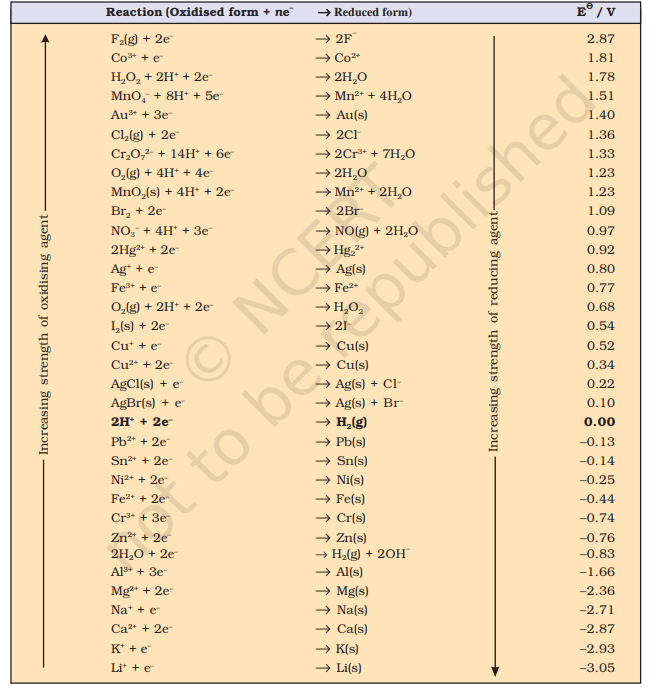
Using the standard electrode potentials given in the Table, predict if the reaction between the following is feasible:

$\mathrm{Fe}^{3+}(\mathrm{aq})$ and $\mathrm{Cu}(\mathrm{s})$.