Question
Why does the difference between Average Total Cost and Average Variable Cost decrease with an increase in the level of output? Can these two be equal at some level of output? Explain.

OR

Why does difference between ATC and AVC decrease with increase in level of output? Explain.
Answer

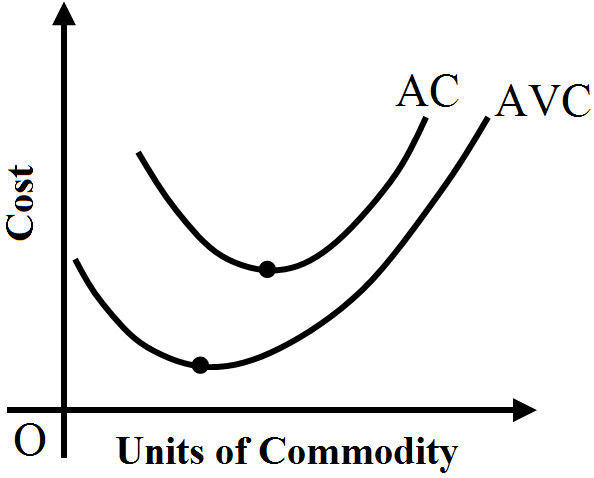
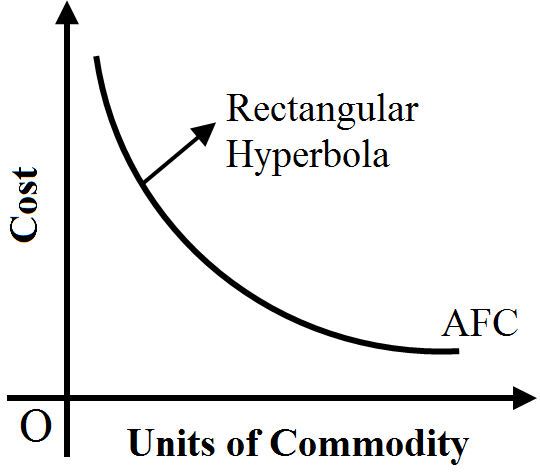
As, we know the difference between Average Total Cost and Average Variable Cost is average fixed cost (AFC = ATC - AVC) and AFC always decreases with the increase in output. It can be explained with the help of the following diagram and schedule.

It can be seen from the above diagram that there is a huge gap between AC and AVC with the starting of production. The gap between them decreases with the increase in production.

It is so because the gap between AC and AVC is AFC and AFC always decreases with the increase in production. The point to be remembered is that AVC can never touch AC curve because AFC cannot be Zero.

Units of Commodity
TFC
AFC
0
60
-
1
60
60
2
60
30
3
60
20
4
60
15
5
60
12

Need a full question paper?

Generate a complete, print-ready paper with questions like this in minutes — across 16+ boards, with answer keys.

Start Generating Free

Similar questions

Considering the same demand curve as in exercise 22, now let us allow for free entry and exit of the firms producing commodity X. Also assume the market consists of identical firms producing commodity X. Let the supply curve of a single firm be explained as.

$\text{q}^\text{s}_f=8+3\text{p for p}\geq20$

$=0\text{ for }0\leq\text{p}<20$

  1. What is the significance of p = 20?
  2. At what price will the market for X be in equilibrium? State the reason for your answer.
  3. Calculate the equilibrium quantity and number of firms.
Explain the law of variable proportions through the behaviour of total and marginal product. Give reasons.

OR

Explain the law of variable proportions (or law of returns to a factor) with the help of total and marginal product curves. Use diagram.

OR

Explain the likely behaviour of TP and MP when for increasing production only one input is increased while all other inputs are kept constant.

OR

State the different phases of changes in Total Product and Marginal Product in the Law of Variable Proportions. Also show the same in a single diagram.

How will you treat the following in estimating National Income of India? Give reasons for your answer.
  1. Value of bonus shares received by shareholders of a company.
  2. Fees received from students.
  3. Interest received on loan given to a foreign company in India.
Suppose C = 100 + 0.75Y D, I = 500, G = 750, taxes are 20 percent of income, X = 150, M = 100 + 0.2Y . Calculate equilibrium income, the budget deficit or surplus and the trade deficit or surplus.
Calculate National Income and Personal Disposable Income:
    (Rs. Crores)
  1.  
Personal Tax 80
  1.  
Private final consumption expenditure 600
  1.  
Undistributed profits 30
  1.  
Private income 650
  1.  
Government final consumption expenditure 100
  1.  
Corporate Tax 50
  1.  
Net domestic fixed capital formation 70
  1.  
Net indirect tax 60
  1.  
Depreciation 14
  1.  
Change in stocks (-) 10
  1.  
Net imports 20
  1.  
Net factor income to abroad 10
What is the behaviour of:
  1. Average Fixed Cost.
  2. Average Variable Cost as more and more units of a good are produced?
Explain the theory of determination of income and employment with the help of Aggregate Demand and Aggregate Supply curves.

OR

Why must Aggregate Demand be equal to Aggregate Supply at the equilibrium level of income and output? Explain with the help of a diagram.

From the following data calculate national income by (a) income method and (b) expenditure method:
S.No.   Rs.(in crores)
1 Private final consumption expenditure. 2,000
2 Net capital formation. 400
3 Change in stock. 50
4 Compenstation of employees. 1,900
5 Rent. 200
6 Interest. 150
7 Operating surplus. 720
8 Net indirect tax. 400
9 Employers' contribution to social security schemes. 100
10 Net exports. 20
11 Net factors income from abroad. -20
12 Government final consumption expenditure. 600
13 Consumption of fixed capital. 100
Distinguish between change in demand and change in quantity demanded.
Explain the inverse relationship between price and quantity demanded of a commodity.

OR

Why is the demand curve of the commodity negatively sloped?