Question
Explain the inverse relationship between price and quantity demanded of a commodity.

OR

Why is the demand curve of the commodity negatively sloped?

Answer

Downward slope of demand curve indicates that more is purchased in response to fall in price and vice-versa. Thus, there is inverse relationship between own price of a commodity and its quantity demanded.

This is attributed to the following factors:
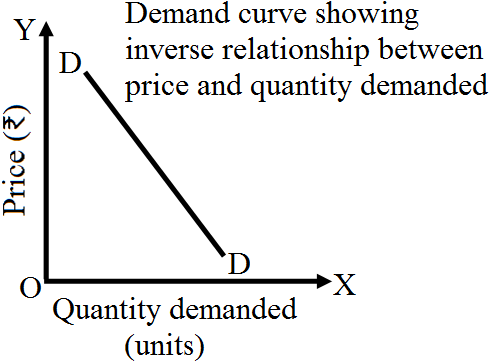
  1. Law of Diminishing Marginal Utility: According to this law, as the consumption of a commodity increases, the utility from each successive unit goes on diminishing. Accordingly, for every additional unit to be purchased, the consumer is willing to pay less price.

  2. Income Effect: Change in the own price of a commodity causes a change in real income of the consumer. With a fall in price, real income increases. Accordingly, demand for the commodity expands and vice-versa.

  3. Substitution Effect: It refers to the substitution of one commodity for the other when it becomes relatively cheaper due to change in relative prices.

  4. Size of Consumer Group: When price of a commodity falls, it attracts new buyers who can now afford to buy it, hence quantity demanded rises.

  5. Different Uses: Many goods have alternative uses, e.g. milk is used for making curd, cheese and butter. If price of milk reduces, it will be put to different uses. Accordingly, demand for milk expands.

Need a full question paper?

Generate a complete, print-ready paper with questions like this in minutes — across 16+ boards, with answer keys.

Start Generating Free

Similar questions

Identify the three phases of the Law of Variable Proportions from the following and also give reason behind each phase:

Units of Variable Input

(Units)

Total Physical Product


1 10
2 22
3 30
4 35
5 30
Find Gross National Product at Market Price and Private Income:
    (Rs. Crores)
  1.  
Private final consumption expenditure 800
  1.  
Net current transfers to abroad 20
  1.  
Net factor income to abroad (-) 10
  1.  
Government final consumption expenditure 300
  1.  
Net indirect tax 150
  1.  
Net domestic capital formation 200
  1.  
Current transfers from government 40
  1.  
Depreciation 100
  1.  
Net imports 30
  1.  
Income accruing to government 90
  1.  
National debt interest 50
Explain the difference between decrease in demand and decrease in quantity demanded. Give two causes of decrease in demand.
Demand for electrical appliances like induction chulazas, heaters etc have increased due to increase in the price of LPG. However, in short run supply of these appliances remains constant. What will be the effect on the equilibrium price of these electrical appliances in the given scenario? In this case, which values are being highlighted by the demanders of electrical appliances?
A consumer consumes only two goods X and Y both priced at Rs. 3 per unit. If the consumer chooses a combination of these two goods with Marginal Rate of Substitution equal to 3, is the consumer in equilibrium? Give reasons. What will a rational consumer do in this situation? Explain.
Calculate “gross national product at factor cost” from the following data by (i) income method (ii) expenditure method:
    (Rs. in crores)
1 Private final consumption expenditure 1,000
2 Net domestic capital formation 200
3 Profits 400
4 Compensation of employees 800
5 Rent 250
6 Government final consumption expenditure 500
7 Consumption of fixed capital 60
8 Interest 150
9 Net current transfers from rest of the world - 80
10 Net factor income from abroad - 10
11 Net exports - 20
12 Net indirect taxes 80
Distinguish between change in quantity supplied and change in supply. Use diagram.
  1. Explain briefly the situation of excess demand in a perfectly competitive market. Use diagram.
  2. Explain briefly the situation of excess supply in a perfectly competitive market. Use diagram.
Define fixed exchange rate. How is the exchange rate determined in a flexible exchange rate system?