Question
Why does water show high boiling point as compared to hydrogen sulphide? Give reasons for your answer.

Answer

In water $\mathrm{H}_2 \mathrm{O}$ there is electrostatic attraction between partially positive hydrogen of one atom with partial negative oxygen (highly electronegative) of another atom which produces dipole-dipole interactions resulting hydrogen bonding. As these hydrogen bonds are strong in water, it requires high energy to break the bonds with high boiling point of 373 K .
While in hydrogen sulphide $\mathrm{H}_2 \mathrm{S}$, even though there are intermolecular forces of attraction between atoms, hydrogen bonding is not present. Hence the $\mathrm{H}_2 \mathrm{S}$ requires less energy to break the bonds with low boiling point of 213 K .

Need a full question paper?

Generate a complete, print-ready paper with questions like this in minutes — across 16+ boards, with answer keys.
Start Generating Free

Similar questions

The $Mn^{3+}$ ion is unstable in solution and undergoes disproportionation to give $Mn^{2+}, MnO_2,$ and $H^+$ ion. Write a balanced ionic equation for the reaction.
How would you explain the fact that the first ionization enthalpy of sodium is lower than that of magnesium but its second ionization enthalpy is higher than that of magnesium?
Write a note on entropy and spontaneity.
Calculate the pH of the following solutions:
0.3g of Ca(OH)2 dissolved in water to give 500mL of solution.
How do you account for the formation of ethane during chlorination of methane?
  1. Identify the oxidising agent and reducing agent in the following reactions:
  1. $\text{MnO}_2+4\text{HCl}\xrightarrow{ \ \ \ \ \ \ \ }\text{MnCl}_2+\text{Cl}_2+2\text{H}_2\text{O}$
  2. $2\text{MnO}_4^-10\text{Cl}^-+16\text{H}^+\\ \xrightarrow{ \ \ \ \ }2\text{Mn}^{2+}+5\text{Cl}_2+8\text{H}_2\text{O}$
  1. Calculate the oxidation number of underlined elements in the following speries.
$\text{Pb}_3\text{O}_4,$ $\text{H}_2\text{Cl}$, $\text{PO}_4^{3-}$
1. During estimation of nitrogen present in an organic compound by Kjeldahl's method, the ammonia evolved from 0.5 g of the compound in Kjeldahl's estimation of nitrogen, neutralized 10 mL of $1 M H _2 SO _4$. Find out the percentage of nitrogen in the compound.
2. Explain why $\left( CH _3\right)_3 \stackrel{+}{ C }$ is more stable than $CH _3 \stackrel{+}{ C } H _2$ and $\stackrel{+}{ C } H _3$ is the least stable cation.
An alkene 'A' on ozonolysis gives a mixture of ethanal and pentan-3-one. Write structure and IUPAC name of 'A'.
1. Give condensed and bond line structural formulas and identify the functional groups present, if any, for:
a. 2, 2, 4-Trimethylpentane
b. 2-Hydroxy-1, 2, 3-propanetricarboxylic acid
c. Hexanedial?
2. Give three points of differences between inductive effect and resonance effect.
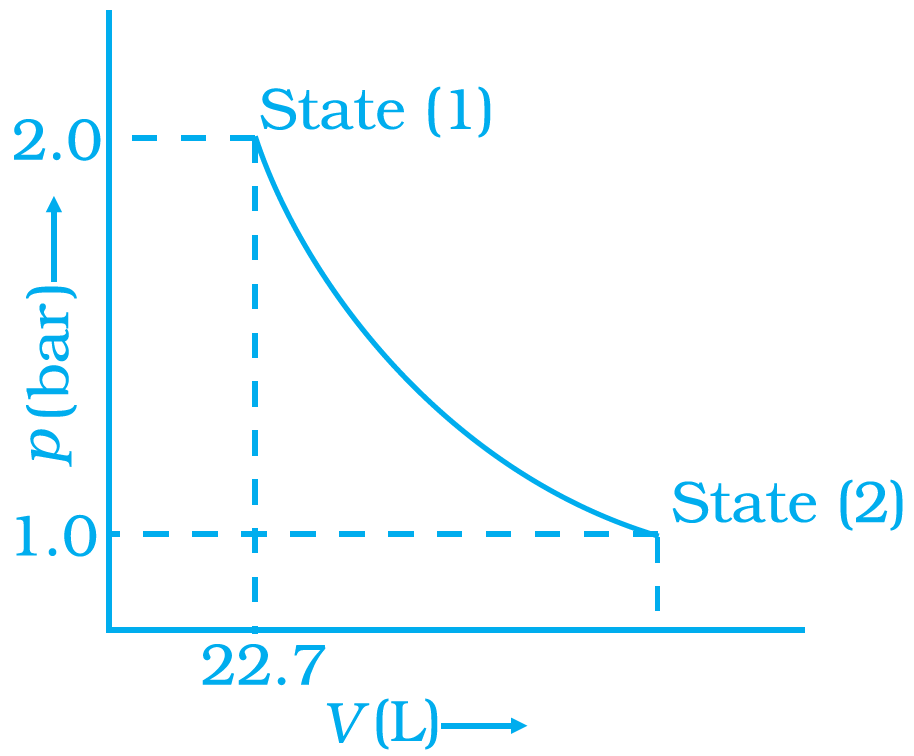
1.0 mol of a monoatomic ideal gas is expanded from state (1) to state (2) as shown in Fig. Calculate the work done for the expansion of gas from state (1) to state (2) at 298K.